
2026 ERCOT Market Update: Rates expected to spike this summer

Grocery Stores & Supermarkets

Insights, tips, and strategies to help Texas grocery stores and supermarkets save on commercial electricity. Discover how to reduce costs by 15–30% with our free reverse auction.
Licensed Texas Broker
 5/5 from TX Businesses
Zero Hidden Fees
Step 1 of 2

Start Your Free Quote Now

Almost Done

Quote Request Received!

I'll personally review your information and reach out within 24 hours with competing quotes from 25+ Texas providers.

📧 A confirmation has been sent to

Submitting Your Quote...

Please wait while we process your request.

Licensed & Insured Texas Broker
25+ Top Providers
ERCOT & PUC Approved
5/5 (Google reviews)
Latest Posts

Blogs for Grocery Stores & Supermarkets

Expert advice on energy savings, ERCOT updates, and strategies tailored for grocery store and supermarket operators.
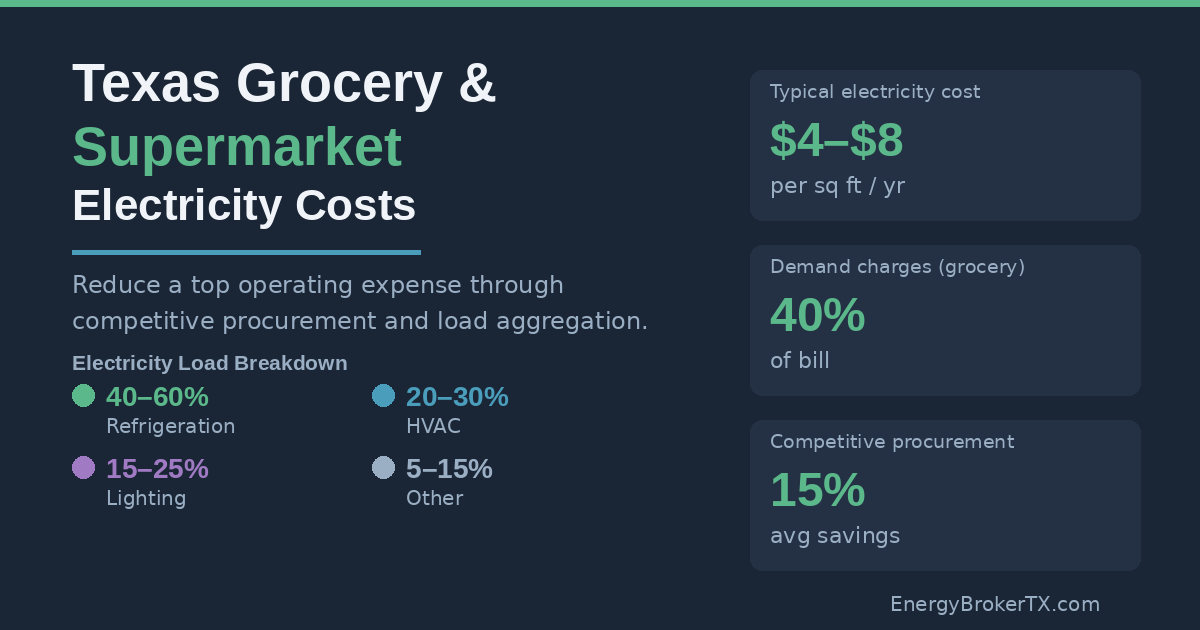
Texas grocery store electricity load breakdown: refrigeration 40–60%, HVAC 20–30%, lighting 15–25%, with 15% avg procurement savings
June 13, 2026
Texas Grocery Store and Supermarket Electricity: How to Reduce a Major Operating Cost

How Texas grocery stores and supermarkets can reduce electricity costs through competitive procurement, demand charge management, and aggregated multi-location buying.

Read More ->

Blogs for Grocery Stores & Supermarkets

Expert advice on energy savings, ERCOT updates, and strategies tailored for grocery store and supermarket operators.
Visit Grocery Store & Supermarket Energy Savings Page →

Frequently Asked Questions

Is there a cost or obligation to compare electricity rates for my grocery store?

No. Running a competitive reverse auction with 25+ licensed Texas providers costs nothing and carries no obligation to switch. We submit your account's usage history and load profile, providers bid against each other, and you review every offer side by side before deciding. Our compensation comes from a built-in commission paid by the winning provider — the same structure that applies whether you use a broker or contact a provider directly — so there's no added cost to shop your rate.

What happens to grocery store electricity costs during Texas summers?

Texas summers push both store-wide HVAC and refrigeration systems to their limits at the same time ERCOT wholesale electricity prices are typically at their least favorable. Grocery stores on variable or index-priced contracts are especially exposed to bill shock during these months, since refrigeration load doesn't decrease even as market prices spike. Locking in a fixed-rate contract ahead of summer, rather than riding out a variable rate, is the most reliable way to avoid unpredictable summer bill increases.

How can a grocery store reduce demand charges from refrigeration equipment?

Demand charges are based on your single highest 15-minute power draw in a billing period, not your total energy use — so the goal is smoothing out peak draw rather than reducing overall refrigeration runtime. Staggering compressor start-up cycles, scheduling defrost cycles for different units at different times, and avoiding simultaneous startup of refrigeration, HVAC, and lighting during the same 15-minute window can meaningfully reduce peak demand. A competitive reverse auction can also surface rate structures specifically built around continuous refrigeration load rather than a flat commercial rate.

Does switching electricity providers disrupt refrigeration or store operations?

No. Switching retail electric providers in Texas's deregulated ERCOT market only changes who bills you for electricity supply — the physical wires, meter, and delivery utility stay exactly the same. Refrigeration systems, freezer cases, POS systems, and store operations continue running without interruption during a switch. Most grocery stores complete the transition and begin service with a new provider within 3–5 business days of signing a new contract, with zero downtime.

Why are grocery store electricity bills so much higher than other retail businesses?

Grocery stores and supermarkets carry a fundamentally different load profile than typical retail — walk-in coolers, open-air refrigerated cases, freezer sections, and backroom refrigeration units run continuously, 24 hours a day, regardless of store hours. That non-stop refrigeration load often represents 30–50% of total electricity use, and the sharp demand spikes it creates can push demand charges to 35–55% of the total bill. A rate structure priced for a typical retail storefront usually doesn't reflect that reality, which is why grocery accounts frequently overpay relative to their actual usage pattern.

Our Data Sources & Methodology

Blogs are informed by real-time ERCOT data and PUC guidelines as of July 2026. We update content regularly for relevance.

ERCOT Market Data
for wholesale rates and forecasts.
U.S. Energy Information Administration (EIA) for national averages and comparisons.
Internal auction data from Texas businesses for savings stats.
Last updated: July 2026

Ready to Stop Overpaying?

Join 100+ Texas businesses that are
saving thousands every year with our free reverse auction.
Get My Free Quote in 60 Seconds ->
Takes 60 seconds
• 100% No Obligation
• Results in 24 hrs