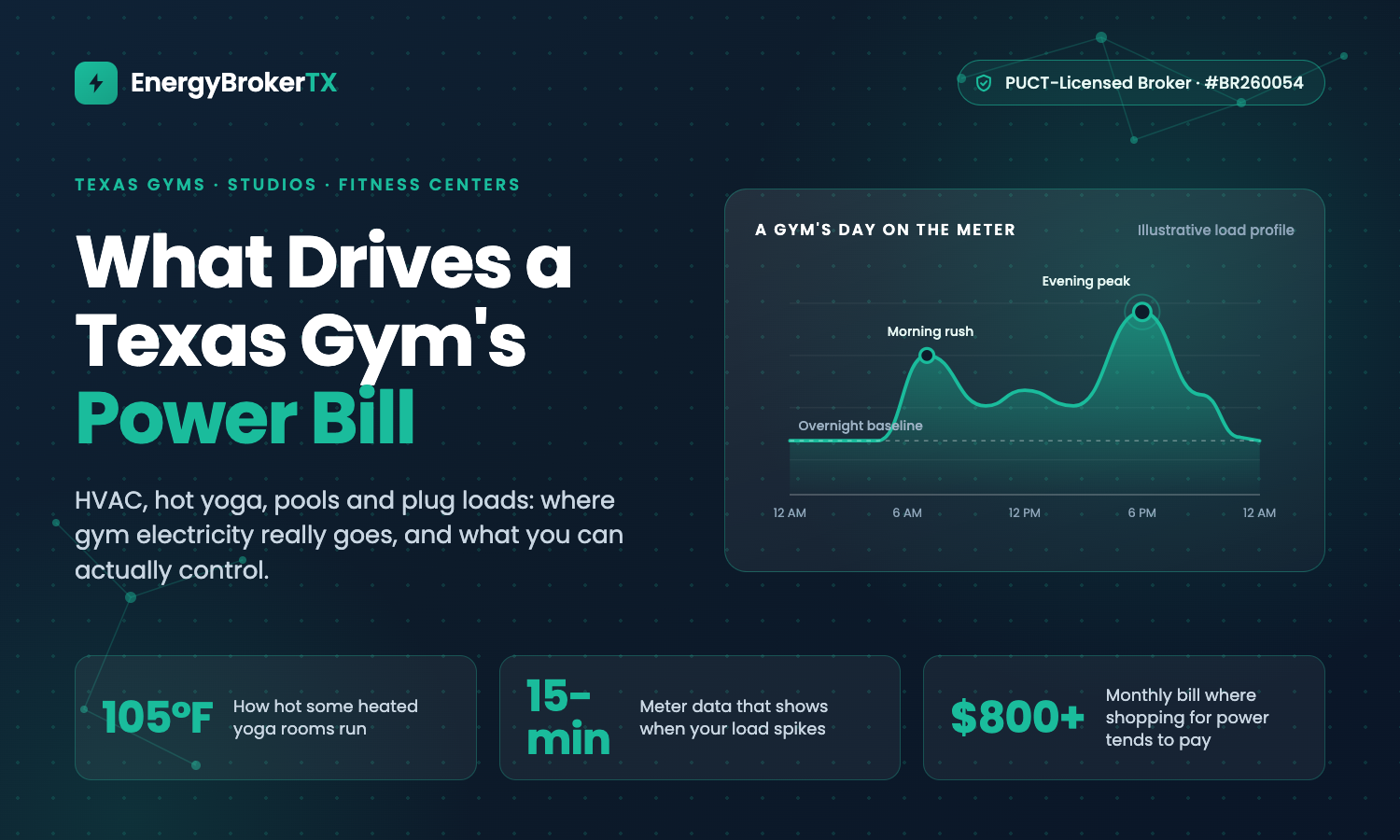
Texas Gyms, Yoga Studios and Fitness Centers: What Drives the Power Bill
What drives the power bill at Texas gyms, yoga studios and fitness centers, from HVAC and hot yoga to pools, and when shopping your rate pays off.

Grocery stores and supermarkets are among the highest electricity consumers in commercial real estate. Refrigeration runs 24 hours a day. HVAC conditions large open-plan spaces through Texas summers. Lighting operates from early morning to late night. A mid-size Texas grocery store using 200,000–400,000 kWh per month is a significant commercial electricity account — exactly the type of account that benefits most from competitive procurement in the ERCOT deregulated market.
Yet grocery operators consistently overpay. The reasons are structural: multi-location chains fragment contracts across locations, independent operators accept renewal quotes without benchmarking, and the operational demands of running a grocery business leave little bandwidth for electricity procurement strategy.
This guide covers what electricity costs look like for Texas grocery and supermarket operations, what drives those costs, and how to reduce them without adding operational complexity.
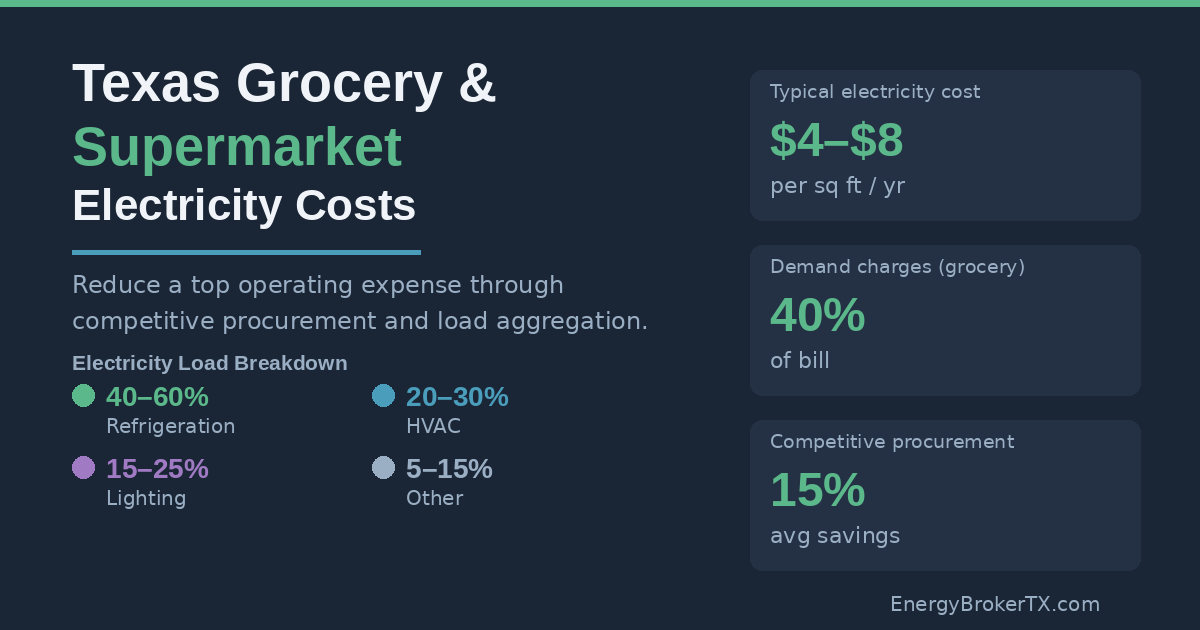
Electricity is typically the second or third largest operating expense for a grocery store, after labor and cost of goods. Industry benchmarks suggest electricity costs of $4–$8 per square foot annually for grocery and supermarket operations in Texas, depending on store format and efficiency.
For a 30,000 square foot independent grocery store in Texas, that translates to roughly $120,000–$240,000 per year in electricity costs. For a regional chain with 15 locations, annual electricity spend in the range of $2–$4 million is common.
These are meaningful numbers — large enough that a 15% reduction through competitive procurement represents $18,000–$36,000 in annual savings for a single store, and $300,000–$600,000 across a 15-location chain.
Refrigeration — open case display coolers, walk-in refrigerators, walk-in freezers, and reach-in cases — typically accounts for 40–60% of a grocery store’s total electricity consumption. This load runs continuously, 24/7, with relatively predictable consumption patterns.
From a procurement standpoint, the refrigeration-dominant load profile is favorable: it produces a high, consistent baseline demand that suppliers can price with confidence. Grocery stores with large refrigerated footprints typically have better load factors than businesses with more variable usage patterns, which translates to more competitive pricing from suppliers.
Texas climate creates substantial HVAC demand, particularly during summer months when ERCOT prices are at their seasonal peak. HVAC typically represents 20–30% of grocery electricity consumption and is the most variable component. Fixed-rate contracts protect grocery operators from summer price exposure; variable-rate contracts transfer that risk onto the business.
Grocery stores require high-quality, consistent lighting across large floor areas. LED retrofits have significantly reduced lighting’s share of total consumption, but lighting typically still represents 15–25% of electricity use.
Bakery and deli equipment, checkout registers and POS systems, back-office computers, and miscellaneous equipment account for the remaining 5–15% of consumption.
For commercial accounts above a certain usage threshold, Texas electricity bills include both an energy charge (per kWh consumed) and a demand charge (per kW of peak demand measured in a 15-minute interval). For grocery stores, demand charges typically represent 25–40% of total monthly electricity cost.
Understanding how demand charges work on Texas commercial electricity bills matters for grocery operators because refrigeration compressor startups and HVAC startup spikes set your monthly peak. When evaluating electricity quotes, always clarify how the contract handles demand charges. An all-in fixed rate that includes demand provides budget certainty; a structure that passes demand through at actual TDSP cost can produce significant bill variation month to month.
For grocery chains operating multiple Texas locations, electricity procurement is one of the highest-leverage financial decisions in the business. The combined load of a 10-location chain — potentially 2–4 million kWh per month in aggregate — places you in a procurement tier where supplier competition for your business is intense and pricing access is substantially better than what individual locations would receive independently.
The practical steps for a multi-location grocery chain:
For a 10-location chain spending $300,000/month on electricity, competitive aggregated procurement achieving 15% savings produces $45,000/month in reduced cost — or $540,000 annually.
Independent grocery operators don’t have the natural volume leverage of a regional chain. But they can still access competitive pricing through a broker who aggregates their account with others in a portfolio.
An energy broker bringing a supplier multiple accounts simultaneously has more leverage than any individual small operator going direct. Working through a licensed Texas energy broker gives an independent grocery store access to pricing tiers closer to what larger operators achieve — typically 10–18% below what they’d receive calling the same supplier directly.
Procurement strategy reduces the per-unit cost of electricity. Efficiency improvements reduce the quantity consumed. For grocery operators, refrigeration efficiency investments often produce the best return:
Whether you operate a single independent grocery store or a regional chain with dozens of Texas locations, the starting point is the same: know your current contract expiration date and have 12 months of electricity bills ready.
A licensed Texas energy broker can review your current contract status, run a competitive procurement process with multiple suppliers, and present you with evaluated quotes. The broker manages the process; you make the final decision.
For more on how the competitive procurement process works, see our complete guide to comparing commercial electricity providers in Texas. For context on the value of working with a licensed broker versus going direct, see our comparison of energy brokers vs. direct supplier procurement.
Submit your account and we'll run a competitive auction with 25+ licensed Texas providers — full bid transparency, no pre-filtering, no obligation.
Get My Free Competing Bids →