Texas Gyms, Yoga Studios and Fitness Centers: What Drives the Power Bill
What drives the power bill at Texas gyms, yoga studios and fitness centers, from HVAC and hot yoga to pools, and when shopping your rate pays off.

"I can just call TXU or Reliant directly — why would I pay a middleman?" This is a reasonable question. It deserves a direct answer, not a marketing deflection. The answer depends entirely on understanding one specific mechanism: what happens to a provider's pricing behavior when they know they are competing against 25 other providers for the same account simultaneously versus when they are the only provider in the conversation. In Texas's deregulated ERCOT market, a business has the legal right to buy electricity from any licensed retail electricity provider without using a broker. Going direct is a legitimate option. But the energy broker vs direct Texas electricity comparison isn't about access — both paths reach the same licensed providers. It's about competitive pressure, and competitive pressure is what determines where within the available rate range your contract lands. This article explains how the Texas electricity market actually works, why simultaneous competitive bidding produces lower rates than sequential direct negotiation, how brokers are compensated and what the legitimate concerns about that model are, and what to ask any broker before engaging them.
Texas deregulated its retail electricity market in 2002, allowing businesses and residents in most of the state to choose their electricity supplier from a competitive marketplace rather than being assigned to a single regulated utility. As of 2026, more than 100 licensed retail electricity providers operate in ERCOT territory, ranging from large national energy companies to regional commercial specialists. The Texas Public Utility Commission licenses and regulates both retail electricity providers and energy brokers, but under separate license categories with separate obligations.
A retail electricity provider is the counterparty to your supply contract — the entity that purchases electricity in the wholesale ERCOT market and sells it to you at a retail rate. A licensed energy broker is a separate category of market participant who represents buyers in the procurement process. EnergyBrokerTX holds PUCT Broker License #BR260054 — a broker license, not a REP license. The distinction matters beyond regulatory paperwork. A REP's commercial interest is to sell electricity at the highest margin their market position allows. A broker's commercial interest is to facilitate competition that drives the price the buyer pays as low as possible, because the broker's business depends on clients coming back at every contract renewal. Clients who save money renew through the same broker. Clients who don't, don't. These are structurally different incentive systems operating in the same market, and understanding that structure is the foundation for evaluating whether a broker is actually working in your interest.
The TDU — Oncor for DFW, CenterPoint for Houston, AEP Texas for West and South Texas — is a separate entity from both REPs and brokers. The TDU owns and operates the physical delivery infrastructure and charges regulated delivery tariffs regardless of which REP supplies your electricity. The broker relationship involves only the REP supply contract, not the TDU delivery charges.
When you call a single retail electricity provider directly and ask for a commercial electricity quote, that provider's pricing desk generates a rate based on their wholesale cost of electricity for your delivery period plus their target operating margin for the account. There is no competitive pressure in that conversation. The provider knows you called one company. They know their rate doesn't need to beat anyone else's rate — it only needs to be acceptable to you. They price accordingly, at whatever margin they can defend in a one-on-one conversation with a buyer who has no real-time alternative to compare against.
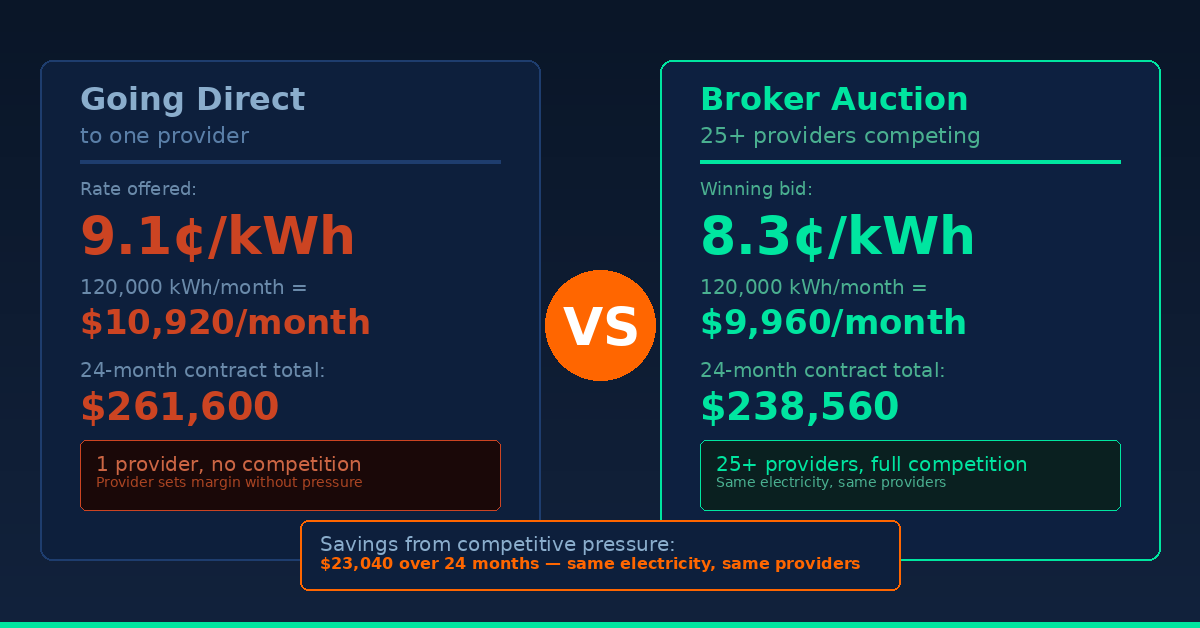
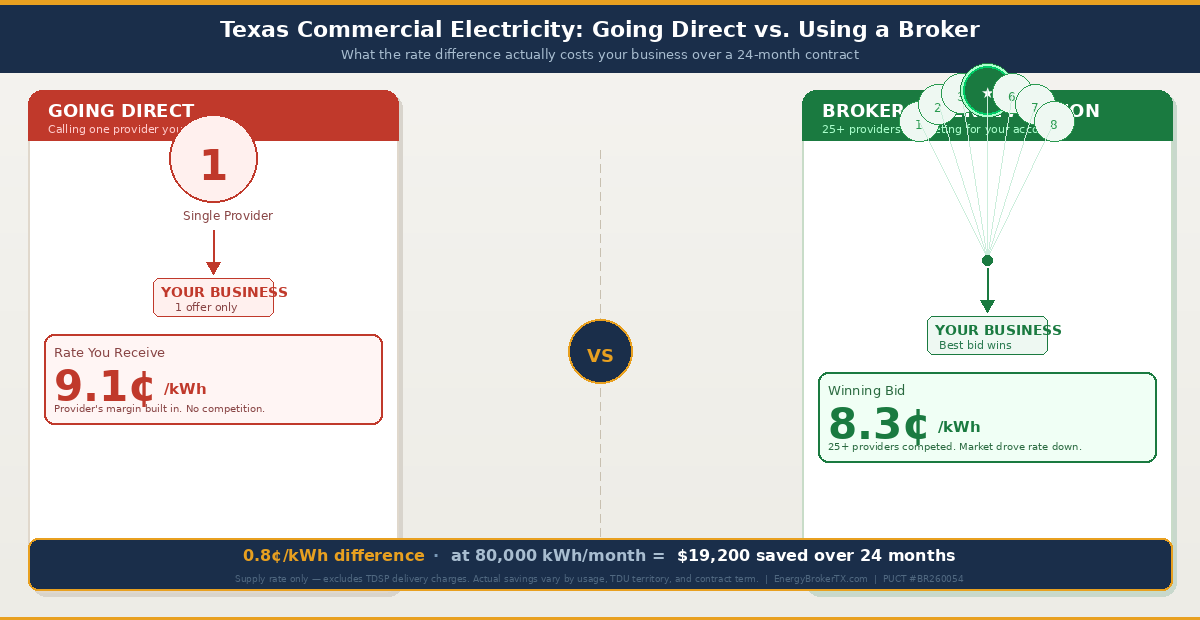
When a licensed broker submits your account to 25 or more providers simultaneously and those providers know they are competing against each other for this specific account, the pricing dynamic changes fundamentally. A provider bidding in that auction knows that bidding at their standard margin means losing the account to a competitor who bids leaner. The incentive is to price aggressively — to win the business at a lower margin than they would accept in a direct sale — because winning at a lower margin is better than not winning at all. The same provider who would quote 9.1 cents per kWh in a one-on-one call will bid 8.3 cents per kWh in a competitive auction because they are pricing against 24 other active bidders, not against a buyer who has no alternative in front of them.
The numbers make the difference concrete. A Houston logistics company consuming 120,000 kilowatt-hours per month going direct to one provider at 9.1 cents per kWh pays $10,920 per month in supply charges. The same account run through a broker auction with a winning bid of 8.3 cents per kWh pays $9,960 per month — $960 less per month. Over a 12-month contract that is $11,520. Over a 24-month contract it is $23,040. That $23,040 difference is attributable entirely to competitive pressure, not to any special pricing access, relationship advantage, or broker magic. The electricity is the same. The providers are the same. The mechanism — 25 providers competing simultaneously rather than one provider negotiating alone — is what produces the rate difference.
Texas energy brokers are compensated through a margin built into the per-kWh rate in the supply contract. The winning retail electricity provider pays the broker a per-kWh fee — typically ranging from 0.02 cents to 0.10 cents per kWh — over the life of the contract. This fee is incorporated into the rate the business pays. It does not appear as a separate line item on the electricity bill, and the business does not write a check to the broker. The business sees one rate per kWh, and the broker's fee is a component of that rate paid by the provider from their margin on the contract.
This raises a legitimate question that deserves a direct answer rather than deflection: if the broker's fee is embedded in the rate, does going direct to a provider produce a lower rate because there's no broker fee component? In practice, the answer is no — and the reason is the math of competitive pressure. A provider bidding in a 25-provider auction accepts a lower net margin to win the business than they would accept in a one-on-one direct negotiation where there is no competing bid. The reduction in provider margin through competitive bidding exceeds the broker's per-kWh fee. The business pays less per kWh in the auction result, including the broker fee, than they would pay in a direct negotiation without competitive pressure.
However — and this is the part that legitimate brokers should say and most don't — this holds true only when the broker runs a genuinely open competitive auction and shows clients every bid received without pre-filtering. A broker who steers accounts toward specific providers because those providers pay a higher commission, or who presents only a subset of bids rather than the full competitive field, is not producing the competitive pressure outcome described above. That broker's fee is not offset by competitive pressure because the competition was manipulated. This is the legitimate concern at the center of broker skepticism, and it is not unfounded. EnergyBrokerTX shows every competing bid received to the client side by side with no pre-filtering. If a provider submitted a bid, the client sees it.
The commercial electricity rates you receive through a transparent broker auction reflect real market competition. The rates you receive from a broker who manages the competitive field to maximize their commission do not. Asking the right questions before engaging a broker is how you tell the difference.
Going direct to a Texas retail electricity provider is not a flawed approach — it is a less competitive one for most commercial accounts. Using the Texas PUC's PowerToChoose.org commercial comparison tool or calling providers individually gives access to the same licensed providers and the same products available through a broker. For small commercial accounts consuming less than 5,000 kilowatt-hours per month, the consumption volume may not be large enough to generate meaningful competitive interest from multiple providers in a formal auction setting, and direct comparison through PowerToChoose may produce results comparable to what a broker auction would deliver.
For commercial accounts above that threshold — any operation with significant HVAC load, commercial kitchen equipment, manufacturing or production equipment, or multiple meters — the difference between one direct quote and a 25-provider competitive auction is material. The question is not whether going direct works in principle, but whether the rate it produces reflects the competitive market or the provider's target margin in a low-competition sale.
There is also a scenario where going direct makes practical sense: an ongoing relationship with a specific provider who has consistently delivered competitive rates at every renewal cycle, paired with data confirming those rates tracked market conditions rather than drifting upward. The relevant test is not loyalty to the relationship — it is whether the rates produced by that relationship are what a competitive market would produce. The only way to know is to compare the current provider's renewal offer against a field of competitive bids. If the current provider wins the competitive auction, you have confirmation the relationship is producing market rates. If they don't win — if a competing provider bids materially lower — you have equally clear information.
A legitimate broker operating under the model described above should be able to answer all of the following questions clearly, specifically, and without hesitation. Vague or evasive answers to any of them are meaningful information.
First: Are you licensed by the Texas Public Utility Commission as an energy broker? Ask for the license number. Verify it at puc.texas.gov in the PUCT broker directory. EnergyBrokerTX's license number is #BR260054 and it is verifiable in the PUCT's public records. A broker who cannot provide a license number or whose license cannot be located in the PUCT directory should not be handling your commercial electricity procurement in Texas.
Second: Do you show clients every bid received in the auction, or do you pre-select which bids are presented? The answer should be every bid, unfiltered, side by side. If the answer involves language about curating the best options or filtering out providers who don't meet quality standards, press for specifics on what that filtering criteria is and who defines it.
Third: Is your per-kWh compensation a fixed rate that you disclose before the auction, or does it vary by provider? A fixed, disclosed broker fee means the broker has no financial incentive to steer toward higher-commission providers. A variable, undisclosed fee structure creates the conflict of interest discussed above.
Fourth: Do you represent any Texas electricity providers on an exclusive or preferred basis? A broker with exclusive arrangements with specific providers is not running a genuinely open auction — they are running a managed selection process that may not produce the competitive pressure outcomes a true open auction would generate.
A commercial operations director going direct to find a new electricity contract starts by calling three providers they know — TXU Business, Reliant for Business, and one other. Each callback takes a day. Each quote comes in a different format with different term options. Comparing them requires building a spreadsheet. Negotiating individually with the lowest bidder means that bidder knows they are the lowest — they have no reason to sharpen their price further. The contract that results reflects the lowest rate among three providers who each knew the competitive field was limited to a one-on-one conversation. The whole process takes a week and produces a rate somewhere in the range of what those three providers were willing to offer in low-competition conditions.
The same operations director working with a licensed broker submits their current electricity bill and account details through a single form. Within 24 hours, 25 or more licensed Texas providers have submitted competitive bids into the same auction. Each provider knows they are competing against 24 others. The bids come back in a standardized format for direct comparison. The broker handles all contract execution and TDU coordination. The operations director spent 10 minutes on the intake form and 30 minutes reviewing the bid results. The rate reflects what 25 providers were willing to accept when competing against each other, not what three providers offered in separate one-on-one conversations. The rate difference between these two outcomes is structural and predictable. It is the mathematical consequence of competitive pressure applied at the moment of pricing.
For a 120,000 kWh per month account, the difference between a competitively bid rate and a direct-negotiated rate is routinely $800 to $1,200 per month over a 24-month contract — $19,200 to $28,800 over the contract term. That number makes the broker vs. direct question less about process preference and more about whether leaving that amount on the table is an acceptable outcome. Understanding your contract renewal timing and using the right procurement process together are the two decisions that determine what Texas commercial electricity actually costs your business. EnergyBrokerTX runs free reverse auctions for Texas commercial accounts under PUCT License #BR260054. Most clients receive competing quotes within 24 hours of submitting their current bill at energybrokertx.com/contact.
Submit your account and we'll run a competitive auction with 25+ licensed Texas providers — full bid transparency, no pre-filtering, no obligation.
Get My Free Competing Bids →