Texas Gyms, Yoga Studios and Fitness Centers: What Drives the Power Bill
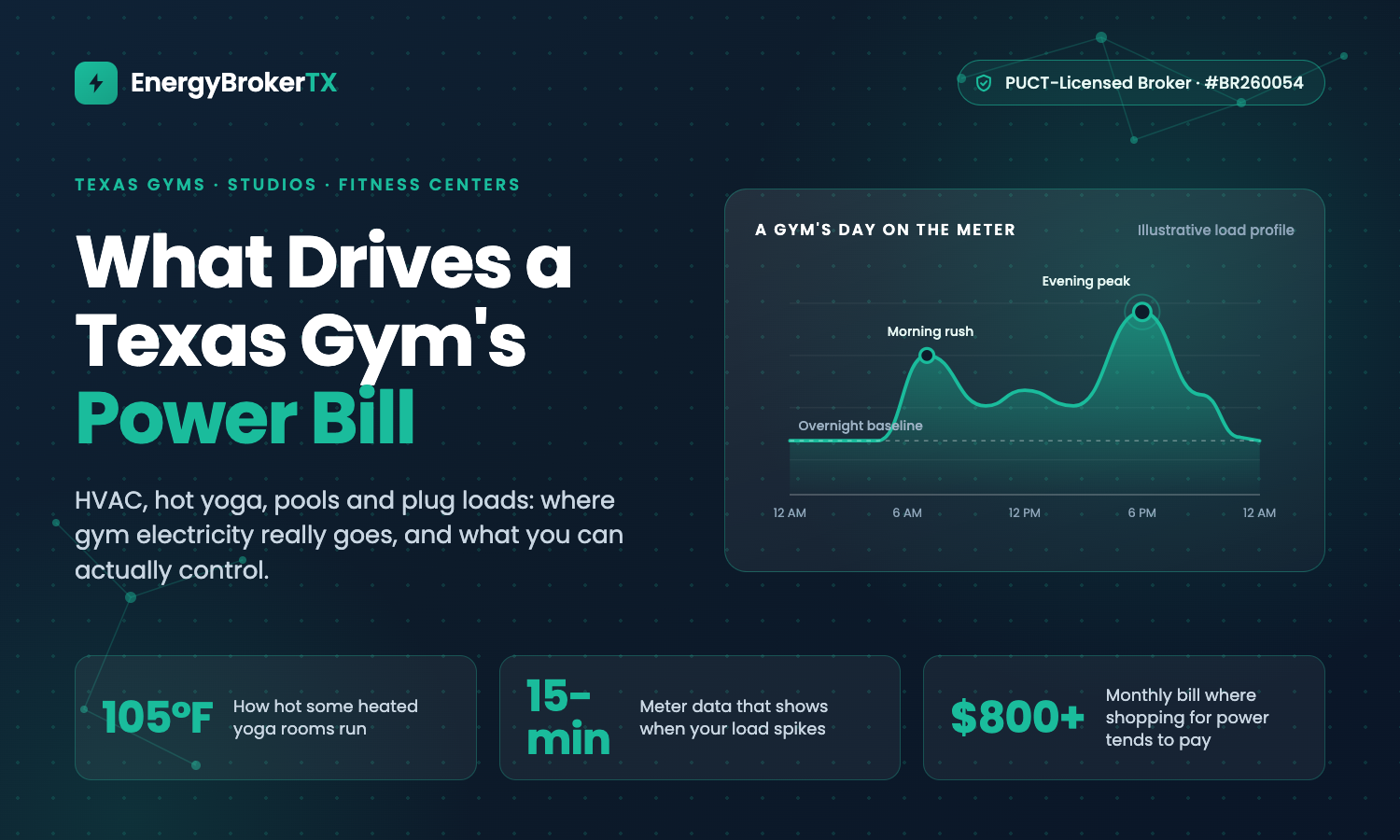
What drives the power bill at Texas gyms, yoga studios and fitness centers, from HVAC and hot yoga to pools, and when shopping your rate pays off.

Fort Worth's commercial electricity market has the same structural advantage as every other deregulated Texas city — and the same structural problem. Over 100 licensed retail electricity providers compete for every commercial account in Oncor's territory. That competition only produces savings when someone actually runs it. Most Fort Worth businesses don't.
Commercial accounts in Oncor's North and South load zones serving Fort Worth that haven't been competitively bid in the past 24 months are almost universally paying 15–25% above what a reverse auction would produce for the same account. The spread between a passive renewal rate and a competitively bid rate for a typical Fort Worth commercial account runs 1.0–2.0¢/kWh. On a 60,000 kWh/month account — a mid-size office building, a restaurant, a church, or a light industrial facility — that gap costs $600–1,200 per month, $14,400–28,800 over a 24-month contract.
This guide covers how electricity procurement works specifically for Fort Worth commercial accounts in Oncor territory, what rates look like across Fort Worth's primary commercial corridors, and what a competitive reverse auction produces for the most common Fort Worth business types.
Every Fort Worth commercial electricity account in the deregulated ERCOT market operates under a two-part structure. Oncor Electric Delivery owns the physical infrastructure — the poles, wires, transformers, and meters throughout Tarrant County and the broader Fort Worth metro. Oncor's delivery charges are regulated by the Texas Public Utility Commission and fixed for every business in the same meter classification regardless of which retail provider supplies the electricity.
Your retail electricity provider (REP) supplies the energy and sets the supply rate — the competitive per-kWh charge on your bill. In Oncor's territory covering Fort Worth, over 100 licensed REPs compete for commercial accounts. The supply rate is what varies between providers and what a competitive auction drives down.
Your total Fort Worth commercial electricity bill = supply rate (competitive, 45–55% of total) + Oncor delivery charge (fixed, 35–50% of total) + taxes and fees. Every dollar of savings from a competitive procurement comes from the supply side. Oncor delivery never changes regardless of which provider you choose.
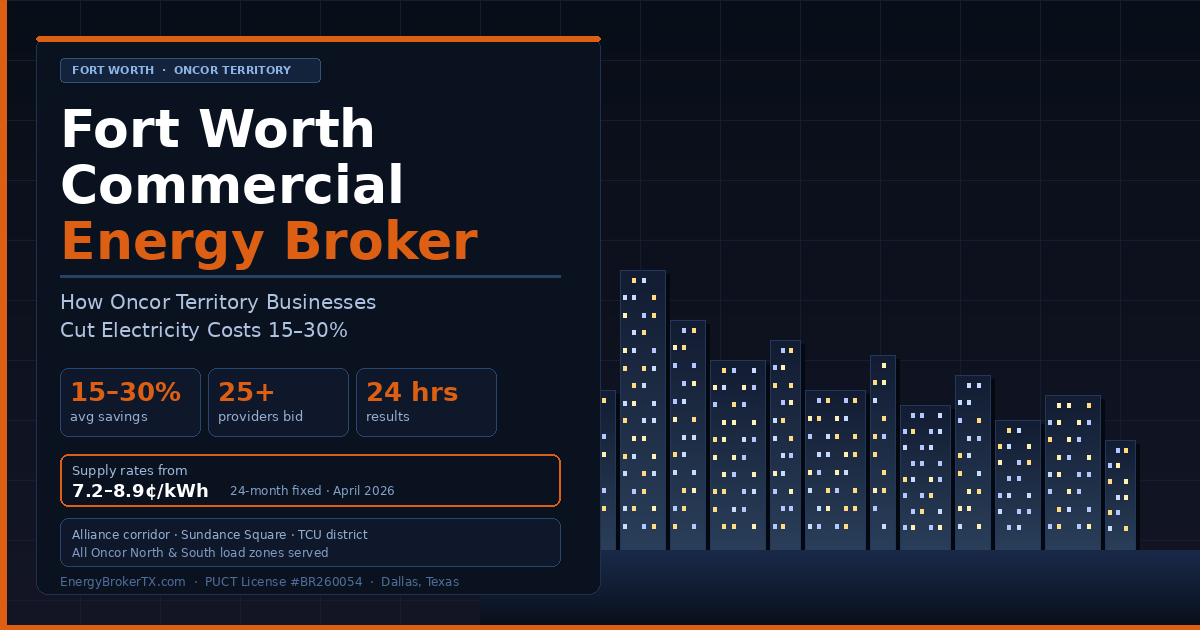
Current supply rates for Fort Worth commercial accounts from competitive auctions as of April 2026: 7.2–8.9¢/kWh for 24-month fixed contracts, depending on usage volume, meter classification, and load profile. Oncor delivery charges add 3.5–4.8¢/kWh depending on rate class. All-in rates for most Fort Worth commercial accounts currently run 11.0–14.0¢/kWh. If your all-in rate exceeds 13.5¢/kWh and your contract is more than 12 months old, a competitive auction would almost certainly improve it.
Fort Worth's commercial economy is more industrially concentrated than Dallas's, with significant manufacturing, logistics, and healthcare anchors alongside growing urban commercial districts. Here's what competitive auctions produce across Fort Worth's primary commercial sectors:
Manufacturing and industrial operations along I-35W, I-20, and SH-360: Fort Worth has one of the strongest manufacturing bases in North Texas — aerospace suppliers, defense contractors, food processing, and industrial logistics concentrated in west and south Fort Worth. Supply rates in competitive auctions: 7.0–8.2¢/kWh for 24-month fixed. Large accounts above 500 kW see rates in the 6.8–7.5¢/kWh range. For Texas manufacturing operations, demand charge structure is as important as supply rate — a 500 kW peak demand account paying $15/kW in demand charges pays $7,500/month in demand charges alone, before any energy charges. See our guide on Texas commercial demand charges for how contract structure affects total cost.
Alliance corridor and North Fort Worth logistics: The Alliance Airport corridor has become one of the most active commercial and logistics development zones in Texas, with warehousing, distribution, and light manufacturing tenants consuming significant electricity. Supply rates in competitive auctions: 7.2–8.6¢/kWh. High-load-factor warehouse operations with steady consumption profiles attract particularly competitive bids — predictable loads are easier for providers to price aggressively.
Medical District and Texas Health Resources facilities: The Near Southside medical district and Texas Health hospital campuses represent some of Fort Worth's largest commercial electricity accounts. Medical facilities run 24/7, have significant HVAC and equipment loads, and face demand charge exposure from simultaneous equipment operation. Supply rates in competitive auctions: 7.6–8.8¢/kWh. For Texas medical facility electricity procurement, demand charge structure matters significantly.
Sundance Square and downtown Fort Worth office and retail: Office buildings, hotels, restaurants, and retail tenants in downtown Fort Worth's central business district. Typically 20,000–150,000 kWh per month depending on size. Supply rates in competitive auctions: 7.4–8.8¢/kWh. Many downtown accounts are on passive renewals from original lease signing and have never been competitively bid.
TCU area, Camp Bowie, and Near Southside restaurants and retail: Fort Worth's urban restaurant and retail corridor — the Camp Bowie West district, Near Southside, West 7th — has expanded significantly over the past decade. Restaurant accounts with high kitchen equipment loads and significant summer HVAC demand. Supply rates in competitive auctions: 7.8–9.0¢/kWh. For Texas restaurant operators, spring procurement before summer ERCOT demand peaks produces materially better forward rates. See our guide on the best time for Texas restaurants to lock in electricity rates.
Churches and religious organizations in Tarrant County: Fort Worth and Tarrant County have a high concentration of churches and religious facilities of all sizes. Weekend-peak load profiles, lower weekday demand. Supply rates in competitive auctions: 7.8–8.8¢/kWh. Fort Worth-area Texas churches also qualify for the state electricity sales tax exemption that permanently eliminates 6–8% of their electricity bill — an opportunity many congregations are missing. See our guide on Texas church electricity sales tax exemption.
Most of Fort Worth sits in ERCOT's North load zone, which covers the majority of the DFW metroplex. Parts of south and southwest Fort Worth fall into ERCOT's South load zone depending on Oncor's specific transmission boundaries. The load zone designation affects forward market pricing for your supply contracts — North and South zone pricing can diverge during high-demand summer periods.
For practical purposes, Fort Worth commercial accounts procuring in spring 2026 are facing the same forward market dynamics as Dallas accounts — ERCOT's own 2026 planning documents project 9%+ demand growth in the North zone driven by data center development in Collin and Tarrant counties. That demand growth is already visible in summer forward pricing for contracts with June through September 2026 exposure.
Fort Worth businesses with contracts expiring between May and September 2026 should be running their procurement auction in April. A forward-start contract executed now — effective at your current contract's expiration — captures spring pricing before summer risk premiums fully embed. For the complete forward market context, see our ERCOT summer 2026 commercial electricity outlook.
The process from bill submission to executed contract for a standard Fort Worth commercial account runs 3–5 business days. Here's exactly what happens:
Day 1: Account analysis. You provide your most recent Oncor bill or account number. The broker pulls your 12-month usage history and 15-minute interval data directly from Oncor, identifies your meter classification (Secondary Service, Large Secondary Service, or Primary Service), notes your current supply rate and contract expiration date, and flags any demand charge patterns worth addressing in the contract structure.
Day 1–2: Auction runs. Your load profile goes to 25+ licensed Texas REPs simultaneously. Each provider bids a fixed supply rate for your account without seeing what competitors are bidding. The auction is blind — genuine competition rather than matching.
Day 2–3: You receive the full bid comparison. Every bid is presented side by side: supply rate, contract term, demand structure, early termination fee, auto-renewal terms. The rate spread between the lowest and highest qualified bid in a Fort Worth commercial auction typically runs 1.2–2.0¢/kWh — which on a 60,000 kWh/month account is $720–1,200/month in the difference between the best and worst available offer.
Day 3–5: Contract execution. You select the winning bid, sign electronically (DocuSign), and the broker submits enrollment to Oncor. The switch takes effect at your next meter read boundary — no service disruption, no operational impact of any kind.
The broker earns a commission from the winning provider — a small per-kWh fee built into the supply rate at the same level whether you use a broker or contact the provider directly. You pay the same total amount either way, but with a broker running a competitive auction the winning rate is consistently below what direct procurement produces.
Fort Worth businesses operating multiple locations — restaurant groups, retail chains, manufacturing operations with multiple facilities, church campuses — have a procurement advantage through portfolio aggregation that single-location accounts don't access.
Aggregating all locations into a single competitive auction produces lower per-kWh supply rates than individual location auctions because providers are competing for more total revenue. A five-location restaurant group combining 100,000 kWh/month in total volume receives more aggressive bids than any single 20,000 kWh/month location would independently.
Portfolio aggregation also unifies contract expiration dates, eliminating the risk of individual locations lapsing onto holdover rates at different times while others are under competitive fixed-rate contracts. For Fort Worth multi-location operators with accounts spanning both Oncor North and Oncor South territories, many Texas REPs are licensed across both zone designations and can supply all accounts under a single supply contract.
PUCT substantive rule §25.475 requires retail electricity providers to send written expiration notices 30–45 days before a fixed-rate commercial contract ends. If no new contract is executed, the account reverts to the provider's holdover rate — a month-to-month variable rate that runs 20–40% above competitive fixed contract pricing for the same account.
A Fort Worth manufacturing operation consuming 150,000 kWh/month that lapses onto a 2.0¢/kWh holdover premium pays $3,000/month extra — $36,000 per year — from a missed 90-day procurement window. For details on exactly how holdover rates are triggered and what the specific contract language looks like, see our guide on Texas commercial electricity contract auto-renewal.
The 90-day window before your contract expiration is your procurement window. Start the reverse auction 90 days out, execute 60 days out, and the new contract begins seamlessly at your existing contract's end date with zero holdover exposure.
No. Oncor maintains the physical grid and delivers electricity to every Fort Worth commercial building regardless of which REP supplies the account. Switching changes only who bills you for the supply charge. Oncor's poles, wires, meters, and emergency response are entirely unaffected. If there's an outage, you call Oncor — that doesn't change when you switch providers.
From bill or account number submission to executed contract: 3–5 business days. Oncor enrollment after contract execution: 7–14 business days. The transition happens at your next meter read boundary with no service interruption of any kind.
Yes, with an early termination fee in most cases. We review your existing contract during the initial audit and calculate whether the ETF makes an early switch economically worthwhile at current market rates. For accounts on holdover rates or significantly above-market passive renewals, the math often favors switching even accounting for an ETF.
The vast majority of Fort Worth and Tarrant County is in Oncor territory. Some specific areas — particularly near the city limits — may fall under Texas New Mexico Power (TNMP) territory. We serve both. The procurement process is identical; delivery charges and rate class structures differ between the two utilities. If you're unsure which TDU serves your address, your electricity bill will show either Oncor or TNMP in the delivery charge section.
Accounts spending $800 or more per month on electricity see meaningful dollar savings from a competitive auction. For multi-location Fort Worth businesses, the relevant threshold is total portfolio spend across all locations — not individual location spend. Three locations each spending $500/month represent a $1,500/month portfolio that is well worth a competitive auction.
Submit your most recent Oncor bill — or just your account number and service address — and we'll pull your 12-month usage history, run a competitive reverse auction with 25+ licensed Texas providers, and present every bid in a standardized side-by-side comparison within 24 hours. No cost to your business. No obligation. No disruption to operations.
Contact EnergyBrokerTX for a free Fort Worth commercial electricity audit. PUCT License #BR260054. Serving Fort Worth, Dallas, Arlington, Plano, and all of North Texas.
Submit your account and we'll run a competitive auction with 25+ licensed Texas providers — full bid transparency, no pre-filtering, no obligation.
Get My Free Competing Bids →