Texas Gyms, Yoga Studios and Fitness Centers: What Drives the Power Bill
What drives the power bill at Texas gyms, yoga studios and fitness centers, from HVAC and hot yoga to pools, and when shopping your rate pays off.

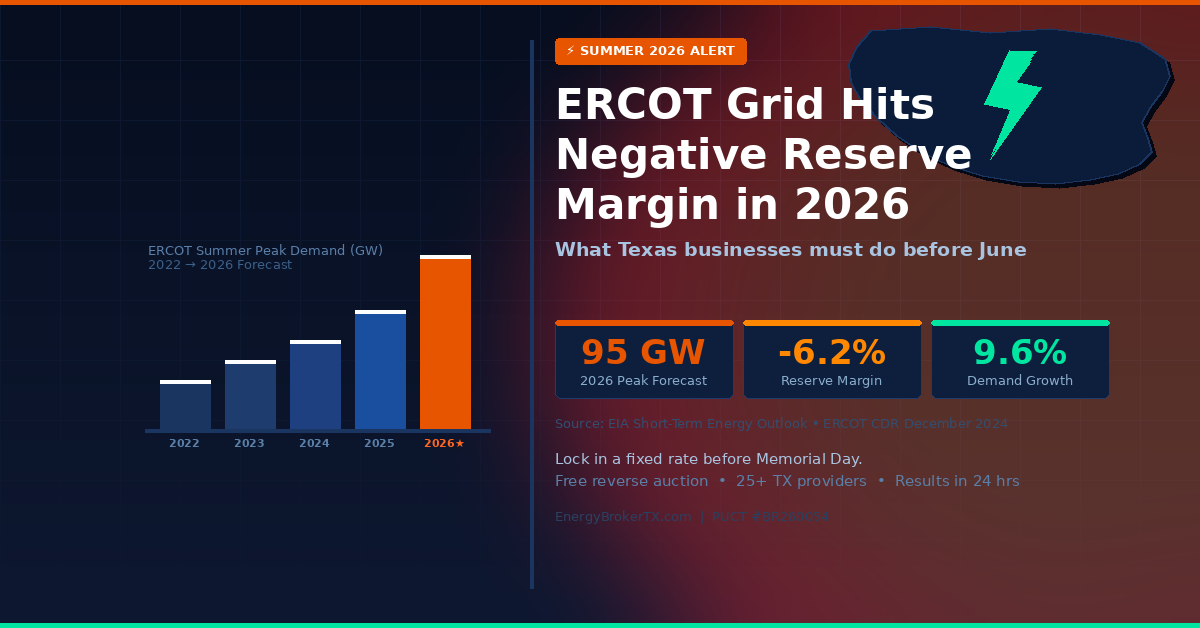
On July 21 and 22, 2026, ERCOT set back-to-back all-time electricity demand records during a statewide heat wave — reaching roughly 87,000 megawatts on Tuesday, then an estimated 91,308 megawatts on Wednesday, surpassing the previous record that had stood since August 2023. That's not far off the 92.2-gigawatt peak ERCOT's own 2026 seasonal forecast flagged as possible this summer, driven by extreme heat stacked on top of rapid load growth from data centers and industrial expansion across the state.
Solar generation and battery storage carried the bulk of the load through the hottest afternoons without tripping emergency conditions — good news for grid reliability. It's easier to miss what it means for one specific, rarely-explained line item on large commercial and industrial electricity bills: the Four Coincident Peak (4CP) transmission charge.
Most Texas businesses are familiar with demand charges set by their own facility's single highest 15-minute usage spike each month. The 4CP charge works on a completely different logic, and it only applies to larger commercial and industrial accounts — typically those on transmission-level or primary-service metering through their TDSP (Oncor, CenterPoint Energy, AEP Texas, or TNMP).
Instead of measuring your facility in isolation, ERCOT identifies the single highest 15-minute interval of demand across the entire Texas grid in each of four months: June, July, August, and September. Your facility's demand during those four specific 15-minute windows — not your total monthly usage, and not your own peak — determines your share of your TDSP's transmission cost allocation for the following calendar year.
Say a facility's demand happens to land at 1,200 kW during June's system-wide peak, 1,150 kW during July's, but only 200 kW during August's peak because operations were scaled back that afternoon, and 1,180 kW during September's. The facility's 4CP average — the number that sets its 2027 transmission cost share — comes out to roughly 933 kW, not the 1,180 kW it might have averaged on a normal day. That single successful reduction in August meaningfully lowered the whole year's allocation. Run the same facility at full load through all four windows instead, and the allocation — and the transmission bill for all of 2027 — comes out noticeably higher.
For large accounts, transmission charges set this way can represent 30–40% of the total electricity bill — frequently a bigger line item than the energy rate itself, and one that's easy to overlook because it doesn't show up as its own charge until the following year.
Two of the four 2026 coincident-peak windows have likely already occurred, given the records set this week. But ERCOT's own pre-season probability estimates put meaningfully higher grid-stress risk in the back half of the season than the front half — meaning the highest-risk days for the remaining two peaks are still ahead of us. If your business runs large, flexible loads — refrigeration, compressors, production lines, EV fleet charging, backup generation — the next several weeks are exactly when a well-timed reduction can still move the needle on your 2027 transmission costs.
It's also worth remembering this is a summer-specific mechanism. If your bigger concern is grid reliability risk in the colder months instead, see our guide to ERCOT winter risk for Texas businesses — a different exposure with a different playbook.
4CP exposure is mainly relevant to larger commercial and industrial accounts on demand-metered or primary-service tariffs — think manufacturing plants, large distribution centers, hospitals, and data centers, not a single-location restaurant or retail storefront. Your TDSP service class is listed on your utility bill, or your broker can confirm it in a couple of minutes.
If your business is on a standard small or mid-size commercial tariff, 4CP likely isn't your biggest lever — your facility's own monthly demand charge is. Start with our guides on reducing facility-level demand charges and how TDSP delivery charges show up on your bill instead.
4CP is a transmission cost allocation methodology, not something any single retail provider controls. Whichever TDSP delivers your power — Oncor, CenterPoint Energy, AEP Texas, or TNMP — uses the prior summer's coincident-peak data to set its transmission cost of service (TCOS) rates for the following year, and those wires charges apply no matter which retail electric provider (REP) bills your account. Switching REPs never changes your TDSP or its delivery charges; it only changes who supplies the energy itself and how that provider chooses to price or pass through transmission costs in your all-in rate.
That last point is where a broker actually adds value on 4CP: some REPs quote a rate that bakes in an estimated transmission cost, insulating you from swings in the TDSP's published TCOS; others pass the actual TDSP charge straight through. Neither approach is universally better, but you should know which one you're signing before a big 4CP season turns into a surprise on next year's bill.
The 4CP methodology itself has drawn scrutiny at the Public Utility Commission of Texas in recent years, with filings arguing that allocating transmission costs based on four narrow summer intervals can blunt the real-time price signals ERCOT's energy-only market is designed to send, and that it creates an incentive for large loads to curtail specifically during peak hours rather than manage usage more broadly. Nothing about the underlying rule (16 Tex. Admin. Code §25.192) has changed for the 2026 season, but it's a live regulatory conversation — one more reason large accounts benefit from a broker who tracks rule changes at the PUC and ERCOT level, not just retail rate offers.
Does 4CP affect my business if I'm a small retail location or single-site restaurant? Almost certainly not directly — 4CP applies to large, primary-metered accounts. Smaller commercial accounts should focus on their own facility-level demand charges instead.
How do I know if my account is on primary or transmission service? It's listed on your utility bill under your rate class, or your broker can confirm it from your account number in minutes.
Can I know for certain which day will be a coincident peak? Not in advance — ERCOT confirms the four peak intervals only after the fact. Large accounts manage this with forecasting rather than certainty, treating the hottest, tightest-grid afternoons as the highest-risk windows.
If you run a large facility and haven't reviewed your 4CP exposure this year, there's still time before September closes out this year's measurement window. And if your contract is coming up for renewal regardless, this is exactly the kind of detail that belongs in a contract renewal review — alongside the broader rate comparison you'd get from running a competitive reverse auction across Texas's licensed providers.
As a licensed Texas energy broker (PUC License # BR260054), we review 4CP exposure as part of every large commercial account we take on, at no cost to your business — our compensation comes from the winning provider, not from you. Contact us for a free review of how your current contract handles transmission costs, and whether a different structure makes sense before September.
Submit your account and we'll run a competitive auction with 25+ licensed Texas providers — full bid transparency, no pre-filtering, no obligation.
Get My Free Competing Bids →