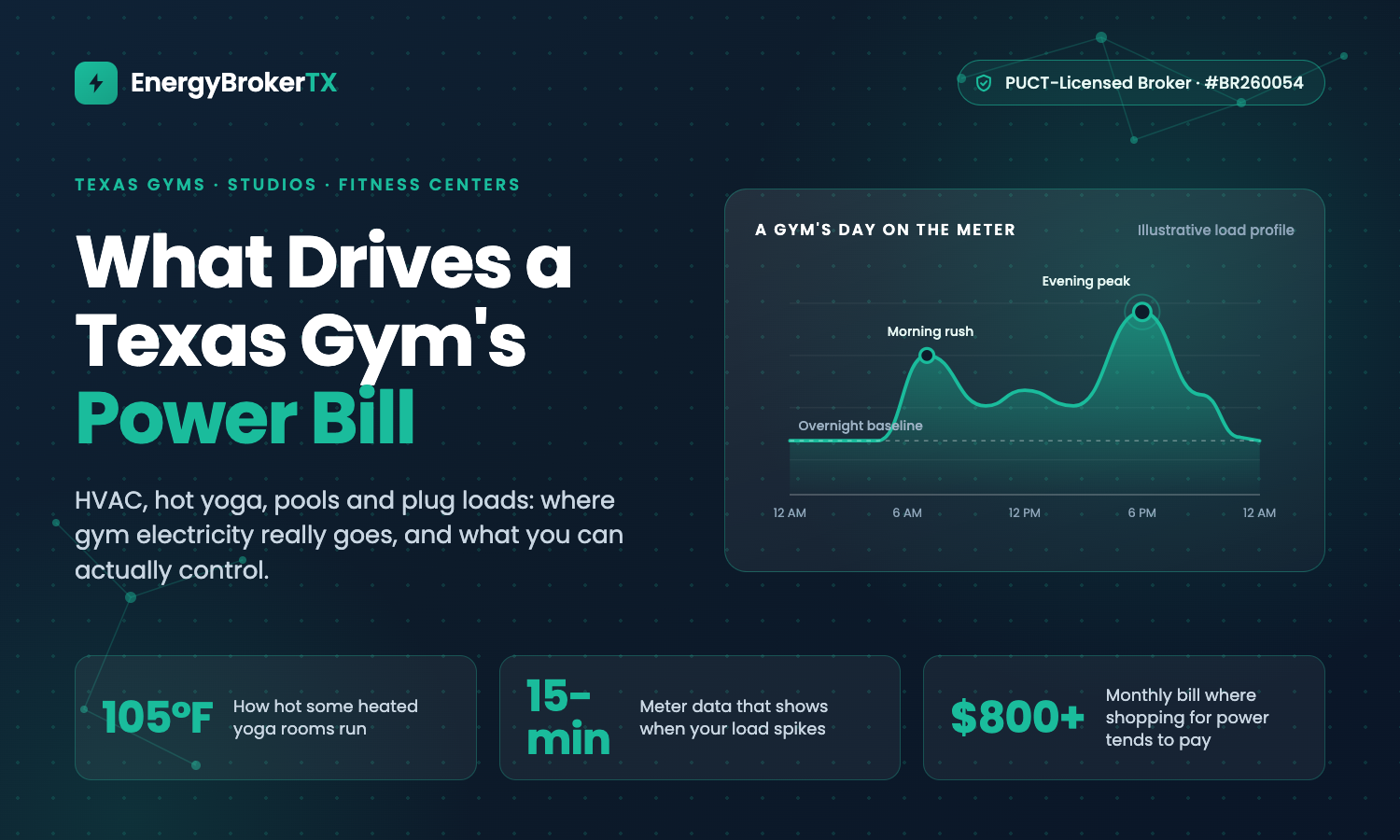
Texas Gyms, Yoga Studios and Fitness Centers: What Drives the Power Bill
What drives the power bill at Texas gyms, yoga studios and fitness centers, from HVAC and hot yoga to pools, and when shopping your rate pays off.

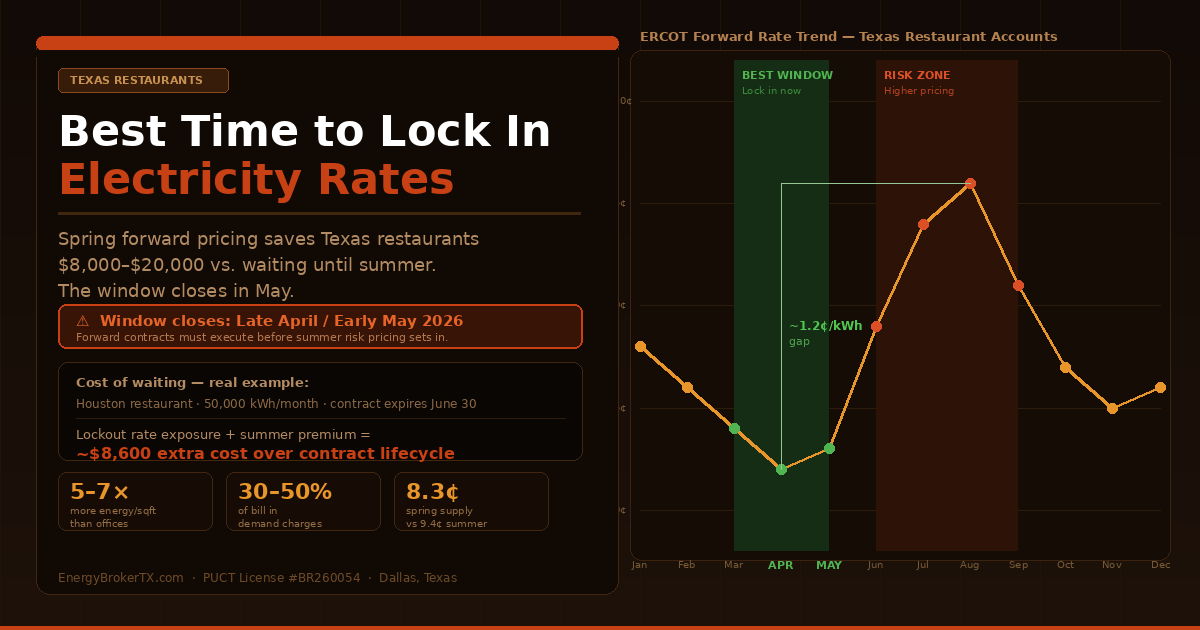
Every Texas restaurant owner knows the summer electricity bill is coming. What most don't realize is that the decision you make in April or May — not July — is what determines how bad that bill gets.
In Texas's deregulated electricity market, forward pricing for commercial supply contracts reflects what providers expect market conditions to look like over the contract term. In spring, before summer heat drives peak demand events and tightens reserve margins, forward prices are typically at their lowest point of the year. By June, those same forward prices incorporate a summer risk premium. By August, if you haven't locked in a new contract, you're either on a holdover rate at your existing provider (almost always above market) or negotiating at the worst possible time.
For Texas restaurants — which use five to seven times more electricity per square foot than standard office buildings, according to the U.S. Energy Information Administration — getting the timing right on electricity procurement isn't a minor administrative detail. It's a material business decision that can mean the difference of $8,000 to $20,000 or more over a 24-month contract depending on your operation's size.
This guide explains exactly how seasonal pricing works in ERCOT, what the right procurement window looks like for Texas restaurants, and how to make sure you're not one of the operators who wakes up in July on a rolled-over contract paying rates 20–30% above what you could have locked in four months earlier.
Texas commercial electricity is priced differently from residential. When you work with a licensed Texas energy broker to run a competitive auction, the rates you receive are forward supply prices — what providers are willing to commit to for the duration of a fixed contract starting on a future date.
Those forward prices are shaped by several factors that all move in the same direction as summer approaches:
ERCOT peak demand forecasts. ERCOT's 2026 summer outlook projects peak demand reaching levels that could stress reserve margins during the hottest afternoon hours. Data center load growth in North Texas is a significant driver — the region added over 2,000 MW of new data center capacity in 2024 and 2025 combined, and more is coming online. When the grid is tighter, providers price more risk into forward contracts.
Natural gas prices. Most of Texas's dispatchable generation — the plants that run during peak demand events — is natural gas-fired. When gas prices move, so does the cost of generating electricity during high-demand periods. Natural gas has been volatile in 2025 and 2026, which adds uncertainty that providers hedge into their forward pricing. That hedge is your cost if you lock in during a high-uncertainty period.
Seasonal load curves. Texas restaurants typically see their highest consumption from June through September. HVAC runs at full capacity to keep dining rooms comfortable in 95–105°F heat. Walk-in coolers and freezers work harder. Patio dining areas may require additional cooling or misting systems. For providers pricing a fixed-rate contract, a restaurant in Texas with a summer-heavy load profile is a more expensive account to price in July than in April, because the first months of the contract are the most expensive.
The practical result: a restaurant that locks in a 24-month fixed supply contract in April typically sees rates 8–15% lower than the same restaurant locking in the equivalent contract in July. On an operation consuming 40,000 kWh per month, that difference is roughly $400–$600 per month, or $9,600–$14,400 over the contract term.
Missing the spring procurement window doesn't just mean paying a higher rate on a new contract. It creates a specific financial exposure that is easy to overlook until it shows up on your operating statement.
Most commercial electricity contracts in Texas have an automatic holdover provision. If your contract expires and you haven't executed a new one, your account reverts to the provider's default month-to-month rate, sometimes called a holdover rate or renewal rate. This rate is not competitive. It is the provider's standard charge for accounts that haven't gone out to bid, and it is almost always 20–40% above what a current fixed contract would cost.
This is one of the most common situations we see when working with new restaurant clients. An operator signs a 24-month contract, it expires quietly, and the bill goes up $600–$1,200 per month without a clear explanation. When we pull the account history, the culprit is almost always a holdover rate that's been running for 3–6 months unnoticed. For more on this, see our detailed guide on how Texas commercial electricity contracts auto-renew.
On a busy full-service restaurant consuming 50,000 kWh per month, a 1.5¢/kWh holdover premium costs $750 per month — $4,500 over six months of inaction before someone notices and starts a procurement process.
You can absolutely run a competitive auction in July or August. Providers will still bid for your account. But the bids will reflect current summer market conditions — higher forward prices, tighter reserve margins, and the fact that your account's highest-consumption months are already baked into the front of the contract. The economics are simply worse than they would have been in spring.
Understanding your load profile is the first step to effective procurement, and restaurants have one of the most distinctive profiles in the commercial sector.
A typical Texas full-service restaurant consuming 40,000–60,000 kWh per month will have electricity costs broken down roughly as follows based on industry data from the U.S. EPA's ENERGY STAR program:
The critical procurement insight from this breakdown is the kitchen equipment load. Commercial kitchens create sharp 15-minute demand peaks — when multiple fryers, grills, and ovens run simultaneously during a dinner rush, instantaneous power draw spikes significantly above your average consumption level. These peaks are what drive your demand charges, which can represent 30–50% of your total monthly bill for high-volume operations.
A broker who understands restaurant load profiles can structure your contract to account for this pattern — specifically, looking at demand charge riders and contract structures that reduce the penalty for high instantaneous peaks relative to your average consumption. This is distinct from simply finding the lowest per-kWh rate, and it's a detail that matters significantly for kitchen-heavy operations.
For a deeper look at how demand charges work, see our guide on demand charges on Texas commercial electricity bills.
The mechanics of a restaurant electricity auction are straightforward, and the entire process from first contact to signed contract typically takes 3–5 business days. Here's how it works.
Providers need 12 months of usage history to price your account accurately. Monthly totals are the minimum; interval data (your 15-minute consumption readings available from Oncor, CenterPoint, or your relevant TDU) produces more accurate bids because providers can see your actual demand patterns rather than estimating them from monthly averages.
If you're in Dallas, Frisco, or anywhere in the North Texas ERCOT market, your TDU is Oncor. If you're in Houston, it's CenterPoint. If you're in San Antonio, it's CPS Energy, which operates a municipal utility and has different rules. If you're in Austin, it's Austin Energy, another municipal utility outside ERCOT deregulation.
Check your most recent electricity bill for the contract end date, or call your current provider and ask. This single piece of information determines your procurement timeline. If your contract expires in June, you need to start now. If it expires in September, you still benefit from spring procurement — most providers offer forward-start contracts with an execution date up to 90 days out from the contract start.
A PUCT-licensed Texas broker submits your account to 25+ retail electricity providers simultaneously, runs a transparent blind auction where providers compete on rate without seeing each other's bids, and presents you with a side-by-side comparison of every offer received. The entire auction typically produces results within 24 hours of submission.
For restaurants, specifically ask your broker to present both all-inclusive fixed rate options and options with separate demand riders — the latter can produce better economics for high-demand operations if the base energy rate is low enough to offset the demand exposure.
If your current contract expires between June and September, executing a new fixed-rate contract with a spring forward start date — signed now, effective when your current contract ends — is the ideal outcome. You capture spring forward pricing and avoid any gap on the holdover rate. Most providers honor forward-start contracts up to 90 days out.
If you operate more than one Texas location, the procurement strategy is materially different from what a single-location operator should do.
Running separate auctions for each location leaves volume on the table. A restaurant group with five Dallas-area locations each consuming 45,000 kWh per month has a combined load of 225,000 kWh per month — 2.7 million kWh annually. At that volume, aggregating all five into a single portfolio auction attracts meaningfully better bids than running five separate processes. Providers price larger aggregated accounts more competitively because they represent more stable, longer-term revenue.
Portfolio procurement also simplifies contract management. Staggering five contract expiration dates across different months creates five separate renewal deadlines to track annually. Aligning all locations under a single portfolio contract with the same renewal date reduces administrative overhead and eliminates the risk of missing one location's renewal while managing others.
The same logic applies to restaurant groups that include different concepts under one ownership structure — a fast casual and a full-service concept can be aggregated into a single portfolio if they share ownership and you have authorization to act on both accounts.
Based on current ERCOT forward market conditions and what we're seeing in auctions across North Texas and Houston, here are realistic supply rate ranges for restaurant accounts as of April 2026:
These are supply rates only. Your total delivered cost includes Oncor or CenterPoint TDSP delivery charges, which are regulated, fixed, and identical regardless of which retail provider you choose. Delivery charges for a typical commercial restaurant in Oncor territory currently add approximately 3.5–4.5¢/kWh to your total all-in rate.
If you are currently paying an all-in rate above 13¢/kWh, you are almost certainly on a holdover rate or an expired contract with an above-market renewal. If you're paying above 14¢/kWh, the gap between your current rate and what a competitive auction would produce is likely costing you $1,500–$3,000 per month on a mid-size operation.
Let's be direct about what the delay costs using a specific example.
A Houston-area full-service restaurant consuming 50,000 kWh per month is currently on a contract expiring June 30. The owner plans to deal with it in July after the summer rush calms down.
By waiting until July to start procurement, the owner is looking at:
That's not a worst-case scenario. It's a realistic middle-of-the-road outcome for a single location. A three-location group with similar usage profiles sees this number multiply accordingly.
In most cases you can, but check for early termination fees (ETFs) before initiating a switch. Most Texas commercial contracts include an ETF, typically calculated as a per-kWh charge for the remaining contract term or a fixed dollar amount. We review your existing contract as part of the audit process and calculate whether the ETF makes an early switch economically worthwhile given current market rates.
From bill submission to signed new contract, most restaurant auctions complete in 3–5 business days. Oncor or CenterPoint enrollment after contract execution takes 7–14 business days. A May 1 start date requires contract execution by approximately April 15–18 at the latest.
No. In Texas's deregulated market, the switching process is handled by the new provider and the TDU. Your current provider is notified by the TDU as part of the enrollment process. There is no service disruption, no gap in power delivery, and no action required on your part beyond signing the new contract.
A new meter or new location can be added to an existing portfolio contract in most cases, or a separate forward-start contract can be executed to align with your opening date. Contact us with your anticipated opening date and address and we'll structure the procurement around your timeline.
If your Texas restaurant's electricity contract expires between June and September 2026, every week you delay this decision costs you money — either in higher forward pricing or in holdover rate exposure. The spring procurement window is the single best opportunity of the year to lock in a fixed rate before summer demand risk is fully priced into the market.
Contact EnergyBrokerTX today for a free restaurant electricity audit. Submit your most recent bill and we'll pull your full account history, run a competitive auction with 25+ licensed Texas providers, and present you with every bid side by side — in 24 hours, at no cost to you. PUCT License #BR260054. Serving Dallas, Houston, Fort Worth, Frisco, Austin, and all of Texas.
The best time to lock in your summer rate was last month. The second best time is today.
Submit your account and we'll run a competitive auction with 25+ licensed Texas providers — full bid transparency, no pre-filtering, no obligation.
Get My Free Competing Bids →