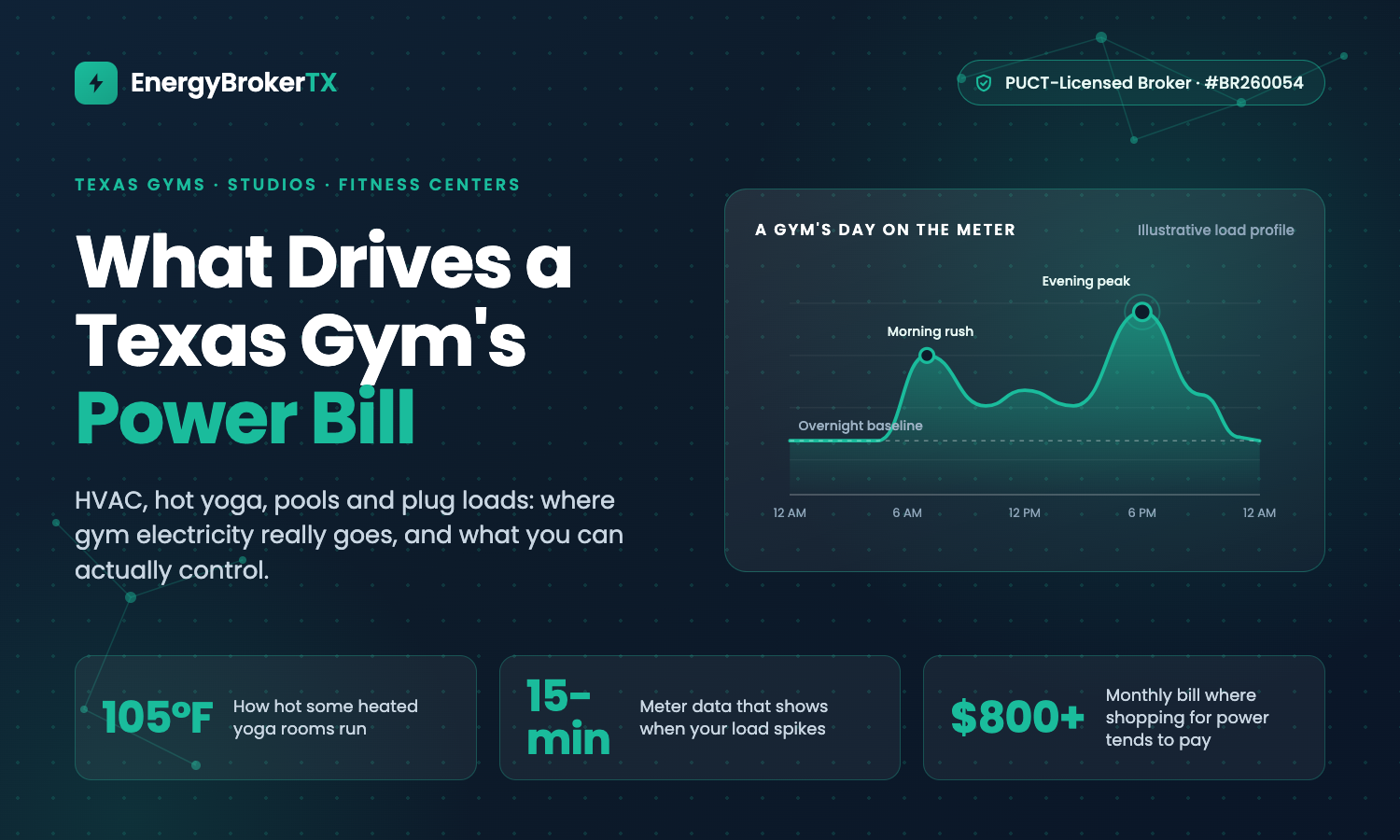
Texas Gyms, Yoga Studios and Fitness Centers: What Drives the Power Bill
What drives the power bill at Texas gyms, yoga studios and fitness centers, from HVAC and hot yoga to pools, and when shopping your rate pays off.

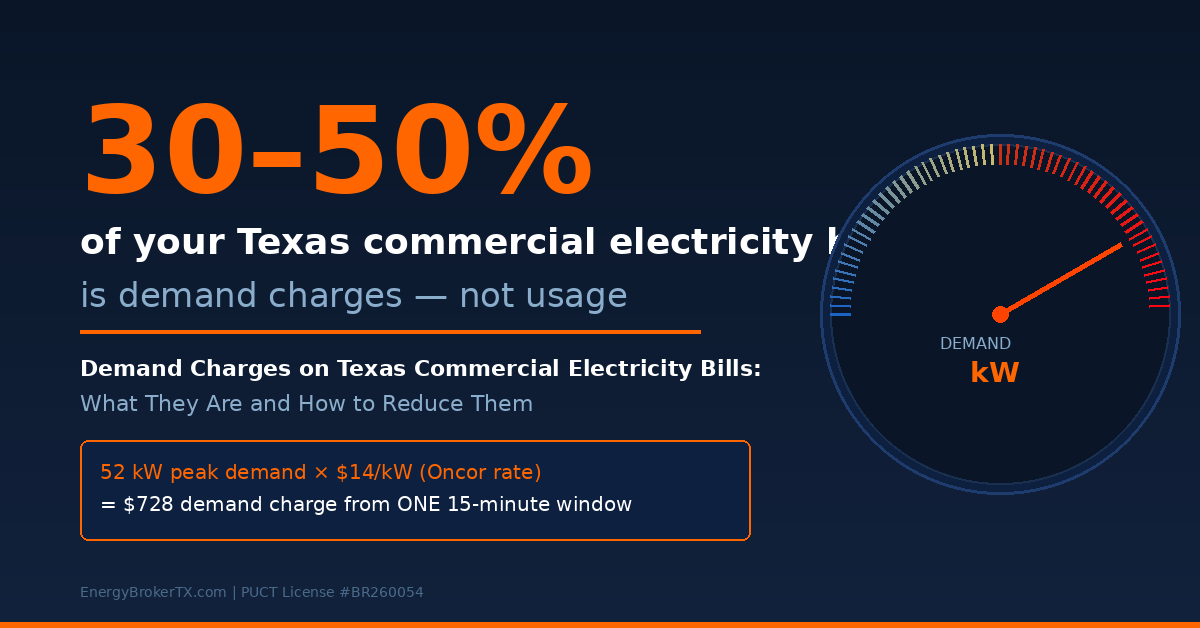
Every month, a Texas business owner gets their electricity bill, scans the total at the top, notices it's higher than last month, and assumes it was a hot month. The HVAC ran more. Makes sense. They pay it and move on. What most commercial business owners in Texas don't realize is that the biggest line item driving that increase often has nothing to do with how much electricity they used — it has everything to do with how fast they pulled power during one specific 15-minute window of the entire billing period. That mechanism is a demand charge, and for most Texas commercial accounts, demand charges on their commercial electricity bills represent 30 to 50 percent of their total monthly spend. This article explains exactly what demand charges Texas commercial electricity customers face, how the 15-minute interval calculation works, why certain industries get hit harder than others, and what specific actions reduce what you pay.
A demand charge is not based on how much electricity your business consumed over the course of the billing month. It is based on how fast your business drew electricity at its single most intense 15-minute interval of the entire billing period. Your Transmission and Distribution Utility — Oncor for Dallas-Fort Worth and most of North Texas, CenterPoint for the Houston metro, AEP Texas for West Texas and parts of South Texas — installs an interval meter at your service location that records your total electrical draw in kilowatts every 15 minutes throughout the month. At the end of the billing period, the single highest 15-minute reading becomes your billing demand in kilowatts. Your TDU then multiplies that one number by their per-kilowatt demand tariff rate to produce your demand charge for the entire month.
The result is financially significant and counterintuitive. A restaurant that pulls 52 kilowatts during one Friday lunch rush — when the line cook fires the convection ovens, the exhaust hoods run at full speed, the commercial dishwasher runs a cycle, and the HVAC ramps to full capacity all within the same 15-minute window — pays a demand charge based on that 52 kW peak for the entire month. At Oncor's commercial demand rate of approximately $14 per kW, that single lunch rush produces a demand charge of $728. That $728 applies to the entire month regardless of how efficiently the restaurant operated during the other 2,975 fifteen-minute intervals. A restaurant with identical total monthly kilowatt-hour consumption but a peak demand of only 38 kW pays $532 in demand charges — $196 less from the exact same energy usage. The only difference is what happened during the worst 15 minutes.
This is why demand charges on a commercial electricity bill consistently surprise business owners who focus exclusively on the per-kWh rate when comparing electricity plans. The advertised supply rate from your retail electricity provider covers only the energy commodity portion of your bill. Your TDU demand charge is layered on top of that, is entirely separate, and is the line item most commercial buyers never think to ask about when shopping for a new contract.
On an Oncor commercial electricity bill, the demand charge appears as a line item labeled TDSP Demand Charge or Distribution Demand in the delivery charges section. On CenterPoint bills it typically appears as Demand Delivery Charge. On AEP Texas bills it is labeled Distribution Demand. All three utilities structure the charge the same way: your peak 15-minute kilowatt demand multiplied by the applicable tariff rate. The tariff rate varies by service class and usage level, but for standard commercial accounts without time-of-use provisions, Oncor's commercial demand rate runs approximately $14 per kW, CenterPoint runs in a similar range, and AEP Texas varies by territory and service class.
The critical distinction for Texas commercial accounts in the deregulated ERCOT market is that the TDSP demand charge is a delivery-side charge. It comes from your TDU, not from your retail electricity provider. This means that no matter which REP you use — TXU, Reliant, Direct Energy, Constellation, or any of the 100-plus licensed providers operating in ERCOT — you pay the same TDU demand rate. It is set by tariff filed with the Texas Public Utility Commission and applies uniformly to every commercial account in that utility territory. A business comparing REP rates who focuses only on the per-kWh supply charge is evaluating somewhere between 50 and 70 percent of their actual total electricity cost. The demand charge portion of the bill gets ignored until it shows up as an unpleasant surprise on a July statement.
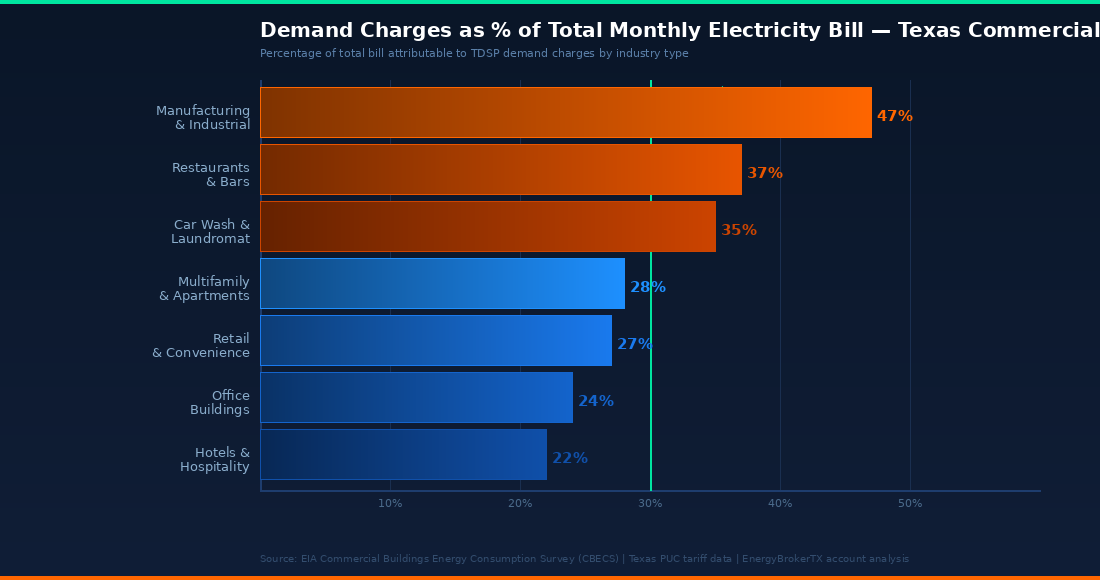
The businesses that get hit hardest by demand charges are those whose operations create large simultaneous electrical loads — multiple pieces of high-draw equipment activating within the same 15-minute window. Restaurants are the clearest example. A commercial kitchen during a lunch or dinner rush is a study in simultaneous load creation: convection ovens, flat-top grills, fryers, commercial refrigeration compressors cycling on, exhaust ventilation running at maximum capacity, dishwashers running cycles, and HVAC maintaining temperature for a full dining room — all happening at the same time during the same 15 minutes. One rush window where all of this overlaps sets the billing demand for the entire month. At $14 per kW on Oncor, every kilowatt of peak draw costs $14 per month. A kitchen that peaks at 52 kW pays $728 in demand charges. Proper startup sequencing that keeps the same kitchen peak draw at 38 kW through staggered equipment activation saves $196 per month from the exact same total energy consumption — without changing a single operational decision beyond the order in which equipment is turned on.
For multifamily and apartment communities, demand charges arrive from a different source: simultaneous resident activity. Common-area HVAC systems, laundry room equipment, elevator motors, parking lot lighting transitions at dusk, and pool and amenity systems all create demand peaks during morning and evening resident activity periods. A property management company running five DFW apartment communities with 12 common-area meters each has 60 independent 15-minute demand intervals being tracked every month across their portfolio. Each property has its own billing demand set independently, and a simultaneous HVAC startup across three buildings during a hot July afternoon can spike one property's billing demand for the entire month based on a 15-minute window that could have been avoided with pre-cooling scheduled before the peak activity period.
For manufacturing and industrial facilities, demand charges are often the dominant cost driver rather than just a significant one. Production equipment startups, compressor activations, conveyor system launches, and industrial HVAC for large floor space create electrical draws that residential and small commercial operations never experience. For a 50,000 square foot manufacturing plant, it is common for demand charges to represent 40 to 50 percent of the total electricity bill. Shift startup sequences — where production equipment across a large floor comes online within a compressed time window — are the primary driver of demand spikes in these environments. A plant that staggers shift startup by 20 minutes routinely sees measurable reductions in billing demand without any change to production output or scheduling.
The TDSP demand charge is a regulated, fixed component of your electricity cost that cannot be changed through your choice of retail electricity provider. Oncor's demand tariff rate is what it is. No broker, no REP, and no contract negotiation changes the per-kW rate your TDU charges for your peak demand. This is a point worth stating plainly because it is frequently misunderstood in commercial electricity procurement conversations — some businesses believe that switching providers will reduce their demand charges, and it will not. The delivery side of the bill is outside the scope of the competitive retail market.
However, the supply contract you sign with your retail electricity provider can be structured in ways that account for your demand profile and affect your total bill cost. Some commercial REP contracts use flat per-kWh pricing applied uniformly regardless of your usage pattern. Others are structured specifically for high-demand-charge commercial profiles and price the supply component differently based on load factor — the ratio of your average demand to your peak demand over the billing period. Running a reverse auction that submits your account simultaneously to 25 or more retail electricity providers — with your actual 12-month interval data included — gives those providers the information to bid with full knowledge of your demand profile. The competitive pressure of that auction consistently produces better outcomes than calling one provider and accepting their standard commercial offer, and it surfaces contract structures suited to your specific load characteristics that a generic rate comparison never would.
The first and most accessible strategy is staggering equipment startups. Instead of activating all HVAC units, kitchen equipment, compressors, and lighting simultaneously when opening for business, space those activations over a 20 to 30 minute window. This spreads the electrical load across multiple 15-minute intervals rather than concentrating it in one. A restaurant that turns on all equipment at 10:00 AM creates one large demand spike in the 10:00 AM interval. The same restaurant staggering activations from 9:45 to 10:15 AM keeps the peak draw in any single interval meaningfully lower, potentially saving $150 to $300 per month in demand charges without changing anything about actual energy consumption or service delivery.
The second strategy is pre-cooling or pre-heating before peak activity periods. For restaurants and retail operations, running HVAC at target temperature before the business opens — rather than ramping it up at open time when all other equipment is also coming online simultaneously — separates the HVAC demand contribution from the equipment activation demand spike. The building retains the conditioned air during peak activity without the HVAC system adding its full draw to the specific 15-minute window when kitchen equipment, lighting, and everything else is also at maximum demand.
Third, review and use your 15-minute interval data. Most Texas commercial accounts in Oncor territory have access to their interval usage data through Oncor's SmartMeter Texas portal at smartmetertexas.com. CenterPoint and AEP Texas have equivalent commercial account portals. Reviewing this data monthly — looking specifically at which days and which 15-minute windows are setting your billing demand — converts a reactive monthly cost into a manageable operational variable. You cannot reduce what you cannot see, and the interval data shows you exactly where your peak is originating, which smdays it's happening, and whether it's correlated with predictable operational events or something anomalous.
Fourth, identify and correct equipment cycling anomalies. Demand spikes that appear at irregular times — not correlated with business hours or production schedules — often trace to equipment issues rather than operational patterns. HVAC systems with faulty staging controls, refrigeration compressors with delayed-start capacitor problems, and motors with incorrect startup configurations can create unexpected demand spikes during off-hours. One Texas manufacturing facility discovered their billing demand was being set by a compressor cycling issue occurring at 2:00 AM on weekday mornings — not by any production activity at all. Correcting the equipment issue eliminated the anomalous demand spike entirely and reduced monthly demand charges by more than $400 with no operational change whatsoever.
Fifth, review supply contract structure specifically at renewal time, not just the per-kWh rate. When your commercial electricity contract approaches renewal, ask providers explicitly how their contract pricing interacts with your demand profile. Providers bidding in a competitive auction with your actual 12-month interval data have the information to price a contract that reflects your specific load characteristics — including whether a time-of-use rate structure or an indexed product with specific demand provisions would produce better total cost outcomes for your operation than a standard flat per-kWh fixed rate.
Sixth, benchmark your demand charge percentage consistently. Divide your monthly TDSP demand charges by your total electricity bill amount and express the result as a percentage. Track this number month to month. If demand charges consistently represent more than 35 percent of your total bill, your operation has a demand profile that warrants specific attention in the procurement process — not just a rate comparison on the supply side, but a full load profile analysis before entering any competitive bidding process. The demand charge percentage is the single most useful diagnostic number for identifying where your electricity cost reduction opportunity actually lives.
Pull your last three months of electricity bills. Find the TDSP Demand Charge line on each statement. Add those three numbers and divide by your total three-month electricity spend — that is your demand charge percentage. If it exceeds 30 percent on a consistent basis, your operation has meaningful demand charge exposure that a supply rate comparison alone will not address. Identify which of the three months had the highest billing demand and cross-reference that month against your operational calendar. Peak demand charges in July and August almost always trace to HVAC coinciding with equipment loads during hot afternoons. An unusually high demand charge in a mild month — October or March — often indicates an equipment anomaly worth investigating before attributing it to operational activity.
If you do not currently have access to your 15-minute interval data, call your TDU's commercial accounts line and ask how to access your interval usage history. For Oncor accounts, this data is available through SmartMeter Texas. Having 12 months of interval data in hand before entering any procurement conversation gives the providers bidding for your account the information to price accurately rather than applying a generic standard rate that assumes a typical load profile your operation may not match.
When your current electricity contract approaches renewal — ideally 90 to 120 days before expiration — run a competitive reverse auction with your demand profile and interval data documented. EnergyBrokerTX runs this process free for Texas commercial accounts under PUCT License #BR260054. Most accounts receive competing bids from 25 or more licensed Texas providers within 24 hours of submitting their current bill.
The demand charge problem does not resolve itself. Texas grid conditions in summer 2026 are projected to be more demanding than prior years, driven by data center load growth concentrated in DFW and Houston that raises the baseline floor of grid demand around the clock. When July and August temperatures arrive and grid-wide demand peaks simultaneously with your operational peak, the businesses that have addressed their demand profile and secured supply contracts structured for their load characteristics through competitive procurement are in a materially different cost position than those that did not act before the summer premium was baked in.
Submit your account and we'll run a competitive auction with 25+ licensed Texas providers — full bid transparency, no pre-filtering, no obligation.
Get My Free Competing Bids →