
Texas Gyms, Yoga Studios and Fitness Centers: What Drives the Power Bill
What drives the power bill at Texas gyms, yoga studios and fitness centers, from HVAC and hot yoga to pools, and when shopping your rate pays off.

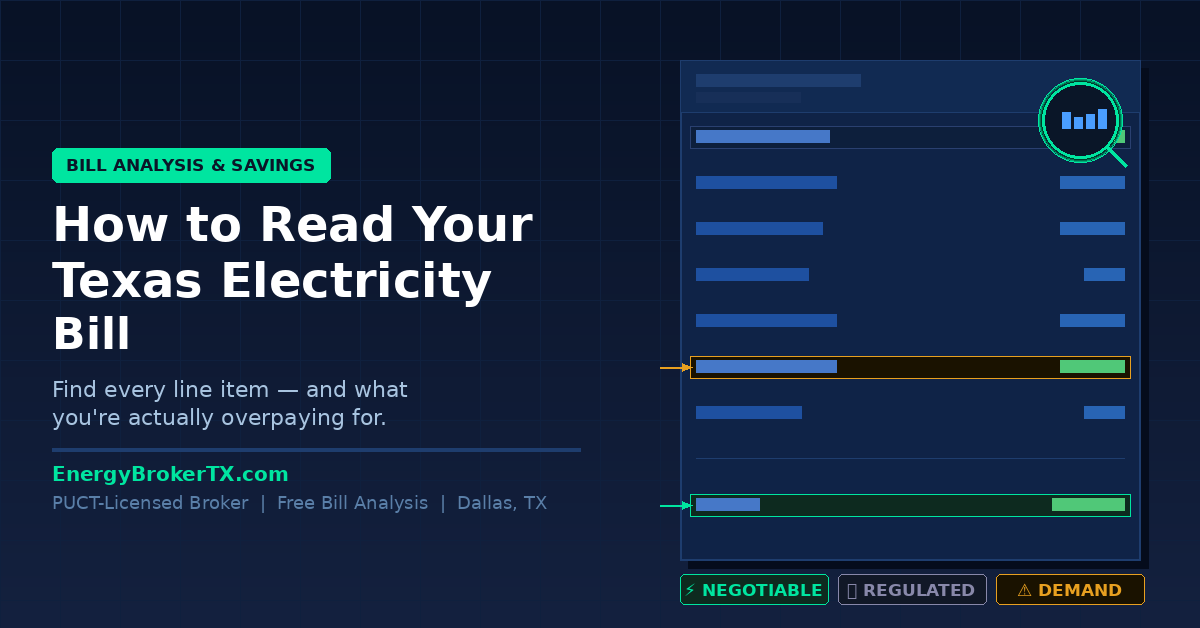
Every month, a business owner gets their electricity bill, sees the total at the top, and pays it. The line items below that total — charges labeled "TDSP Delivery," "Fuel Cost Adjustment," "Ancillary Services," "TDSP Base Charge" — get skimmed or ignored entirely. They look like accounting noise: fixed, opaque, and not worth the time it would take to decode them. Most commercial accounts in Texas have been operating this way for years. That's the problem this article solves.
A Texas commercial electricity bill is built from two fundamentally different parts: the supply side and the delivery side. The supply side covers the actual electricity commodity — the power your business consumes — and it is negotiable. The delivery side covers the physical infrastructure that moves electricity from the grid to your building, and it is regulated by the Texas Public Utility Commission with rates that apply uniformly to every customer in a given territory. Every single charge on your bill belongs to one of these two buckets. Most businesses don't know this split exists. Understanding it is the entire foundation of lowering what you pay — because the levers you have access to only apply to one side.
After reading this article, you will know exactly what every standard line item on a Texas commercial electricity bill means, where each charge comes from, and whether it's fixed or negotiable. You'll also have three specific calculations you can run on your current bill today to determine whether your effective rate is competitive, whether demand charges are consuming a disproportionate share of your cost, and whether your contract status is quietly costing you money right now.
In Texas's deregulated electricity market, your bill reflects charges from two entirely separate entities. Your Retail Electricity Provider — the company you signed a contract with, whether that's TXU, Constellation, Reliant, Direct Energy, NRG, or one of more than 100 other licensed providers — supplies the electricity you consume. Your Transmission and Distribution Utility, also called a TDU or TDSP, owns and operates the physical poles, wires, transformers, and meters that deliver that electricity to your building. These are different companies with different regulatory authorities and entirely different billing structures.
Your TDU is determined by your address and cannot be changed. In the Dallas-Fort Worth metro area and most of North and West Texas, it's Oncor Electric Delivery — the state's largest TDU, serving roughly 10 million customers under tariff schedules set by the Texas Public Utility Commission. In the Houston metro area and surrounding counties, it's CenterPoint Energy. In West Texas and parts of Central and South Texas, it's AEP Texas. These utilities don't sell you electricity — they deliver it. Their charges are set through PUC rate proceedings and apply identically to every customer in their service territory, regardless of which REP that customer has chosen.
As of the September 2025 rate adjustment cycle, Oncor's delivery tariff runs approximately $4.23/month plus 5.60¢/kWh; CenterPoint's runs $4.90/month plus 5.90¢/kWh. These figures update each March and September and apply regardless of which REP you choose.
Your REP, by contrast, is your choice. That's where the competitive market operates — and where an energy broker or Texas Public Utility Commission resources come in. A broker runs a competitive bid process to find the lowest available supply rate from a licensed REP. No broker, no contract negotiation, and no REP sales process changes what your TDU charges. Those rates are fixed by tariff.
The practical implication is this: any meaningful strategy to lower your electricity cost must begin by separating these two sides. A rate comparison that looks only at the total bill — treating it as one undifferentiated number — misses the point. The delivery side is fixed. The supply side is where the savings live. Attacking the total without knowing which portion is which is exactly why most commercial cost-reduction efforts produce disappointing results or collapse under scrutiny.
| Component | What It Is | Who Controls It | Negotiable? | Typical % of Bill |
|---|---|---|---|---|
| Energy Charge | Cost per kWh for the electricity itself | Your Retail Electric Provider (REP) | Yes | 45–60% |
| TDSP Delivery Charge | Physical delivery through poles, wires, and meters | Regulated utility (Oncor, CenterPoint, AEP Texas, TNMP) | No | 35–50% |
| Demand Charge | Your single highest 15-minute draw each billing period, plus 4CP exposure for large accounts | Set by tariff, driven by your own usage behavior | Partially | 0–15% |
| Taxes & Fees | State sales tax, franchise fees, small regulatory charges | State and local government | No | 3–5% |
This is the same four-way split covered in detail below — keep it as a quick reference while you go line by line through your own bill.
A standard Texas commercial electricity bill contains six to nine distinct line items, depending on your TDU territory, account service class, and contract structure. Here is what each one is, where it comes from, and whether it falls on the negotiable supply side or the regulated fixed side.
The TDSP demand charge is the most counterintuitive line item on a Texas commercial electricity bill, and it is disproportionately responsible for the gap between what businesses expect to pay and what they actually owe. The demand charge on an electricity bill in Texas is not based on how much total energy you consumed — it is based on how fast you drew power at your single worst moment of the month.
Here is how it works. Your TDU's interval meter records your total electrical draw in kilowatts every 15 minutes throughout the billing period. At the end of the month, the single highest 15-minute reading becomes your billing demand. The TDU multiplies that one number by their per-kW tariff rate. That product is your demand charge for the entire month.
Consider a restaurant with a commercial kitchen. On a Friday lunch service, the line cook fires up the convection ovens, the exhaust hood fans run at full speed, the commercial dishwasher runs a cycle, and the HVAC ramps up simultaneously at 11:45 a.m. For those 15 minutes, the restaurant's total electrical draw hits 52 kW. That single window — one out of roughly 2,900 fifteen-minute intervals in a billing month — sets the demand charge for the entire period. At Oncor's commercial demand rate of $14 per kW, that 52 kW peak produces a demand charge of $728. A restaurant running identical total monthly kWh consumption but with a peak draw of only 35 kW would pay $490 in demand charges. Same energy usage. $238 difference — because of what happened in one 15-minute window during one lunch rush.
This is why two businesses with identical monthly kWh totals can receive bills that differ by hundreds of dollars. Demand charges don't measure consumption volume — they measure consumption rate at your single most intense moment. For a deeper look at how these charges are calculated and what high-load businesses can do about them, see the detailed guide on ERCOT manufacturing demand charges. Texas manufacturing and industrial facilities face this challenge acutely, but the mechanics apply to any commercial account large enough to carry a demand charge line item.
Beyond the monthly demand charge above, ERCOT runs a separate, longer-cycle transmission cost mechanism called the Four Coincident Peak (4CP). Your share of transmission costs for the following 12 months is set by your electricity demand during four specific hours: the single highest-demand hour across the entire ERCOT grid in each of June, July, August, and September. Out of 8,760 hours in a year, those four—roughly one per month—determine a material portion of your annual transmission cost.
The stakes are real. A mid-sized commercial facility that reduces its peak draw by 150 kW during those four windows can save $15,000–$25,000 annually in transmission cost allocation. For industrial accounts running 2–3 MW of peak demand, that scales to $40,000–$80,000 per year. The catch: 4CP hours aren't announced in advance—they're typically weekday afternoons in July or August when statewide ERCOT load exceeds 75–78 GW under sustained heat. Businesses on interval metering can pre-cool, defer non-critical equipment cycles, and shed load during high-probability windows to materially reduce this specific cost.
A fixed-rate electricity contract locks your per-kWh energy charge. It does not lock your total bill. That distinction causes real confusion when a business owner on a "fixed rate" watches their bill move by hundreds of dollars month to month and assumes something's wrong.
Four things move independently of your energy rate. Your kWh consumption itself changes with weather and operations — Texas summer cooling loads commonly run 30–60% above spring baseline for the same building. Your TDSP's delivery rate adjusts on a set schedule (Oncor and CenterPoint typically file rate changes each March and September), and that change applies to every customer in their territory the moment it's approved, regardless of your REP contract. If you're on a demand-metered rate class, your peak 15-minute reading shifts with your own operational pattern each month. And PUC-authorized pass-through adjustments can move between billing cycles independent of anything in your contract.
The practical takeaway: watching only your contracted per-kWh rate is incomplete. Businesses that track just the energy charge often miss 10–15% in TDSP-side movement that has nothing to do with their REP contract at all.
The month-to-month movement above sits on top of a longer multi-year trend, and it's worth understanding why rather than treating each increase as a surprise. ERCOT load growth has accelerated well beyond historical norms, driven largely by data center and other large-load interconnections across the state — enough new demand that ERCOT has revised its own peak forecasts upward more than once in the last two years. That growth pulls wholesale prices up with it and tightens reserve margins, which increases the frequency of high-price events during summer peaks.
At the same time, TDSPs have been recovering the cost of post–Winter Storm Uri grid-hardening investment through their regular rate filings — a multi-year process that shows up as the steady TDSP delivery-charge increases many businesses have noticed each spring and fall since 2021. And because roughly 40% of Texas generation runs on natural gas, LNG export demand from Gulf Coast terminals has kept gas prices — and the generation cost built on top of them — structurally higher than pre-2022 levels.
None of this means your bill is out of your control. It means the negotiable, supply-side portion of your bill matters more than ever, since the delivery side only moves in one direction. If sustainability commitments matter to your business independent of cost, see our guide to green energy plans for Texas businesses — but for most accounts, the reverse auction below is where the real savings are.
These are not general tips. They are a specific diagnostic protocol — three calculations anyone who wants to know how to read a Texas commercial electricity bill can run on their current statement in about ten minutes to determine exactly where you stand relative to the market.
Number 1: Effective rate per kWh. Divide your total bill amount by your total kWh consumed that month. The result is your effective all-in rate. This number almost always exceeds the rate your REP advertised in your contract, because the REP's rate covers only the energy supply portion of the bill. The advertised rate is real — it accurately reflects what your REP charges for the commodity. But it does not include TDSP delivery, TDSP base charge, TDSP demand, ancillary services, fuel adjustments, or taxes. Your effective rate includes all of it. The U.S. Energy Information Administration reports Texas commercial electricity supply averages around 8.6¢/kWh at the wholesale-to-commercial supply level — but when all-in charges are included, most Texas commercial accounts run effective rates of 10.5–13.5¢/kWh depending on load profile and TDU territory. A Texas electricity bill breakdown that uses only the REP's advertised rate as a benchmark will consistently mislead you about your actual cost position. See current Texas EIA commercial electricity rate data for reference.
Number 2: Demand charge as a percentage of total bill. Divide your total TDSP demand charges by your total bill amount and multiply by 100. If demand charges exceed 30% of your total bill, it may be worth evaluating whether your current supply contract is optimized for your usage profile. Certain commercial REP contracts are structured to reduce effective demand charge exposure for specific account types — this is a negotiable element of the supply agreement, not a fixed TDU tariff. The 30% threshold is a diagnostic starting point. A demand charge percentage of 40% or higher on a consistent basis is a signal that plan restructuring — through a competitive bid process — is likely to produce material savings on top of any rate improvement.
Number 3: Contract expiration date. Find the contract end date on your bill or call your REP's commercial accounts line and ask directly. When a Texas commercial electricity contract expires without a new agreement in place, most contracts roll to a month-to-month holdover rate or an auto-renewal rate. These rollover rates typically run 20–40% above the original fixed contract rate — sometimes more during periods of tight ERCOT market conditions. A business whose $2,200-per-month contracted rate expired six months ago and rolled to a rate 30% higher has spent approximately $3,960 in avoidable overcharges since expiration. The contract expiration date is not a scheduling nuisance. It is the single most financially consequential piece of information on your commercial electricity account. Use current Texas commercial energy rates as your benchmark for what a renegotiated contract should deliver.
Once you know your contract expiration date, timing the renewal itself matters more than most businesses realize. Starting the comparison process 90–120 days before expiration gives you real market optionality — enough time to watch wholesale price movement rather than accepting whatever rate is available the week your contract lapses.
Seasonality moves rates too. Contracts signed in July or August — when ERCOT demand peaks and REPs are managing maximum hedging exposure — commonly carry an 8–12% premium over the same term signed in September or October. A 24-month contract locked in during peak summer carries that premium for its entire term. If your expiration falls in the summer window, it's worth starting the shopping process even earlier to lock in spring pricing ahead of it.
Contract length should match the rate environment, not habit. Shorter terms make sense when current rates sit high relative to the forward curve or your load profile is likely to change soon. Longer terms make sense when you can lock a rate below the forward curve and want budget predictability — but they also mean giving up the ability to benefit if the market softens unexpectedly.
Start by confirming your contract status. Look for a "contract end date" on your most recent bill — most Texas REPs are required to include this — or call your REP's commercial accounts line and ask for the end date and current rate type. If your contract ended within the last 90 days and you didn't execute a new agreement, you are almost certainly on a rollover or variable holdover rate. This is the single most common cause of unexplained bill increases for commercial accounts in Texas, and it is correctable immediately once identified.
Next, isolate demand charge movement. Pull your bills for the prior three months and compare the TDSP demand charge line on each. A significant jump — more than 15–20% above prior months — almost always traces to a specific operational event: a piece of equipment turned on at an unusual time, a new appliance brought online without adjusting the startup sequence, a change in staffing or shift scheduling, or equipment cycling that created an accidental simultaneous peak. Identifying the cause is essential, because a demand spike that isn't understood tends to repeat — and in some TDU territories, ratchet clauses mean a single bad month can shadow your demand billing for up to 11 additional months.
Then calculate your effective rate. Total bill divided by total kWh consumed. Compare the result to the current Texas commercial electricity market average for your TDU territory. If your effective rate exceeds the market average by more than 15%, you are a candidate for immediate rate shopping. A commercial electricity bill explained as "just what electricity costs here" is often the result of an expired contract, a poor initial rate, or a variable-rate product that has drifted well above the competitive market. At 120,000 kWh annually, a 2.5¢/kWh gap between your effective rate and the competitive market represents $3,000 per year in unnecessary cost.
Finally, put your account into a competitive bid process — but do not call your current REP first. Your current provider has no commercial incentive to offer you a better rate while you remain on their contract or holdover. The correct move is to run a competitive reverse auction that invites 25 or more licensed Texas REPs to bid simultaneously against each other for your contract. Knowing your effective rate, your demand charge percentage, and your contract history going in is what allows you to evaluate those bids accurately.
A broker operates exclusively on the supply side of your bill. That is a significant lever — but it is not the whole bill, and understanding the boundary matters as much as understanding what's possible within it.
A broker can lower your energy supply charge — the per-kWh rate your REP charges for the commodity — by running a competitive process that forces licensed providers to compete for your contract in real time. A broker can influence the fuel cost structure of your agreement, specifically whether your contract locks in a fixed fuel component or exposes you to wholesale market fuel pass-throughs. A broker can negotiate certain ancillary service structures depending on what contract types are available in your market and what your REP will offer. And for accounts with specific load profiles, a broker can identify REP contract structures that carry lower effective demand charge exposure — some commercial supply plans are designed to reduce the demand-related portions of the supply contract for accounts whose usage patterns benefit from that structure.
A broker cannot change your TDU's delivery charges. Oncor's distribution rate is a PUC tariff. CenterPoint's base charge is set through a rate proceeding that applies uniformly to every account in their territory. AEP Texas's per-kWh delivery charge is the same whether your business is served by a Fortune 500 REP or a regional startup. No broker, no REP, and no negotiation changes these numbers — full stop. The same applies to state and local taxes and your physical meter service class.
Any broker or REP sales representative who tells you they can lower your Oncor delivery charge, reduce your TDSP base fee, or give you a better TDU rate through a provider switch is either misinformed about how Texas electricity regulation works or is misrepresenting what their service does. This is one of the most persistent sources of confusion in commercial electricity procurement — the regulated delivery side of your bill is fixed, and it cannot be negotiated. The supply side is not fixed, and that is where the savings live. For Texas churches and houses of worship, supply-side savings through competitive procurement routinely reach 15–30% of the total bill even with delivery charges unchanged. The same applies to Texas restaurants and bars, where supply procurement savings can offset a significant portion of the high-demand-intensity utility costs that come with commercial kitchen operations.
Contract expires in 0–6 months: Start the comparison process now — 90 days out is the minimum window for real optionality, not a suggestion.
Contract expires in 6–18 months: Run the three-number diagnostic above now so you know where you stand, then set a reminder to start shopping 90–120 days before expiration.
Locked in for 18+ months: If you're on a demand-metered rate class, this is the window to address your 4CP exposure before next summer, not after.
Not sure where your contract stands: That's exactly what the three-number check above is for — run it today.
If you've run the three calculations above — effective rate per kWh, demand charge as a percentage of total spend, and contract expiration date — you now have a clear picture of where your account stands relative to the Texas commercial electricity market. If your effective rate is running above 11–12¢/kWh all-in, or if your contract expired in the last six months and you haven't shopped it, a better rate is almost certainly available for your account right now.
The reverse auction process works as follows: you submit your account details — your most recent bill, your contract end date, and your address — once. EnergyBrokerTX then runs a competitive bid process with 25 or more licensed Texas REPs, who bid against each other in real time for your contract. You receive every offer side by side, with full transparency on rates, contract length, fuel structures, and terms. You choose the one that fits your account, or you decline entirely. There are no provider sales calls, no obligation to switch, and no direct cost to your business — EnergyBrokerTX is compensated by the winning provider, not by you.
Contact EnergyBrokerTX to start with a free bill review and rate comparison. Most Texas commercial accounts receive competing quotes within 24 hours. If your current rate turns out to be competitive, you'll know that — and that's worth knowing too.
Submit your account and we'll run a competitive auction with 25+ licensed Texas providers — full bid transparency, no pre-filtering, no obligation.
Get My Free Competing Bids →