Texas Gyms, Yoga Studios and Fitness Centers: What Drives the Power Bill
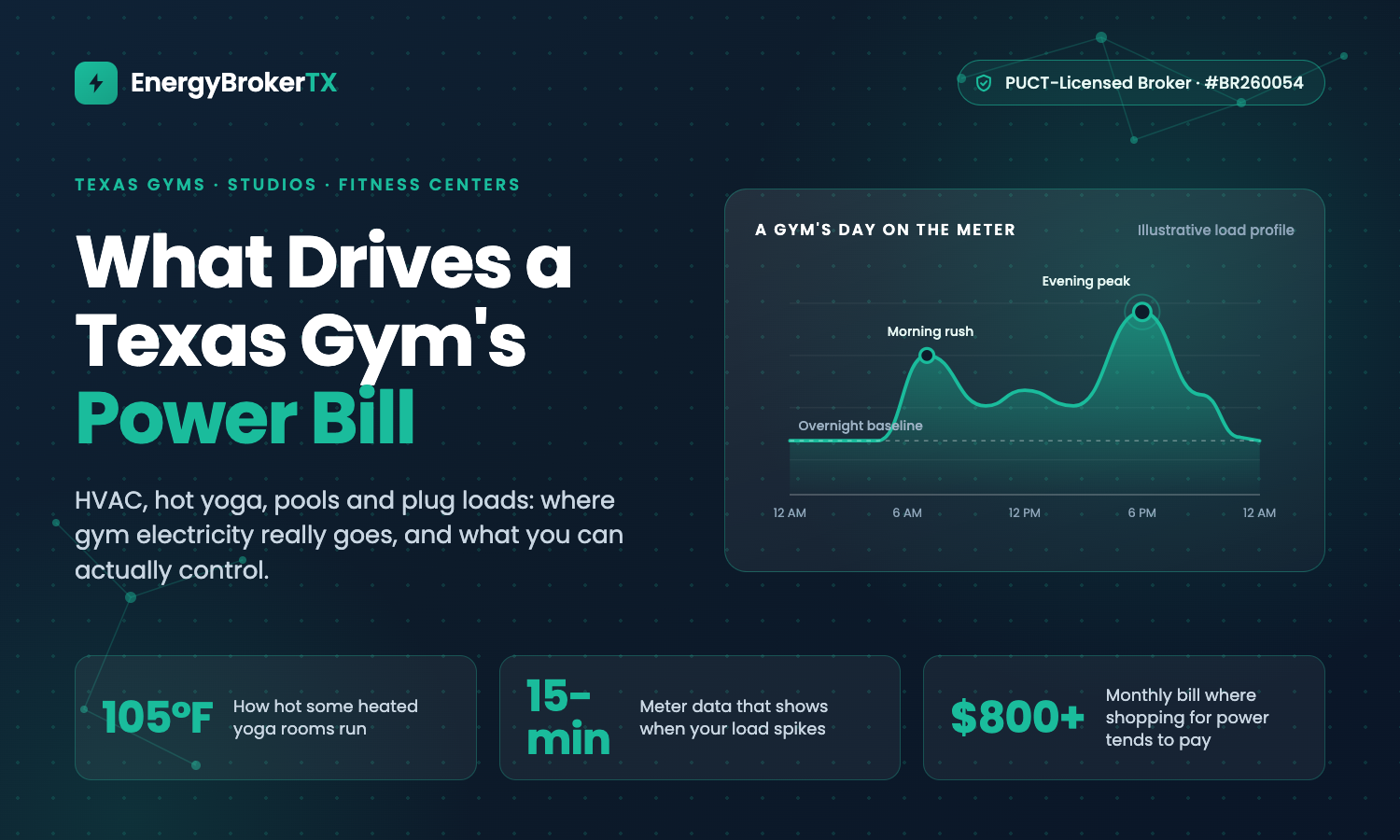
What drives the power bill at Texas gyms, yoga studios and fitness centers, from HVAC and hot yoga to pools, and when shopping your rate pays off.

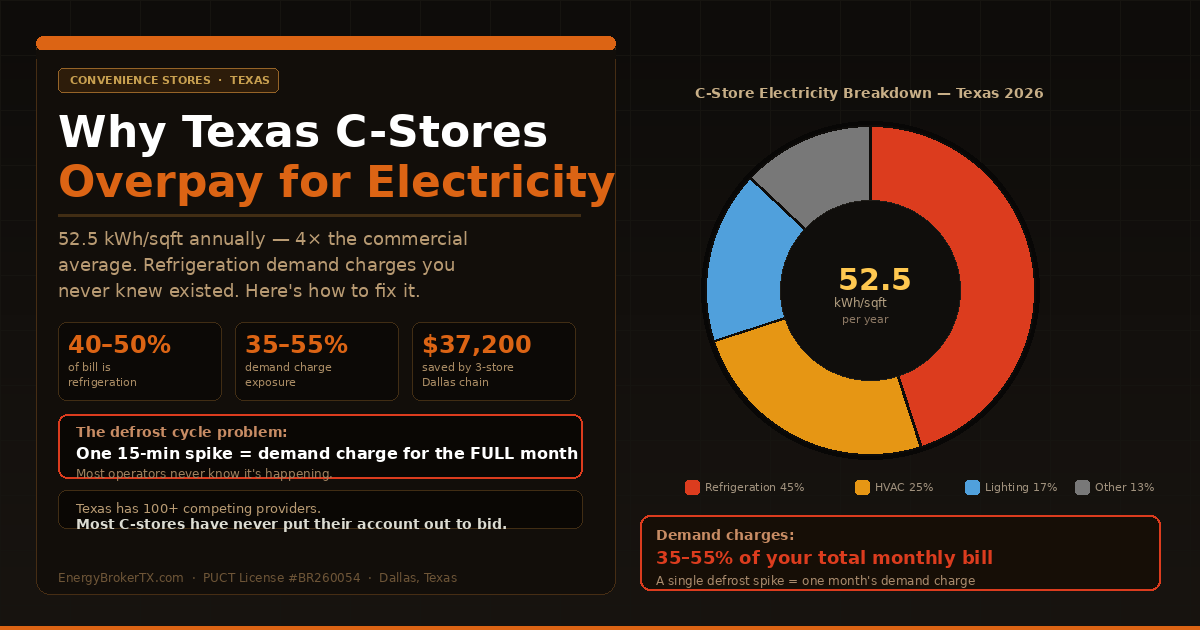
Convenience stores are among the most electricity-intensive commercial buildings in Texas. The U.S. Energy Information Administration's Commercial Buildings Energy Consumption Survey puts convenience store electricity intensity at 52.5 kWh per square foot annually — more than four times the commercial building average of 14.3 kWh per square foot. A 3,000-square-foot C-store consumes as much electricity as a 10,000-square-foot office building.
That intensity creates a cost structure that is fundamentally different from almost every other commercial customer in the Texas deregulated electricity market. Understanding why your bill is so high — and what the specific drivers are — is the prerequisite to doing anything meaningful about it.
This guide is written specifically for Texas C-store operators, fuel retailers, and multi-location convenience chains. It covers the mechanics of your electricity bill, why demand charges hit C-stores harder than most businesses, and the exact steps that are producing 15–30% savings for Texas convenience store operators right now.
A typical Texas convenience store's electricity consumption breaks down roughly as follows, based on industry data from the National Association of Convenience Stores and the EPA ENERGY STAR program:
The critical insight from this breakdown is not just the total consumption — it's the shape of it. C-store loads are dominated by equipment that cannot be curtailed, shifted, or turned off. That creates the demand charge problem.
Most commercial electricity customers think of their bill primarily in terms of kilowatt-hours consumed. For C-stores, that's the wrong frame. Demand charges — fees based on your peak power draw in kilowatts during any 15-minute interval in the billing period — frequently represent 35–55% of a convenience store's total electricity bill.
Here's why C-stores are particularly exposed:
Refrigeration creates a high, inflexible base demand. Your cooler banks, walk-in compressors, and refrigerated cases collectively draw significant baseline power continuously. When you add HVAC, lighting, and food service equipment, you have a large minimum demand level that exists 24 hours a day regardless of customer traffic. Your utility's demand charge is calculated on your peak 15-minute interval — but your base load is already high before any peak events occur.
Defrost cycles create invisible demand spikes. Commercial refrigeration systems run automatic defrost cycles, typically 2–4 times per day, during which heating elements inside the cases activate to clear frost buildup. These cycles draw significant power simultaneously across multiple cases. If your defrost cycles aren't staggered, you can create a substantial demand spike that persists on your bill for the entire month — from one 15-minute window early in the morning that most operators never think about.
Morning opening and shift-change peaks. When a C-store opens — or when a car wash attached to the store fires up its pump motors alongside the store's morning HVAC startup — instantaneous demand can spike sharply. That single morning startup event, if it represents your highest 15-minute draw of the month, determines your demand charge for the entire billing period.
For a concrete illustration: a C-store with a baseline demand of 45 kW sees a defrost cycle spike to 62 kW for one 15-minute window on a Tuesday morning. That 62 kW peak — not the 45 kW average — is what gets billed at your demand rate for the full month. At a typical demand charge of $12–$18/kW in Texas, that's $744–$1,116 in demand charges for that month from one 15-minute event.
Understanding demand charges in detail — how they're calculated, what drives them, and how contract structure affects them — is covered in our full guide on demand charges on Texas commercial electricity bills.
The majority of Texas convenience stores are on electricity contracts that were set up at the store's opening, renewed once or twice since then without competitive bidding, and have quietly accumulated above-market rates through successive passive renewals.
Here's what a passive renewal looks like in practice. Your two-year fixed-rate contract expires. Your current provider sends a contract expiration notice 30–45 days before the end date, as required by PUCT substantive rule §25.475. If you take no action, your account reverts to the provider's holdover rate — a month-to-month variable rate that is almost always 20–40% above what a competitive fixed contract would cost. Many operators sign the renewal offer their current provider sends without shopping alternatives, because it's easier than running a procurement process.
The result is consistent: C-store operators who haven't competitively bid their electricity in the past 24 months are almost universally paying above-market rates. In Texas's deregulated market, where over 100 licensed retail electricity providers compete for commercial accounts, the spread between a passive renewal and a competitively bid rate has historically been 15–25% and is currently wider given ERCOT market dynamics.
A three-location Dallas-area convenience store group we worked with recently was spending $11,200 per month across all locations. After running a portfolio reverse auction — submitting all three accounts to 25+ providers simultaneously — they locked in a structured rate that reduced their combined monthly spend to $8,100. That's $37,200 per year in savings that went straight back into the business, not because they changed operations or upgraded equipment, but because they ran a competitive procurement process for the first time in four years.
If you operate more than one Texas location, you have a procurement advantage that single-location stores cannot access — and most multi-location operators don't use it.
Portfolio aggregation means combining the total electricity load from all your locations into a single competitive auction. Instead of submitting one 3,000-square-foot store consuming 15,000 kWh per month to bid, you submit a five-store chain consuming 75,000 kWh per month. That volume difference changes the economics meaningfully.
Retail electricity providers price accounts based on the volume and predictability of consumption. A larger account represents more revenue certainty and lower per-account acquisition cost for the provider. The result: providers bid more aggressively on aggregated portfolio accounts than they do on individual store accounts. Multi-location C-store chains consistently see lower per-kWh rates through portfolio procurement than the same stores would achieve through individual separate auctions.
Portfolio aggregation also solves a contract management problem that plagues multi-location operators. With five stores under separate contracts, you have five different expiration dates to track annually. Miss one renewal window and that location lapses into a holdover rate while the others are under competitive contracts. Aligning all locations under a single portfolio contract with one expiration date simplifies management and eliminates the risk of missing an individual location's renewal.
Our Texas retail and convenience store energy brokerage page covers the portfolio procurement process in more detail, including how we handle staggered existing contract terms when building a consolidated portfolio.
This is the single highest-impact operational change most C-store operators can make without spending a dollar on equipment. If your refrigeration cases are all set to defrost at the same time — a common factory default setting — you are creating an avoidable demand spike every day.
Work with your refrigeration technician or energy management system to offset defrost start times across different case groups by 15–30 minutes. Instead of all defrost cycles firing simultaneously and creating a 20 kW spike above your baseline, the load spreads across a 90-minute window at a much lower incremental draw. This single change has reduced demand charges by 15–25% for C-stores we've worked with, without affecting refrigeration performance or food safety.
Most C-store operators focus on the per-kWh supply rate when shopping electricity. For refrigeration-heavy operations, the demand charge structure embedded in your contract is equally important. Some Texas retail electricity providers offer contracts with demand charge riders — separate demand components that can be structured to reduce the penalty for high peak draws relative to your total consumption.
A contract with a slightly higher per-kWh energy rate but a more favorable demand charge structure can produce a lower total bill for a C-store with high refrigeration loads than a contract with a low headline rate and standard demand charge terms. A broker who understands C-store load profiles can model this comparison for your specific usage data before you sign anything.
Load factor measures how efficiently you use your peak demand capacity — it's your total kWh consumed divided by your peak kW demand multiplied by the hours in the period, expressed as a percentage. A higher load factor means your peak demand is being used more consistently, which is favorable for procurement.
C-stores typically have load factors in the 55–70% range due to their steady refrigeration base load combined with cyclical HVAC and lighting loads. Knowing your load factor matters because some Texas REPs offer incentives for high-load-factor accounts — recognizing that steady, predictable loads are easier and less expensive to serve than volatile, peaky ones. Presenting your interval data (your 15-minute consumption readings from Oncor or CenterPoint) alongside your monthly totals in a procurement auction gives bidding providers the information they need to price your account favorably.
As with restaurants and other high-summer-usage businesses, the spring procurement window produces materially better forward rates for C-stores than summer or fall procurement. Texas ERCOT forward pricing reflects expected market conditions over the contract term — in spring, before summer demand risk is fully priced in, providers offer lower rates than they will once peak summer conditions are apparent.
A C-store chain with contracts expiring in June or July should begin procurement in April at the latest. Waiting until contracts expire means either accepting a holdover rate through the summer — the worst possible months to be on a variable rate — or locking in a new fixed contract at summer peak pricing. Either outcome costs significantly more than a spring forward-start contract executed now.
For the full seasonal timing analysis, see our guide on the best time to lock in Texas commercial electricity rates — the same seasonal dynamics apply to C-stores.
Monthly electricity bills show your total consumption and peak demand for the month. They don't show you which 15-minute window created your peak, what your load looked like at 3 AM on a Tuesday versus 6 PM on a Friday, or how your demand compares to your consumption pattern throughout the day.
Your TDU — Oncor if you're in Dallas, Frisco, Fort Worth, or most of North Texas, CenterPoint if you're in Houston — collects 15-minute interval data for every commercial meter. This data is available to you on request and is typically provided free of charge.
Interval data is one of the most valuable tools for reducing your electricity costs. It shows you exactly when your demand peaks occur, whether those peaks are caused by defrost cycles, opening procedures, or other identifiable events, and whether the peaks are consistent or variable across months. A broker can use this data to present a more accurate load profile to bidding providers, which typically produces better auction results than monthly total data alone.
Based on current ERCOT forward market conditions and auctions we're running across Dallas–Fort Worth, Houston, San Antonio, and other Texas markets, here are realistic supply rate ranges for C-store accounts as of April 2026:
If your current all-in rate is above 14¢/kWh and your contract is more than 12 months old, you are almost certainly overpaying relative to what a competitive auction would produce today. If you're on a holdover rate, the gap is larger.
Supply rates are energy-only. Your total delivered cost adds regulated Oncor or CenterPoint TDSP delivery charges, which are fixed and identical regardless of which provider you choose. These currently add approximately 3.5–5.0¢/kWh for most C-store meter classifications in Texas.
No. Provider switching in Texas's deregulated market changes only who bills you for electricity — the physical delivery of power through the grid is handled by your TDU (Oncor, CenterPoint, or AEP Texas) and is completely unaffected by which retail provider you choose. Refrigeration, HVAC, lighting, and POS systems experience zero disruption during or after a provider switch. The transition happens at a meter-read boundary, typically overnight, with no interruption to any store system.
Rate matching by your current provider is possible and sometimes worth considering, but it requires caution. A provider who offers to match a competitor's rate after you've run a competitive auction is telling you they were overcharging you before. The more important questions are: Does the matched rate also match the contract term, demand charge structure, and auto-renewal terms of the competing offer? Or are they matching the headline rate while preserving unfavorable contract terms? Always compare the full contract, not just the per-kWh rate.
Yes. A car wash adds significant motor load — high-pressure pumps and vacuum systems draw substantial instantaneous power during operation. This creates sharper demand spikes than a standalone C-store. If your car wash is on the same meter as the store, your demand charge exposure is higher because car wash startups can push your peak demand well above your refrigeration baseline. We account for this in the procurement process by pulling interval data to identify car wash-driven demand peaks and selecting contract structures that minimize the penalty for those spikes.
Multi-location chains that span different TDU territories — some stores in Oncor territory in DFW, others in CenterPoint territory in Houston — can still be aggregated into a portfolio auction. Many Texas REPs are licensed to serve multiple TDU territories, and we submit the full portfolio load to all qualifying providers. Stores in different territories will have different delivery charges (these are regulated and territory-specific) but can share the same supply contract with one renewal date.
There's no formal minimum, but the economics generally become most compelling for accounts spending $1,000 or more per month on electricity. Below that threshold, the absolute dollar savings from a rate improvement are smaller, though still real. For multi-location operators, the portfolio total is what matters — three small stores each spending $800/month represent a $2,400/month combined account that is well worth a competitive auction.
The combination of high refrigeration loads, demand charge exposure, 24/7 operations, and passive renewal habits makes Texas convenience stores one of the most reliably overpaying categories we encounter. The fix is straightforward: submit your bills, let 25+ licensed Texas providers compete for your account in a transparent reverse auction, and review every offer side by side before signing anything.
At EnergyBrokerTX (PUCT License #BR260054), our service is 100% free to C-store operators. We're compensated by the winning provider, not by you. The auction takes 24 hours. The contract takes minutes to execute electronically.
Contact us today for a free convenience store electricity audit. Send your most recent bill and we'll pull your full account history, identify your demand charge exposure, run a competitive portfolio or single-location auction, and present every bid transparently — at no cost to you. Serving Dallas, Fort Worth, Houston, San Antonio, Austin, and all of Texas.
Submit your account and we'll run a competitive auction with 25+ licensed Texas providers — full bid transparency, no pre-filtering, no obligation.
Get My Free Competing Bids →