
Manage Demand Charges: Save 15–30% on Texas EV Charging Station Electricity 15–30%
We Partner with Leading Texas Electric Providers to Secure You the Best Energy Rates








The Hidden Cost of Running EV Charging Stations in Texas
Peak afternoon and early evening hours carry significantly higher rates. Without smart load management, commercial EV charging stations often pay premium prices during the exact times customers want to charge.
EV charging creates sharp, unpredictable peaks when multiple vehicles charge at once. These demand charges can represent 40–60% of your monthly bill, punishing busy afternoon or evening sessions even if total usage is moderate.
24/7 availability, lighting, HVAC for comfort, and supporting infrastructure add up fast. Many operators unknowingly overpay 20–40% due to outdated contracts or lack of competitive bidding.
Every extra dollar spent on electricity directly cuts into your charging revenue and slows ROI. In ERCOT’s volatile market, unpredictable bills make it harder to scale your EV charging business profitably.
Get Better Rates in Under 24 Hours
Send us a single electric bill or just your ZIP + average kWh. Takes 60 seconds.
25+ suppliers bid live in our transparent reverse auction. You see every offer.
Pick the best rate. We handle all paperwork. Zero cost to you.
Why Texas EV Charging Operators Choose Us in 2026
Real Texas EV charging operators are locking in rates 20–40% below retail, improving margins and accelerating ROI.
vs. national average of 14.1¢/kWh (35% lower thanks to ERCOT competition) — even better when demand charges are optimized.
Most operators receive competing offers and switch within one business day, minimizing disruption.
Real Texas EV Charging Operators Saving Real Money
In-Depth Case Studies
Through a competitive energy auction, 8 providers vied for the property’s business, ultimately securing a new fixed rate of 9.7 cents/kWh — a drop from 14.8 cents/kWh — resulting in a 34% reduction in electricity costs. For their annual usage supporting 5 Level 2 chargers, this delivers roughly $6,300 in yearly savings, while the 36-month rate lock ensures budget stability and protection against future market spikes.
When a retail center expanded its EV charging offerings, they needed to optimize for high afternoon peaks. We handled the paperwork and secured a custom rate structure with reduced demand ratchets, delivering $12,250 in annual savings while maintaining excellent uptime for customers.
Frequently Asked Questions
Share your recent electric bills (ideally 12 months). We identify your demand peaks, off-peak usage ratios, and current rate structure, then run a reverse auction targeting providers with EV-favorable terms. You review quotes within 48 hours. Switching is seamless—no charger downtime, no service interruption. Most EV operators have a new rate locked in within one week. No fees—providers pay our commission.
Most EV operators we’ve helped reduce their blended electricity cost by 10–25%. For a medium-sized public charging station billing $8,000–$15,000/month in electricity, that’s $800–$3,750 in monthly savings. A 36-month fixed contract could lock in $28,000–$135,000 in cumulative savings—with no capital investment required. Want a free analysis based on your actual bills?
Yes. Beyond rate negotiation, we help EV charging operators understand demand response programs, off-peak incentives, and how smart charging scheduling can reduce peak demand readings. Some ERCOT programs actually pay EV operators to curtail charging during grid stress events—turning your station into a revenue opportunity. We connect you with the right providers and programs based on your station size and usage patterns.
Absolutely. Fixed-rate contracts (12–60 months) give EV charging operators predictable electricity costs—critical for modeling ROI on charger installations and station build-outs. In ERCOT, wholesale prices can swing dramatically in summer. A locked-in rate protects your margins. Our reverse auction compares fixed-rate bids from 25+ providers matched to your load profile. Most EV operators prefer 24–36 month terms for business planning certainty.
Demand charges are often the biggest cost driver for EV charging operators. A single large vehicle charging event can spike your 15-minute peak demand reading and trigger a high per-kW charge for the entire month. We help EV operators choose rate structures that minimize demand charge exposure and negotiate with providers offering favorable terms for charging-forward businesses. Understanding your demand profile is step one—let us analyze your bill at no cost.
Insights for Texas EV Charging Operators
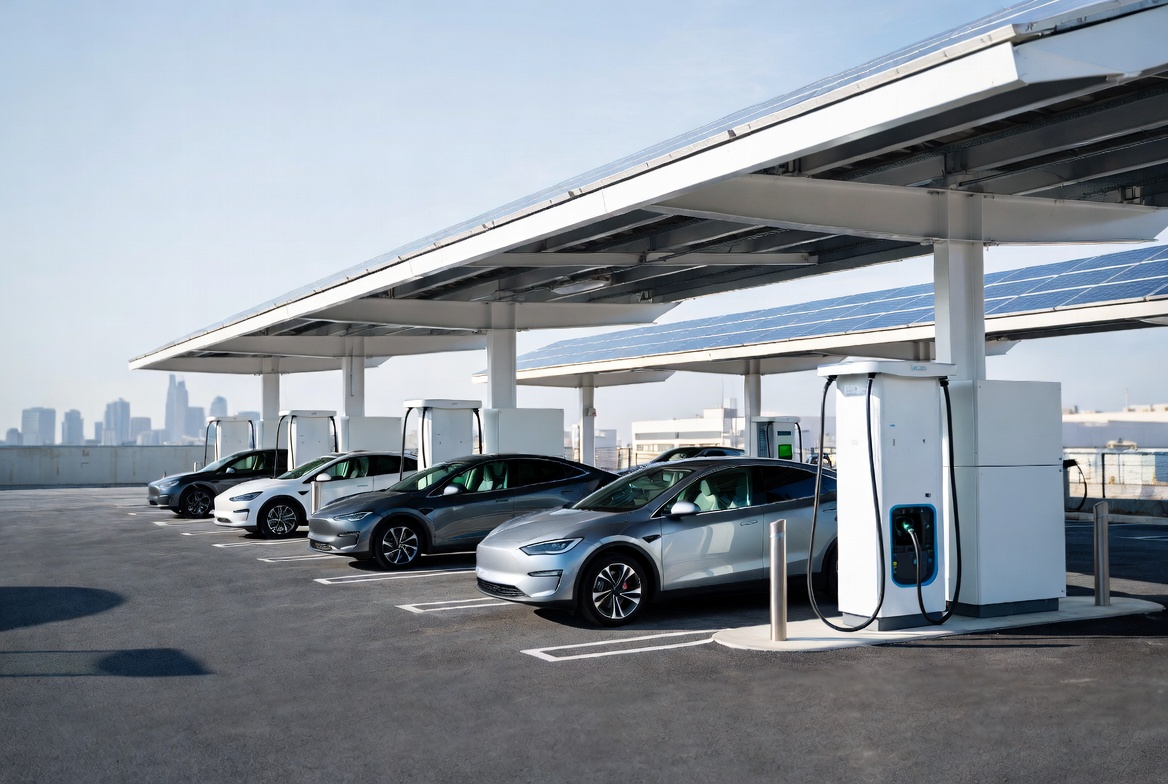 Electrical Vehicle & Charging
Ready to Power Your EV Charging Business More Profitably?