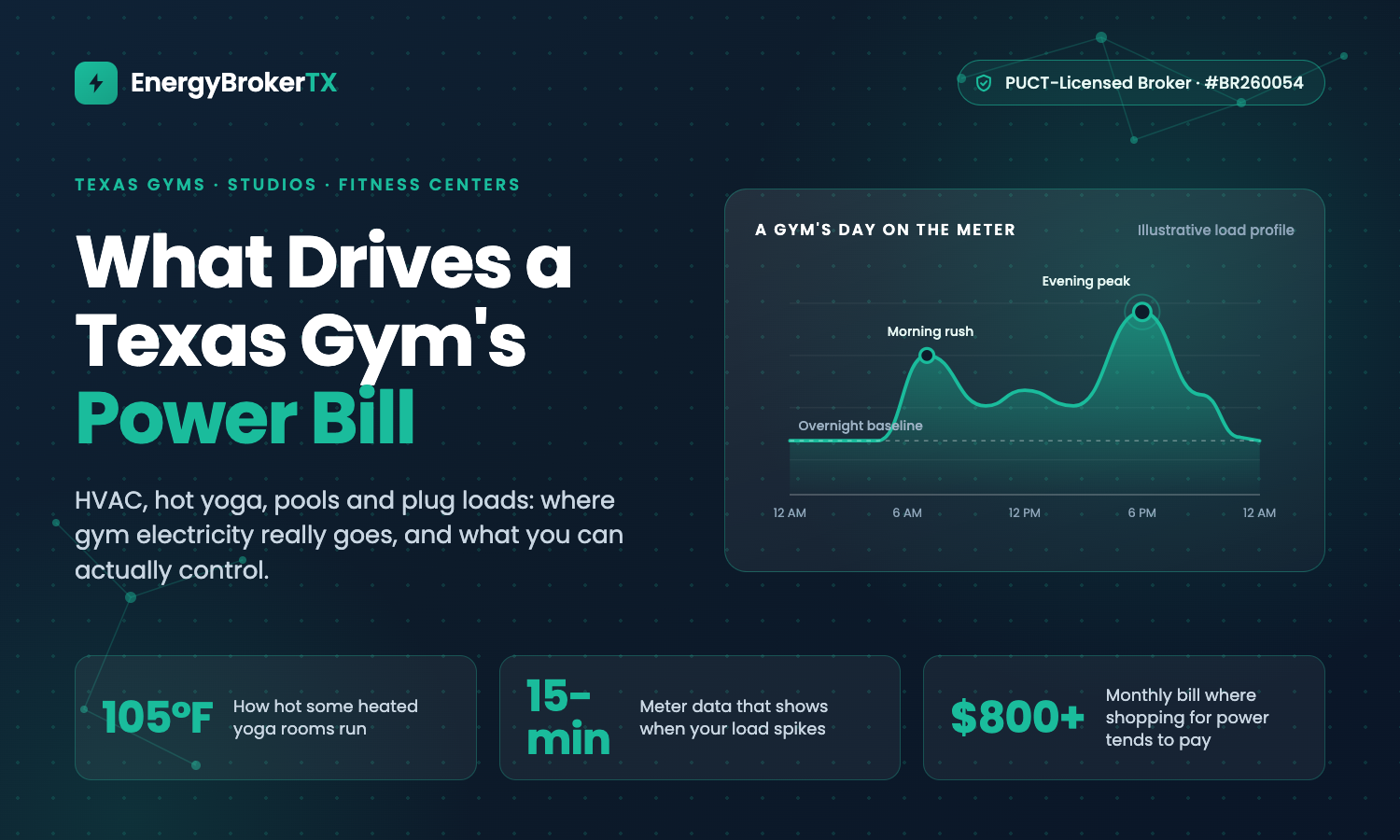
Texas Gyms, Yoga Studios and Fitness Centers: What Drives the Power Bill
What drives the power bill at Texas gyms, yoga studios and fitness centers, from HVAC and hot yoga to pools, and when shopping your rate pays off.


Every month, Texas churches pay a 6.25% state sales tax on their electricity bills — plus local taxes that push the combined rate to 8.25% or higher in cities like Houston, Dallas, and Corpus Christi. For most congregations, that's a permanent surcharge quietly compounding on top of an already significant utility expense. What many pastors and church administrators don't realize is that this tax is not mandatory for qualified religious organizations.
The Texas Comptroller of Public Accounts allows churches to apply for a sales tax exemption on their electricity purchases, and for most congregations, the application process is straightforward. This isn't a one-time rebate or a limited program — once approved, the exemption eliminates the sales tax line on your electricity bill permanently, as long as your organization continues to qualify. It is one of the most effective and consistently overlooked cost-reduction tools available to Texas faith communities.
Of the Texas churches we work with at EnergyBrokerTX, the majority have never claimed this exemption when we first begin reviewing their accounts. Many administrators didn't know it existed. Others started the process and stalled on paperwork. A few submitted the form to the wrong entity and never followed up. The result in every case is the same: years of avoidable tax payments on a bill that should have been reduced years ago.
This guide covers exactly what the exemption covers, who qualifies, how to file, and what the savings look like in real dollars for a typical Texas congregation.
Texas sales tax law imposes a 6.25% tax on electricity sold for non-residential use. For commercial accounts — which is how most churches are classified by their retail electricity provider — that tax applies automatically unless the buyer has an approved exemption certificate on file.
Under Texas Tax Code §151.310, qualifying religious organizations are exempt from paying sales tax on electricity consumed at their regular place of worship. This means the electricity powering your sanctuary, fellowship hall, administrative offices, and any other space used primarily for religious activities qualifies for exemption. The exemption applies to the electricity account tied to your church facility — not to every organization that happens to have a religious affiliation, and not to electricity used for incidental commercial operations that charge the public for services.
The distinction matters for churches that operate commercial daycare centers, catering facilities, or for-profit businesses on the same property. Those portions of usage may need to be assessed separately. For the typical Texas congregation — worship services, midweek programming, youth ministry, and administrative functions — the full electricity account at the church's primary location qualifies.
The local tax component adds up quickly. The state base rate is 6.25%, and local jurisdictions can add up to 2% more. A church in an incorporated Texas city with a full 8.25% combined rate is paying noticeably more than one in an unincorporated rural area. Both qualify for exemption on the state portion, and most qualify for the local portion as well. Your exemption certificate, properly filed, eliminates both layers for qualifying purchases.
The Texas Comptroller applies a practical, straightforward test for religious organization exemptions. To qualify, your church must meet all of the following conditions:
Your organization must be organized and operated primarily for religious purposes. This covers churches, parishes, synagogues, mosques, temples, and other houses of worship across all denominations and faith traditions. The governing word is "primarily" — your main organizational function must be religious ministry, not commercial activity.
Your organization must hold regular worship services at a fixed location. The Comptroller uses this as a baseline test. A congregation that meets consistently at a physical facility — whether the building is owned, leased, or rented — satisfies this condition. The key is regularity and a fixed address. Portable or traveling ministries without a primary fixed location may face additional scrutiny during the application process.
Your organization must be a nonprofit. For most churches, this is automatic under IRS rules — either as a recognized 501(c)(3) or as an automatically recognized religious organization that is not required to file for federal tax-exempt status. You do not need a federal determination letter to qualify for the Texas exemption, but having one on file simplifies the process if the Comptroller requests supporting documentation.
You do not need formal articles of incorporation, though having them makes documentation easier. The Comptroller evaluates applications based on the nature and primary purpose of the organization, not on the formality of its legal structure. A small congregation of 75 members meeting in a rented storefront qualifies on the same basis as a 3,000-member megachurch with a dedicated campus.
Multi-campus churches can apply the exemption to each electricity account, but each location needs its own certificate on file with the relevant retail electricity provider. In practice, this means presenting the exemption documentation for every meter or account number tied to a qualifying facility. If your church runs three campuses served by a single electricity provider, your account representative can apply the exemption to all three accounts once you submit the certificate — but you need to ask explicitly and confirm on the next billing cycle.
For churches managing multiple campuses under separate electricity contracts or providers, this is also a timely reason to evaluate whether consolidating procurement makes sense. Running a reverse auction that aggregates your campus loads often produces a lower rate than negotiating each location independently, and it simplifies the exemption paperwork to a single provider relationship. If your church has grown through satellite campuses over the past few years and hasn't revisited its energy procurement structure, you may be overpaying on multiple fronts simultaneously.
The process is simpler than most church administrators expect. It involves one form, one signature, and one submission to your electricity provider. Here is exactly how it works.
Step 1: Download Texas Comptroller Form 01-339. This is the Texas Sales and Use Tax Exemption Certificate. It is available directly from the Texas Comptroller's website at comptroller.texas.gov. The form covers multiple exemption types on a single page — you will be completing the section for religious organizations as a buyer claiming exemption on a purchase.
Step 2: Complete the form with your church's information. You will need your church's legal name as it appears on any state or federal filings, the address of the church facility covered by the exemption, and the basis for exemption (religious organization). If your church has an EIN, include it. You are completing this form as a buyer — you do not need a Texas sales tax permit number, which is issued to sellers, not buyers claiming exemption.
Step 3: Have an authorized representative sign the form. The certificate must be signed by a person with authority to act on behalf of the organization. This is typically the senior pastor, executive pastor, church business administrator, or treasurer. The signature does not need to be notarized.
Step 4: Submit the completed form to your retail electricity provider. This is where many churches stall. The certificate goes to your REP — the company you pay for electricity — not to the utility company (Oncor, CenterPoint, AEP Texas, etc.) that delivers power to your meter. The utility and the REP are separate entities in Texas's deregulated market. Call your REP's commercial accounts department, explain that you are a religious organization submitting a sales tax exemption certificate, and ask for their specific intake process. Some accept email; others require a fax or portal submission. If you work with an energy broker, this step can be handled as part of your contract setup.
Step 5: Verify the exemption appears on your next bill. After submission, check the following month's bill. The sales tax line should be zero or show a significantly reduced amount reflecting only any non-exempt charges. If you still see the full tax amount, follow up immediately — some REPs require an internal account update that takes one full billing cycle, while others have processing backlogs. Do not assume the exemption was applied without confirming it.
Step 6: Keep a copy of the certificate and track your exemption status when switching providers. The exemption does not expire as long as your church continues to qualify. However, it is tied to a specific provider relationship. If you switch electricity providers — whether at contract renewal or through a broker-run bid process — you will need to submit a new certificate to the incoming REP. This is a routine step, but it requires a proactive reminder in your contract transition checklist so the exemption doesn't inadvertently lapse for a billing cycle or two during a switch.
The dollar impact depends on your total electricity spend and your local combined tax rate. For most Texas churches, the numbers are meaningful enough to make claiming the exemption an immediate priority.
Consider a 500-seat church running three Sunday services per week, with a fellowship hall used for events most weekends and a midweek Bible study. A facility of that size and usage profile in Texas typically consumes between 80,000 and 140,000 kilowatt-hours annually. At current commercial electricity rates of approximately 8–9 cents per kWh, total annual electricity spend before taxes and delivery charges falls roughly between $6,400 and $12,600. In a Texas city with the full 8.25% combined sales tax rate, this church is paying between $528 and $1,040 per year in sales taxes on electricity — all of it avoidable with a filed exemption certificate.
Over a three-year contract term, that's $1,584 to $3,120 in sales tax payments that could have funded youth camp scholarships, food pantry supplies, or deferred maintenance on the building. Over five years, the range extends to $2,640–$5,200.
For larger congregations — those with sanctuary seating for 1,500 or more, broadcast production facilities, full commercial kitchens, school buildings, or gymnasium spaces — annual electricity spend routinely runs $30,000–$100,000 or higher. A church spending $70,000 annually on electricity in a city with 8.25% combined sales tax has been paying roughly $5,775 per year in avoidable taxes. Over a five-year period, that approaches $29,000. That's not an abstraction — that's real dollars that should have stayed in the ministry budget.
To calculate your church's specific exposure, pull the last 12 months of electricity bills and locate the sales tax line on each statement. Add them up. That total is what you have been paying annually in avoidable taxes — and it is the baseline savings that claiming the exemption will deliver starting immediately upon approval.
Eliminating the sales tax on your electricity is a meaningful and permanent win. But it is applied to whatever rate your church is currently paying — and if that underlying rate is higher than what the competitive market can deliver, you are still overpaying on the largest portion of your bill.
The math makes this clear. If your church is on an electricity contract at 10.5 cents per kWh when the current market can deliver 7.5 cents, the 3-cent rate gap costs more each month than the full sales tax does. On 120,000 kWh of annual usage, that rate difference represents $3,600 per year — separate from any tax savings. The two levers work independently, and the combination is where significant total savings are found.
When EnergyBrokerTX begins working with a Texas church, the standard process includes reviewing the current exemption status alongside the existing contract rate. If no exemption certificate is on file, we help the church obtain and submit Form 01-339 before or concurrent with the contract transition. That way, the new competitive rate — secured through a reverse auction with 25 or more licensed providers competing for your business — is applied tax-free from the first bill forward.
The most common outcome for a Texas church that has neither filed for the exemption nor shopped its electricity in the past two to three years is a double correction: the rate drops, and the tax disappears. Together, these changes routinely produce reductions in the 20–30% range on total electricity spend, which at meaningful scale redirects thousands of dollars annually back to the congregation's actual mission priorities. Our FAQ covers the most common questions we receive from church administrators about the procurement and exemption process.
The Texas sales tax exemption for churches on electricity is not a loophole, a special program with limited enrollment, or a benefit reserved for large congregations. It is a legal right under Texas tax law for any qualifying religious organization that files the appropriate documentation. Most Texas churches qualify. Most have not filed. The form is one page, the process is routine, and the savings are permanent.
If your church is currently paying sales tax on its electricity bills and has not filed Form 01-339 with your retail electricity provider, every month you wait is a month of avoidable overpayment. The Comptroller does not offer refunds for prior years of sales taxes paid on exempt purchases — the exemption applies going forward from the date of filing, not retroactively. There is no benefit to waiting.
Start with a review of your current bills, confirm whether you have an exemption certificate on file with your provider, and take the steps above if you do not. If you would like help navigating the process — or want to combine the exemption with a full rate review and competitive bid — the next step is a straightforward conversation.
Contact EnergyBrokerTX today to request a free bill review. We will assess your current tax exposure, confirm your exemption status, and show you what competitive procurement through our free reverse auction can deliver for your church's electricity budget. There is no cost to your ministry for either service. We work with Texas churches the same way we work with any commercial account: transparently, with real numbers, and with the goal of freeing up resources for the work your congregation actually came together to do.
Submit your account and we'll run a competitive auction with 25+ licensed Texas providers — full bid transparency, no pre-filtering, no obligation.
Get My Free Competing Bids →