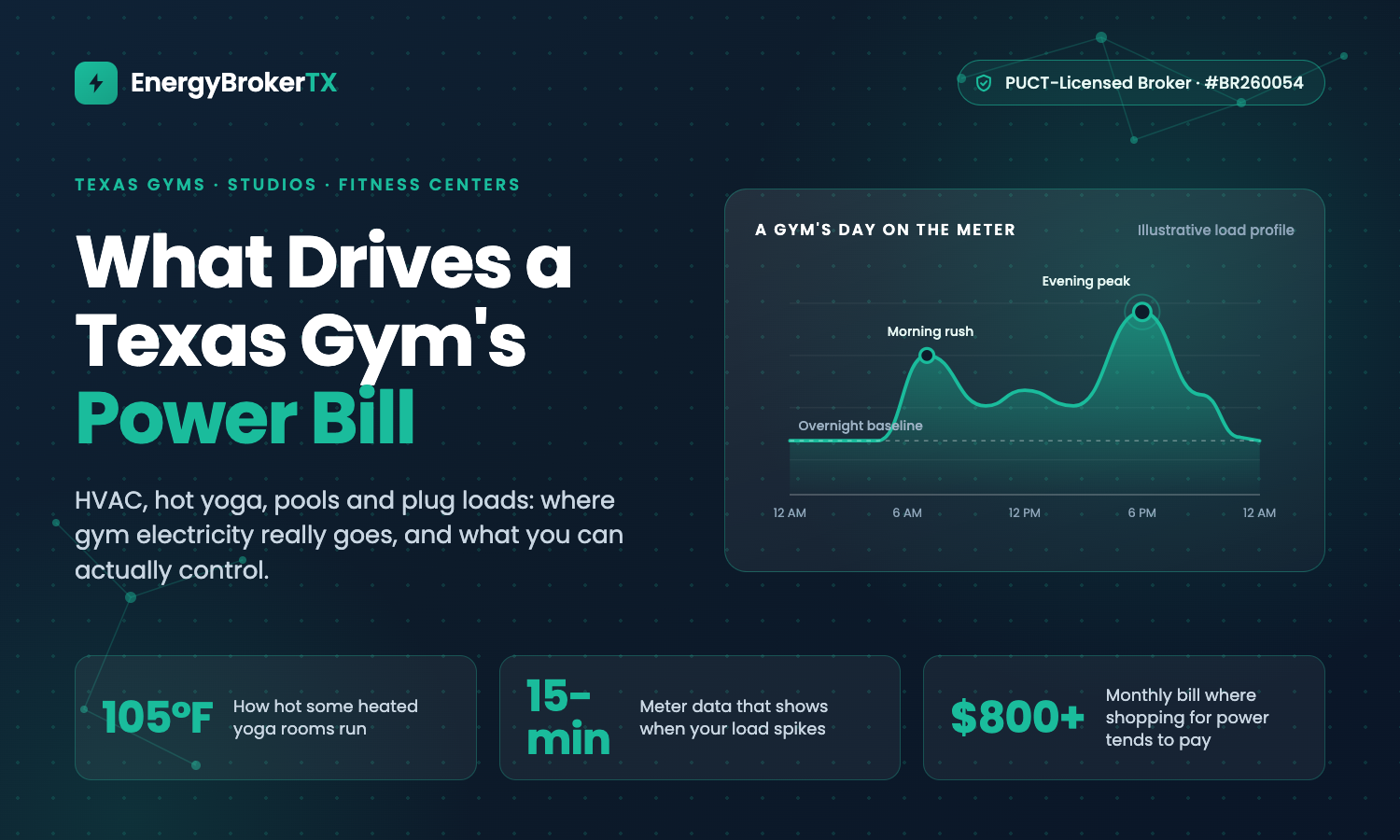
Texas Gyms, Yoga Studios and Fitness Centers: What Drives the Power Bill
What drives the power bill at Texas gyms, yoga studios and fitness centers, from HVAC and hot yoga to pools, and when shopping your rate pays off.

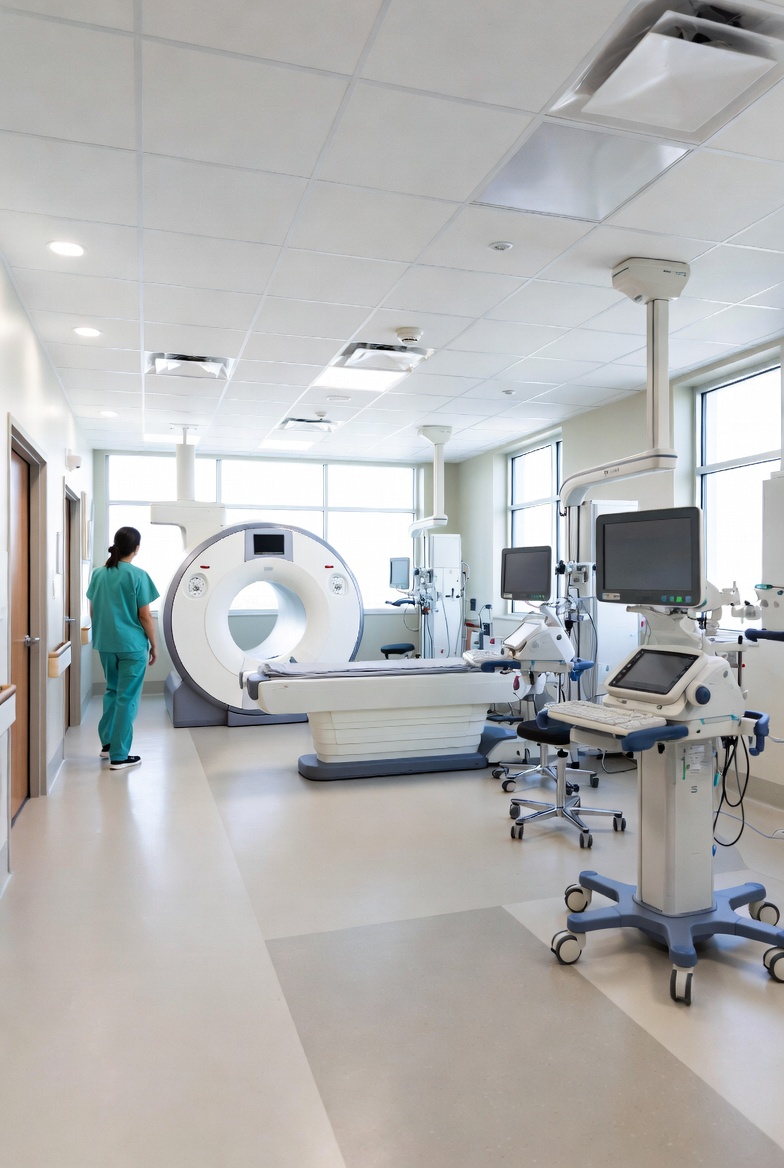
Running a hospital or medical facility in Texas is a 24/7 responsibility. Lights stay on, HVAC systems maintain strict temperature and humidity controls for patient safety and infection prevention, refrigerators and freezers protect vaccines and medications, sterilization equipment runs constantly, and backup generators stand ready for emergencies. All of that adds up to one of the highest electricity consumption profiles in the commercial sector.
The good news is that Texas’s deregulated energy market gives healthcare facilities real leverage to control these costs. In 2026, with ERCOT forecasting continued wholesale price pressure and peak demand challenges, proactive energy management can deliver 15–30% savings without compromising patient care or regulatory compliance.
I’m Michael, owner and CEO of EnergyBrokerTX (PUC License # BR260054). Over the past several years I’ve worked directly with hospital administrators, clinic operators, and healthcare facility managers across Dallas, Houston, Plano, Waco, and smaller communities. The facilities that achieve the biggest reductions aren’t chasing the lowest headline rate — they’re building a complete strategy that combines competitive procurement, grid flexibility, on-site backup power, and efficiency upgrades tailored to 24/7 critical operations.
This guide walks you through the five strategies that are working right now for large healthcare facilities, plus a dedicated section below for smaller practices — dental offices, urgent care clinics, and physician offices — where the equipment, load profile, and procurement math are meaningfully different from a hospital's.
Most healthcare facilities renew with the same provider year after year and end up overpaying by 15–25%. In Texas you’re not locked in — you can force 25+ retail electricity providers to compete for your business in real time through a reverse auction.
How it works: A PUC-licensed broker collects 12–24 months of your usage data, maps your peak loads (sterilization, imaging equipment, HVAC for operating rooms), and opens a blind bidding process. Suppliers submit their best offers without knowing the competition. You get transparent, side-by-side quotes that almost always beat direct negotiations.
We recently helped a mid-sized hospital system in the Houston area drop from 9.4¢/kWh to 7.2¢/kWh on a multi-facility load. That translated to roughly $280,000 in annual savings while maintaining full reliability for critical systems.
Implementation tip: Start 90 days before your current contract expires. Make sure the broker understands healthcare-specific needs: no unplanned interruptions, priority restoration, and compliance with Joint Commission and CMS power requirements. For more on timing renewals properly, see our guide on contract renewal and switching.
ERCOT pays large loads to reduce consumption during peak events, and many medical facilities can participate safely — even with life-safety requirements.
The Large Flexible Load (LFL) program and 4 Coincident Peak (4CP) avoidance allow you to earn credits or avoid high transmission charges by curtailing non-critical load during grid stress events. Importantly, life-safety systems (emergency generators, operating rooms, ICUs) are exempt and remain fully powered.
A McKinsey analysis of flexible loads in ERCOT estimates that participating healthcare facilities can reduce effective power costs by 8–15% on top of base rate savings. One Dallas-area hospital group we assisted earned $140,000 in credits in 2025 by curtailing non-essential lighting and deferring non-urgent HVAC adjustments during notified events — all while maintaining full redundancy for critical areas.
How to implement safely:
This approach turns grid participation into a revenue source without risking patient safety.
Hospitals already require robust backup power for life-safety systems. Adding behind-the-meter generation (on-site natural gas turbines, solar-plus-storage, or combined heat and power) can turn that backup into a cost-saving asset.
Deloitte’s 2026 renewable energy outlook highlights that behind-the-meter solutions are growing rapidly in Texas, particularly for 24/7 critical facilities. When sized correctly, these systems can offset a significant portion of grid usage during peak pricing periods while providing seamless failover.
We helped a Houston-area medical office building install a 1.2 MW natural gas CHP system that provides both primary power and waste heat for domestic hot water. The effective blended rate dropped below 6¢/kWh, and the system qualified for federal investment tax credits and local rebates.
Implementation steps:
This strategy is especially powerful for facilities planning expansions or equipment refreshes in 2026.
Not all kilowatt-hours cost the same in ERCOT. Time-of-use (TOU) plans offer significantly lower rates during off-peak hours — perfect for healthcare facilities that can shift non-critical loads.
Practical shifts:
Bain & Company’s 2026 energy outlook shows that TOU + load shifting can reduce effective costs by 10–18% for 24/7 facilities with flexible non-clinical loads. A Frisco hospital we assisted saved $210,000 annually by shifting central sterile processing to off-peak windows.
Implementation tip: Install sub-metering on major loads (sterile processing, laundry, kitchen) to identify shiftable opportunities. Pair TOU with a hybrid contract for maximum flexibility.
Texas utilities and federal programs offer substantial incentives for healthcare efficiency projects — especially for 24/7 operations.
High-impact upgrades:
Oncor and CenterPoint rebates can cover 20–50% of project costs. Deloitte estimates that healthcare facilities taking advantage of these programs can reduce total electricity spend by 8–12%.
Implementation tip: Start with a free utility rebate application through your TDU. Pair upgrades with a new fixed-rate contract to lock in savings on the reduced load. For more on bill analysis and spotting rebate opportunities, see our commercial bill analysis & savings.
Everything above applies to large 24/7 facilities. Small medical practices — dental offices, urgent care clinics, and physician offices — have a different load profile and a different procurement problem, so they need a separate playbook.
Small practices consume 8,000–30,000 kWh per month, with peak demand concentrated in the hours regulations require you to be fully operational — typically 10 AM to 5 PM, which is exactly when ERCOT wholesale prices are highest. Autoclaves draw 4–6 kW per sterilization cycle, surgical overhead lights run 500–1,000W each, and imaging equipment, patient monitors, and infection-control HVAC all run simultaneously during patient hours. That creates two compounding cost drivers most practice owners never separate: the per-kWh energy rate, and the demand charge triggered by the single highest 15-minute interval each month.
Small practices have also been historically underserved by brokers, since their monthly volumes generate lower absolute commissions than large commercial accounts — meaning many dental and medical offices simply never receive a competitive bid at renewal and sit on auto-renewal pricing indefinitely. Current competitive rates for medical practices in ERCOT-deregulated territories run 7.8–9.2¢/kWh; practices still paying 10.5–12¢/kWh are almost always on that auto-renewal penalty rate.
Demand management without touching patient care. You can't shift when patients arrive, but you can sequence equipment within your operating hours. Staggering autoclave cycles rather than running two simultaneously typically cuts peak draw 10–15%. Pre-cooling treatment areas to 70°F by 1:45 PM, then allowing a 1–2°F setback during the 2–5 PM peak window, reduces HVAC compressor cycling 12–20% without detectable patient discomfort. Timer-scheduling tank water heaters for early morning and evening hours is a zero-cost change worth another 5–10%.
2-Chair Dental Practice, Dallas (Oncor Territory). Starting position: 14,500 kWh/month at 11.2¢/kWh — $19,488/year, three consecutive years of auto-renewal with no interval data on file. After a competitive reverse auction: 8.1¢/kWh on a 24-month fixed contract, saving $3,360/year. Staggered autoclave scheduling and HVAC pre-cooling cut peak demand from 38 kW to 32 kW, saving another $1,680/year in demand charges. A partial LED retrofit (40% covered by Oncor rebate) added $320/year. Total: $5,360/year, a 27.5% reduction, with procurement complete in 3 weeks.
4-Room Urgent Care Clinic, Houston (CenterPoint Territory). Starting position: 28,000 kWh/month at 10.8¢/kWh — $36,288/year. After a competitive bid: 7.9¢/kWh on a 36-month contract, saving $7,840/year. HVAC pre-cooling and staggered sterilization scheduling cut peak demand from 65 kW to 56 kW, saving $4,260/year. Two medical refrigerator replacements plus an LED retrofit and smart thermostat added $1,200/year on a $4,200 capital investment with under 4 months' payback. Total: $13,300/year, a 36.6% reduction.
Most Texas dental practices, urgent care clinics, and physician offices are leaving $8,000–$28,000 a year on the table simply because they've never run a competitive bid. A bill audit takes under 30 minutes to submit and requires only your last 12 months of bills — request a free bill analysis to see where your practice stands.
How much can Texas hospitals realistically save on electricity in 2026? Most facilities we work with achieve 15–30% total savings by combining competitive procurement, curtailment credits, and efficiency upgrades.
Is demand response safe for hospitals? Yes — life-safety systems are exempt. Only non-critical loads (administrative HVAC, lighting) are curtailed, and many facilities earn significant credits without risk.
What’s the biggest mistake healthcare facilities make with energy contracts? Auto-renewing without shopping — many pay 15–25% more than market rates. Always review 60–90 days before expiration.
Are there rebates specifically for medical equipment upgrades? Yes — utilities offer incentives for high-efficiency refrigeration, sterilization, and HVAC upgrades critical to infection control and patient safety.
Can a broker help if we’re locked into a bad contract? Yes — we review existing contracts, identify exit opportunities, and negotiate with current or new providers to minimize penalties.
How do I get started with a broker for a hospital or clinic? Request a free bill analysis and load profile review. We’ll show you exactly where the 15–30% opportunity exists for your facility.
Ready to Reduce Your Healthcare Facility’s Electricity Costs? Texas hospitals and medical facilities don’t have to accept rising power bills as the cost of providing care. With the right combination of competitive procurement, grid flexibility, on-site generation, and efficiency upgrades, many are saving 15–30% while maintaining full reliability for patient safety.
At EnergyBrokerTX, our PUC-licensed team (BR260054) specializes in helping healthcare providers navigate these opportunities. Visit our contact page to request a free bill analysis and preliminary savings projection. We’ll show you exactly where the 15–30% opportunity exists for your facility — no obligation, no cost, and results in 24 hours.
Submit your account and we'll run a competitive auction with 25+ licensed Texas providers — full bid transparency, no pre-filtering, no obligation.
Get My Free Competing Bids →