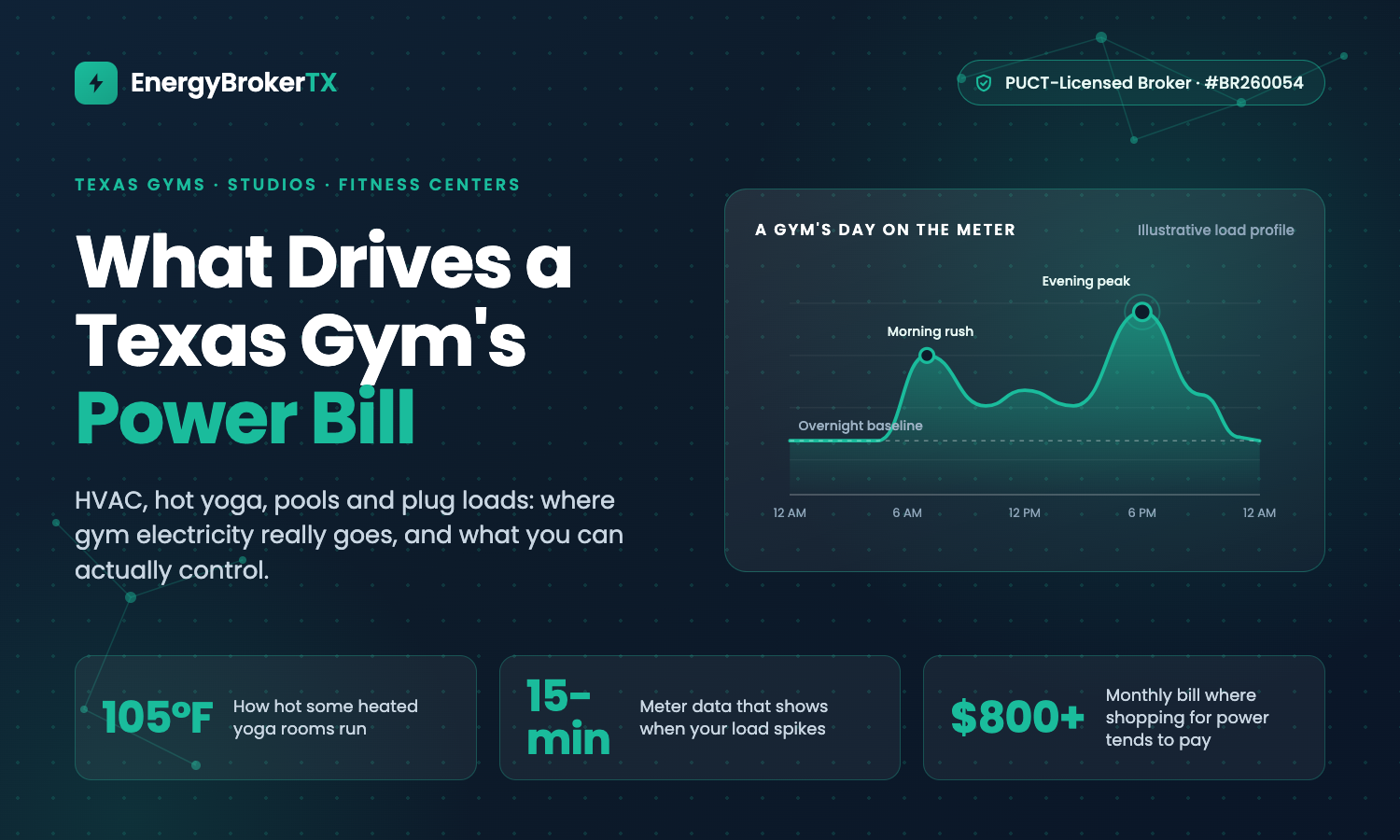
Texas Gyms, Yoga Studios and Fitness Centers: What Drives the Power Bill
What drives the power bill at Texas gyms, yoga studios and fitness centers, from HVAC and hot yoga to pools, and when shopping your rate pays off.

Running a franchise or multi-location business in Texas means managing electricity costs across accounts that are almost certainly under different contracts, with different suppliers, at different rates, expiring on different dates. This fragmentation is the default state for most multi-site operators — and it’s one of the most reliably correctable sources of overpayment in commercial operations.
The core opportunity is simple: aggregated load negotiates better rates than fragmented load. A franchise with 8 locations paying for electricity independently has less pricing leverage than the same 8 locations consolidated under a single competitive procurement process. But capturing that leverage requires deliberate coordination that most franchise operators don’t have time to manage on their own.
Electricity contract fragmentation across a franchise or multi-site portfolio happens for predictable reasons:
Locations were opened at different times, each signed with whatever supplier was convenient at that moment. Nobody coordinated expiration dates or procurement timing.
Franchisees or location managers made local decisions without visibility into what other locations were paying, creating inconsistent rates for essentially the same load profile.
Auto-renewal clauses kept contracts rolling with existing suppliers rather than triggering a competitive review. Each renewal locked in another term at whatever rate the supplier offered, without benchmarking against the market.
No one owns the problem centrally. For franchise groups, electricity management falls between regional managers, the home office, and individual operators — and it falls through the cracks.
When you submit the combined electricity load of multiple locations to suppliers simultaneously, the dynamics of the procurement change. Instead of each location being evaluated as a standalone small or mid-size commercial account, the aggregate becomes a large commercial account — which suppliers price and compete for differently.
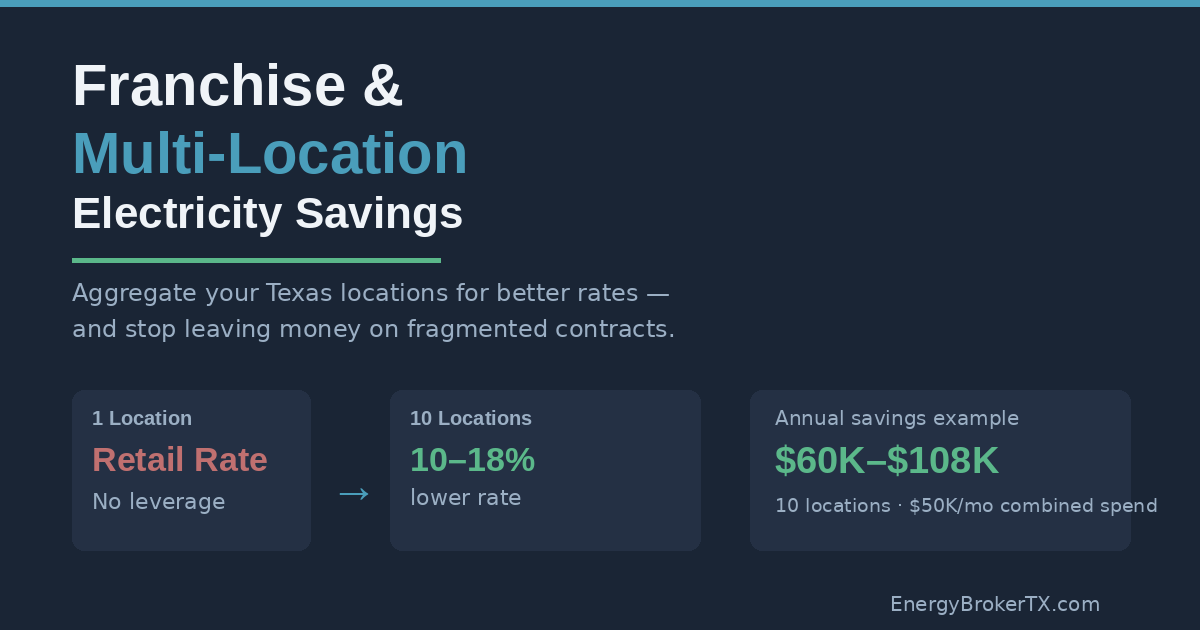
The practical effect: a franchise group with 10 locations using an average of 25,000 kWh/month each (250,000 kWh/month total) typically accesses rates 10–18% below what each location would get individually. On $50,000/month in combined electricity spend across all locations, that’s $5,000–$9,000/month in savings — or $60,000–$108,000 over a 12-month contract period.
Texas has multiple TDSP territories. The main ones affecting franchise operators with multiple Texas locations:
TDSP charges differ by territory and are non-negotiable. When aggregating a multi-territory franchise portfolio, suppliers typically quote each territory’s locations separately but compete for the total portfolio. The pricing leverage still comes from the aggregate volume, even across territories.
Before pursuing aggregated electricity procurement for a franchise, check your franchise agreement. Some franchise systems have preferred supplier arrangements, group purchasing programs, or no restrictions at all. If your agreement designates a preferred or required electricity supplier, your ability to independently procure may be limited. Franchisees in this situation should understand exactly what the agreement requires before proceeding.
For franchise operators with locations that run HVAC, commercial cooking equipment, refrigeration, or other high-draw loads, demand charges on Texas commercial electricity bills may represent 25–50% of total monthly electricity spend. Understanding how demand charges affect each location’s cost structure is important for evaluating rate quotes accurately.
One of the most valuable things a broker can do for a multi-location franchise operator is build a contract synchronization strategy — a plan for moving all locations onto aligned contract expiration dates over time. The goal is a procurement calendar where all contracts expire within the same 30–60 day window, allowing a single competitive procurement process to cover the entire portfolio at once.
Achieving full synchronization typically takes 12–24 months depending on current contract expiration dates, but partial synchronization (grouping by region or utility territory) can deliver most of the benefit sooner.
The first step is a contract landscape audit: map every location’s current supplier, expiration date, and monthly consumption. With that inventory in hand, a broker can identify the first synchronization opportunity and build a procurement roadmap.
See our overview of how Texas businesses save on commercial electricity through competitive procurement for additional context, or review the guide to comparing Texas commercial electricity providers to understand how supplier evaluation works across your portfolio.
Submit your account and we'll run a competitive auction with 25+ licensed Texas providers — full bid transparency, no pre-filtering, no obligation.
Get My Free Competing Bids →