Texas Gyms, Yoga Studios and Fitness Centers: What Drives the Power Bill
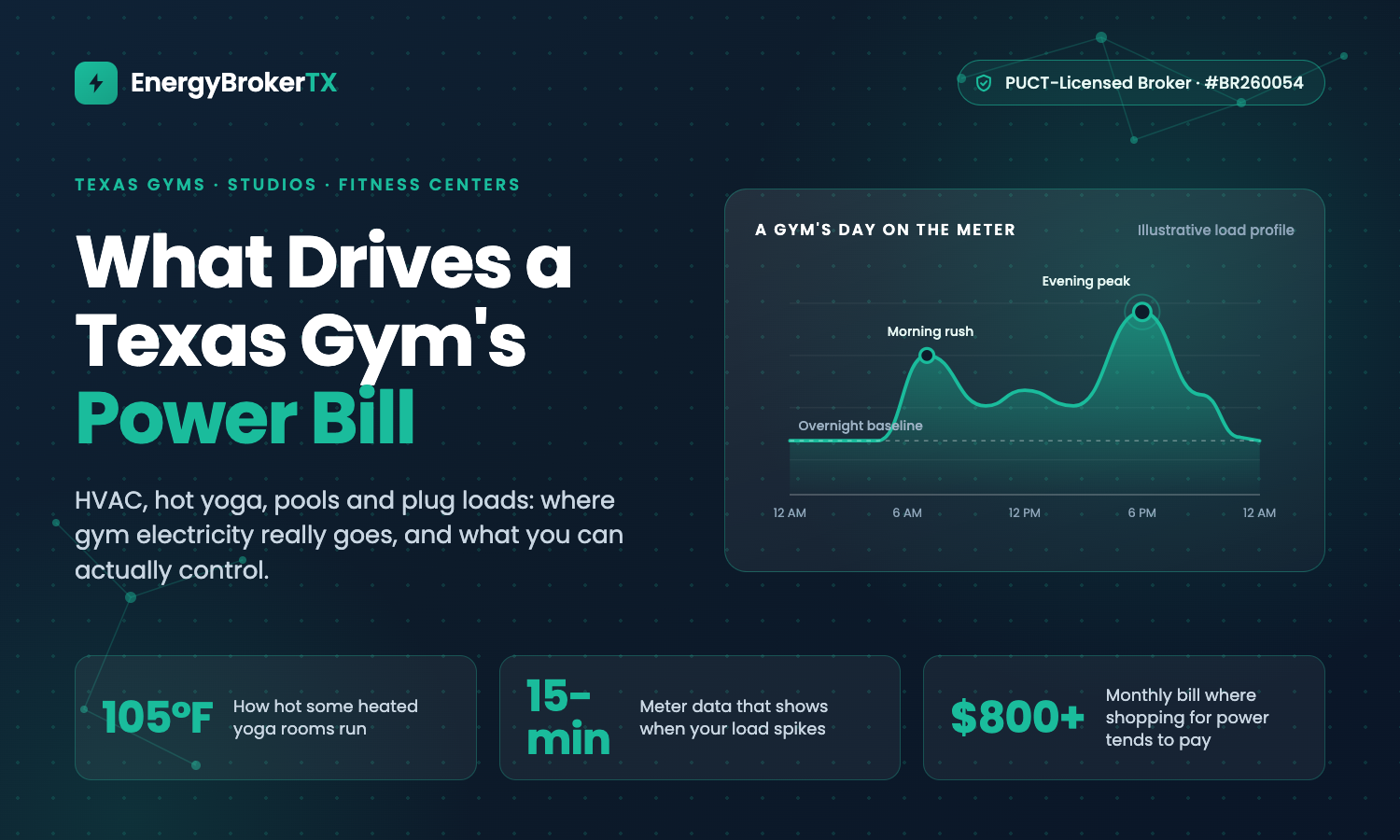
What drives the power bill at Texas gyms, yoga studios and fitness centers, from HVAC and hot yoga to pools, and when shopping your rate pays off.


The Texas deregulated electricity market gives commercial businesses access to over 100 competing retail providers — a genuine structural advantage over regulated states where the utility sets the rate and there's no alternative. That advantage only materializes, however, if someone actually runs the competition. Most Texas businesses don't.
The default behavior is passive renewal: a business signs an electricity contract when it opens, renews with the same provider when the contract expires (or lapses onto the holdover rate when it doesn't), and never submits the account to competitive bid. In a market where the spread between a passive renewal rate and a competitively bid rate for the same account runs 1.0–2.5¢/kWh, that habit has a specific dollar cost.
This applies whether you're running a retail storefront, a professional office, a warehouse or manufacturing facility, or a restaurant. The mechanism is identical across industries — the only variable is how much your specific load profile is worth to a competing provider, which is exactly what a broker running a reverse auction on your behalf uncovers.
At 50,000 kWh per month and a 1.5¢/kWh above-market renewal rate: $750/month over-charge, $9,000 per year, $18,000 over a 24-month contract. That's the cost of not running a competitive auction. It's not hypothetical — it's what the data from commercial auctions we run across Texas shows, consistently, for accounts that haven't been competitively bid in the past 24 months.
This guide explains exactly where the savings come from, what the reverse auction process looks like, and what different categories of Texas commercial businesses typically save when they go through a competitive procurement. If you want the short, plain-English version of what a reverse auction actually is first, see our quick explainer: What Is a Reverse Auction for Electricity?
Before you can capture savings, you need to understand which parts of your electricity bill are negotiable and which aren't. Most business owners don't know the answer to this, which is why they accept renewal offers without understanding what they're agreeing to.
Every Texas commercial electricity bill has two primary cost components. The first is your TDU delivery charge — the regulated fee your transmission and distribution utility (Oncor in DFW, CenterPoint in Houston, AEP Texas in West Texas) charges to deliver electricity to your building. These charges are fixed, identical for every business in the same meter class in the same territory, and non-negotiable regardless of which provider you choose.
The second is your supply charge — the per-kWh rate your retail electricity provider (REP) charges for the energy itself. This is the competitive piece. This is what varies between providers. This is what a reverse auction drives down. Every dollar of savings from a competitive procurement comes from the supply side.
For most Texas commercial accounts, the supply charge represents 45–60% of the total bill. The TDU delivery charge represents 35–50%. Taxes and fees make up the remainder. Understanding this split tells you your maximum savings opportunity: if your total bill is $5,000/month and the supply portion is $2,500, a 20% improvement in your supply rate saves $500/month — $12,000 over a 24-month contract. See our guide on how to read a Texas commercial electricity bill for a full breakdown of each line item.
A reverse auction is the mechanism that produces genuine competition in the Texas commercial electricity market. Here's the specific difference between a direct quote process and a reverse auction:
When you call a provider directly, they quote you a rate knowing you're one prospect who came to them. They price their quote to be competitive enough to win your business without leaving money on the table. They assume some probability that you'll accept their offer without seeing alternatives.
When a broker submits your account to 25+ providers simultaneously in a blind auction, every provider knows they're competing against 24 other bids they can't see. The rational response is to price as aggressively as possible to win the account. The same provider that would quote 9.2¢/kWh in a direct conversation will bid 8.0¢/kWh in a blind auction for the same account — because in the auction, pricing conservatively means losing to a competitor.
That 1.2¢/kWh difference is the competitive pressure produced by the auction structure. It has nothing to do with the account or the market — it's purely a function of whether providers know they're competing.
The broker's compensation comes from the winning provider — a small commission built into the supply rate at the same level whether you use a broker or contact the provider directly. You pay the same total amount either way. But with a broker running a competitive auction, the winning rate is consistently lower than what any direct comparison process produces.
Savings vary by industry because electricity load profiles vary by industry. Here's what competitive auctions produce across the primary commercial sectors in Texas:
Office buildings and professional services firms in Dallas, Houston, and Frisco: Typically 40,000–200,000 kWh per month with steady weekday load profiles. Supply rates in competitive auctions: 7.2–8.4¢/kWh. Accounts that haven't been bid in 24+ months typically see 15–22% supply rate improvements. A 100,000 kWh/month office building saving 1.5¢/kWh nets $18,000 annually.
Restaurants and food service operations: High kitchen equipment loads, significant summer HVAC demand in Texas, demand charge exposure from simultaneous high-draw equipment operation. Supply rates in competitive auctions: 7.8–9.0¢/kWh. Texas restaurant electricity procurement benefits particularly from spring timing before summer ERCOT demand peaks embed in forward pricing.
Manufacturing and industrial operations: High base load, significant demand charge exposure from production equipment peaks. Supply rates in competitive auctions: 7.0–8.2¢/kWh. Texas manufacturing operations with demand above 100 kW benefit from demand charge structure optimization in the contract, not just supply rate competition. The demand component can represent 40–50% of total cost for high-intensity operations.
Churches and religious organizations: Weekend-peak load profiles, lower weekday baseline. Supply rates in competitive auctions: 7.8–8.8¢/kWh. Texas churches also qualify for a 6–8% electricity sales tax exemption that eliminates that cost permanently — a savings many congregations are missing entirely.
Laundromats and car washes: High equipment loads, hot water heating in laundromats, pressure pump demand spikes in car washes. Supply rates in competitive auctions: 7.8–9.2¢/kWh. For Texas laundromat and car wash operators, portfolio aggregation across multiple locations produces better pricing than individual location auctions.
Commercial real estate: Master-metered common areas, portfolio of individually-metered tenant spaces. Supply rates for common area accounts in competitive auctions: 7.4–8.6¢/kWh. Texas CRE operators benefit most from portfolio aggregation that unifies all property electricity accounts under a single competitive procurement.
Not every Texas commercial account has the same savings potential from a competitive auction. Two situations consistently produce the largest improvements:
Passive renewals at or above market. An account that signed a competitive contract two years ago, received a renewal offer from the same provider, and signed it without shopping is almost certainly paying above-market rates on the renewal. Providers offer competitive pricing to win new accounts and less competitive pricing to retain existing ones. The renewal offer reflects what the provider believes you'll accept without comparison — not what the market would produce in an auction.
Holdover rate situations. When a Texas commercial electricity contract expires and no new contract is executed, the account reverts to the provider's holdover rate — a month-to-month variable rate that runs 20–40% above competitive fixed contract pricing. An account on a holdover rate has the largest immediate savings potential from a competitive auction because the gap between current cost and market rate is widest. For details on how holdover rates are triggered and what they cost, see our guide on Texas commercial electricity auto-renewal.
Running a competitive auction through EnergyBrokerTX takes 3–5 business days from bill submission to executed contract for a standard Texas commercial account.
Day 1: You provide your most recent electricity bill or your TDU account number. The broker pulls your 12-month usage history and interval data, identifies your meter classification, notes your current supply rate and contract expiration date.
Day 1–2: The broker submits your load profile to 25+ licensed Texas REPs simultaneously. Each provider bids a fixed supply rate without seeing competing bids.
Day 2–3: You receive every bid in a standardized side-by-side comparison: supply rate, contract term, demand structure, early termination fee, auto-renewal terms. Total delivered cost for your specific usage profile.
Day 3–5: You select the winning bid. Contract execution via DocuSign. The broker submits enrollment to your TDU. Service transitions at your next meter read boundary — no service disruption, no operational impact of any kind.
Yes. EnergyBrokerTX earns a commission from the winning provider — a small fee built into the supply rate that is identical whether you use a broker or contact the provider directly. You pay the same total amount for the electricity. The auction produces a lower rate than direct procurement, so the net result is consistently a lower bill than you'd achieve without the broker.
Accounts spending $800 or more per month on electricity generally see meaningful dollar savings. Below that threshold, the absolute dollar improvement is smaller though still real. For multi-location businesses, we aggregate all locations into a single portfolio auction regardless of individual location size, producing better pricing through combined volume.
We review your existing contract for the early termination fee and calculate whether the ETF makes an immediate switch worthwhile at current market rates. For accounts that are significantly above market, the math often favors switching even with an ETF. For accounts near expiration, we execute a forward-start contract that locks current market pricing without any gap in coverage.
No. Your TDU (Oncor, CenterPoint, or AEP Texas) continues delivering electricity through the same poles, wires, and meters regardless of which REP supplies your account. Switching affects only the billing — the physical delivery is entirely unaffected.
Yes. Reverse auctions fully comply with Public Utility Commission of Texas (PUCT) guidelines for competitive electricity markets. EnergyBrokerTX operates under PUCT License #BR260054, and every auction we run follows the same regulatory framework that governs direct provider negotiations — you're simply seeing more of the market at once.
Yes. For multi-location Texas businesses, we aggregate every meter into one portfolio auction regardless of individual location size. Combined load typically attracts more competitive bids than running separate auctions per location, and it lets you align contract expiration dates across your entire portfolio so no single site lapses onto a holdover rate.
Submit your most recent electricity bill to EnergyBrokerTX for a free commercial electricity audit. We'll pull your full usage history, run a competitive reverse auction with 25+ licensed Texas providers, and present every bid transparently within 24 hours. No cost. No obligation. No disruption. PUCT License #BR260054. Serving all of Texas including Dallas, Houston, San Antonio, Fort Worth, and beyond.
Submit your account and we'll run a competitive auction with 25+ licensed Texas providers — full bid transparency, no pre-filtering, no obligation.
Get My Free Competing Bids →