Electricity for Texas RV Parks, Campgrounds and Cabin Parks
Master vs submetered billing, Texas rules for charging RV guests for power, seasonal contracts and buying a park, explained for park owners.

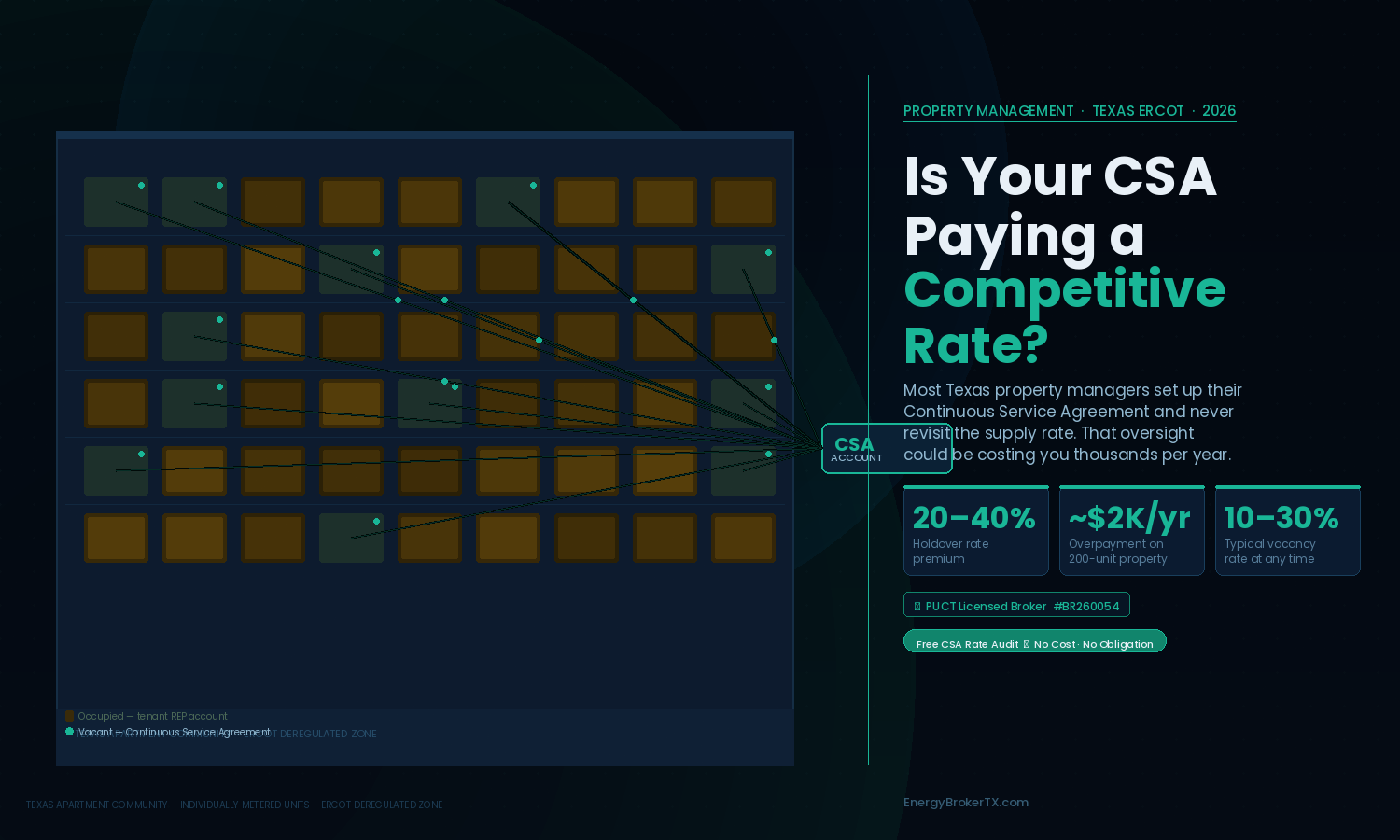
When a tenant moves out of a Texas apartment, something happens automatically on the property’s electricity account that most leasing managers never think about twice. If the property has a Continuous Service Agreement in place, that vacant unit’s electricity service transfers seamlessly to the property’s standing account. The lights stay on. The HVAC keeps running. The unit stays show-ready. No staff time, no service gap, no scramble to establish new service before the next prospect walks through the door.
The Continuous Service Agreement — or CSA — is not optional for Texas multifamily properties that want to manage vacancy periods without operational and financial headaches. In ERCOT’s deregulated electricity market, where each tenant holds their own individual contract with a licensed retail electric provider, vacancy creates a gap that must be covered by someone. The CSA is how the property covers that gap.
This is not the article to convince you that you need a CSA. If you manage Texas apartment communities, you already know you do.
This is the article that asks the question almost nobody in Texas property management is asking: what rate is your Continuous Service Agreement actually paying — and has anyone ever verified whether that rate is competitive?
A Continuous Service Agreement is a standing electricity account held in the property’s name, maintained with a licensed retail electric provider, and configured to automatically accept vacant unit service when a tenant’s individual account closes or lapses.
In Texas’s deregulated electricity market — governed by the Electric Reliability Council of Texas (ERCOT) for approximately 90% of the state — each tenant in an individually metered apartment unit must establish their own electricity account with a retail electric provider. They hold the contract, they pay their bill, and when they move out, that account closes. When no new account is established on the meter, the unit either reverts to Provider of Last Resort (POLR) service or experiences an actual gap in service. POLR rates are the state-mandated backstop rates available from the local utility — they exist to prevent service interruptions but are among the most expensive electricity options in the Texas retail market. Neither POLR exposure nor a service gap is acceptable for a property trying to maintain show-ready units and protect HVAC systems during the Texas heat.
A properly configured CSA prevents both outcomes. When the outgoing tenant’s account closes, the property’s CSA account automatically takes over the meter. The transition happens without staff involvement, without a service gap, and without a POLR exposure event. The unit stays conditioned, protected, and lit for the next showing.
Setting up a CSA is the foundational step in managing Texas multifamily electricity properly. Getting it onto a competitive supply rate is the step that almost nobody takes next — and it is that omission that this article addresses.
Most Continuous Service Agreements in Texas were established through one of three channels: a phone call with a REP’s property management team, a default enrollment through a property management software integration, or a recommendation from another property in the same ownership portfolio. In each case, the primary objective was the same — get a CSA in place before the next move-out. The rate was secondary. In many cases, it was not considered at all.
Once the CSA is established and working, property managers move on. The account runs quietly in the background. Electricity bills for vacant units arrive, get paid, and get absorbed into operating expenses without scrutiny. The supply rate that was set at enrollment — whatever it was, from whichever provider was easiest at the time — continues indefinitely, often renewing automatically at holdover pricing without anyone noticing.
This is the compounding problem. A CSA supply rate that made sense three years ago may be significantly out of step with today’s ERCOT market. Competitive supply rates have moved with natural gas futures, forward pricing cycles, and provider competition. The rate available today through a properly structured reverse auction may be meaningfully lower than what your CSA account is currently paying — and the only way to know that is to look.
Unlike a residential account, where a tenant might notice their rate and shop alternatives, the CSA is a property-level commercial account that nobody is actively managing once it is set up. The leasing team is focused on occupancy. The property manager is focused on operations. The accounting team sees the bills and pays them. Nobody is asking whether those bills could be lower.
This is exactly the same pattern that drives overpayment on any commercial electricity account that auto-renews at holdover rates without active procurement. As documented in the Texas Commercial Electricity Contract Renewal Playbook, the holdover rate on a lapsed or auto-renewed commercial contract is typically 20–40% above what competitive procurement would produce. CSA accounts are not exempt from this dynamic. The same mechanism that causes a restaurant or warehouse to overpay on auto-renewal is quietly working on your property’s CSA contract right now.
The electricity consumed by vacant units is not zero. A vacant apartment in Texas requires HVAC operation to prevent moisture damage, mold growth, and extreme temperature conditions that would make units unshoveable and create liability exposure. Security lighting, ventilation systems, and minimal plug loads add additional consumption. A conservatively managed vacant unit in Texas typically consumes 400–700 kWh per month depending on unit size, season, and thermostat setpoint during the period it sits on the CSA.
For a 200-unit apartment community operating at 10% average vacancy — a conservative figure for a stabilized property — that is 20 vacant units on the CSA at any given time. At 550 kWh per month per unit, the CSA account is consuming approximately 11,000 kWh per month. At a competitive supply rate of 7.5¢/kWh, that represents roughly $825 per month in supply costs. At an uncompetitive rate 1.5¢/kWh above market — well within the typical gap between an uncontested default rate and a competitively auctioned rate — that same usage costs $990 per month.
The gap is $165 per month, or approximately $2,000 per year, on a single 200-unit property at conservative vacancy assumptions. Scale that to a 400-unit community, a higher-vacancy lease-up property, or a portfolio of multiple communities under common ownership, and the aggregate overpayment becomes a material variance in operating expenses — one that flows directly to NOI and, by extension, to property valuation at disposition.
Common area electricity — pool pumps, hallway and corridor lighting, fitness center and clubhouse equipment, elevator systems, parking lot and security lighting — represents a separate and often significantly larger electricity account on the same property. Smart Texas property managers are already applying competitive procurement to their common area accounts and capturing 20–35% in supply rate savings. The CSA account deserves identical treatment and has historically received none.
A Continuous Service Agreement is a commercial electricity account. It carries an ESI ID — the unique Electric Service Identifier assigned to each meter by the local TDU — and it has a monthly consumption profile that can be presented to competing providers. A CSA account can be submitted to a reverse auction with licensed Texas retail electric providers in exactly the same way as a manufacturing facility, a medical clinic, or a hotel.
The process is straightforward. A PUCT-licensed energy broker submits the account details — the property address, TDU service territory, 12 months of usage history, and desired contract length — to 25 or more competing REPs. Those providers submit bids. The property manager reviews the bids side by side and selects the best supply rate and contract terms. No fees are paid by the property; the broker’s compensation comes from the winning provider’s built-in commission structure, meaning competitive procurement produces rates that are lower than what the property would obtain by calling a single REP directly.
For a CSA account, a few procurement considerations specific to multifamily properties apply. First, contract term: a CSA is an ongoing operational necessity with no natural end date tied to a business activity, making 24 or 36-month fixed rate contracts appropriate for locking in today’s competitive pricing across a full ERCOT rate cycle. Second, the account may be structured as a single master account covering multiple unit meters, or as individual unit-level accounts enrolled under a property-wide CSA arrangement — the structure affects how the auction is presented to bidding providers and which supply rate categories are available.
Third, if the property currently has no CSA and has been relying on Provider of Last Resort coverage for vacant units, establishing a competitive CSA and running the initial auction simultaneously is both possible and advisable. The two steps can be completed in a single engagement with a broker who understands the Texas multifamily electricity structure. There is no requirement to first accept a default rate before seeking a competitive one.
Texas imposes a state sales tax on electricity, with an exemption for residential electricity use. For a Continuous Service Agreement covering individually metered apartment units — where the electricity is consumed in residential living spaces, regardless of whether those spaces are currently occupied by a tenant or are vacant between tenancies — the correct tax classification on that usage is typically the residential exemption.
Many CSA accounts in Texas are currently set up as commercial accounts paying sales tax on electricity that qualifies for the residential exemption. This is not an edge case. It is a systemic pattern that results from how CSAs are established: through commercial account workflows managed by REP property management teams, without specific attention to the tax classification of the underlying meter use. The leasing manager who set up the CSA three years ago was focused on getting the account active. The sales tax classification question was likely never raised.
If your property’s CSA account is classified commercially and paying sales tax on electricity consumed in individually metered residential units, the overpayment is straightforward to calculate and recoverable prospectively through a reclassification with the REP. This is directly analogous to the sales tax exemption available to Texas churches and qualifying nonprofit organizations — the exemption is real, commonly missed, and fixed through proactive action rather than automatic correction.
Any CSA rate audit should include a review of the current tax classification on the account. The savings from correct classification are independent of the supply rate and compound month over month once applied. Together, a corrected tax classification and a competitively procured supply rate represent two separate and additive improvements to the property’s electricity cost structure.
Every CSA is a contract with a defined term, an expiration date, and an auto-renewal clause. Like every commercial electricity contract in Texas, the CSA will automatically renew at a holdover rate — typically above the contracted rate — if the property fails to provide notice of non-renewal within the required termination window, which varies by contract but typically falls 30–90 days before expiration.
Property managers who actively track tenant lease expirations often have no equivalent process for their own CSA contract expiration. The CSA was set up, it works, and it recedes into the background. The contract’s anniversary passes unnoticed. The holdover rate takes effect. And the property is now paying above-market rates on an account whose overpayment becomes structurally locked in until the next termination window opens.
The question to answer right now is simple: when does your CSA contract expire, and what is the required notice period for non-renewal? If you do not know the answer to both questions, you are operating without visibility into a contract that is automatically renewing on its own schedule. Adding the CSA expiration date to the same operational calendar used for vendor agreements, insurance renewals, and major equipment service contracts is the minimum step required to avoid the auto-renewal trap.
Apartment communities are the most common CSA users in Texas, but the same electricity management structure — and the same rate oversight gap — applies across a broader range of property types.
Student housing properties near Texas universities experience concentrated, predictable vacancy patterns during summer months and between academic terms. Vacancy rates of 30–50% during summer create significant CSA electricity spend concentrated in the high-ERCOT-demand season. Competitive procurement for summer-peak CSA exposure is both available and strategically important given ERCOT’s summer rate pressure.
Assisted living and senior care facilities experience room turnover between residents, often accompanied by cleaning and preparation periods during which the room’s electricity is the property’s responsibility. Electricity costs at Texas assisted living properties are already elevated by continuous HVAC, medical equipment, and life-safety system demands. The electricity consumed during room turnover is incremental cost sitting on whatever standing property account is in place — which may not be competitively priced.
Commercial office parks and mixed-use properties face the same vacancy electricity challenge as multifamily properties when tenants vacate. How Texas commercial landlords structure electricity cost recovery in lease agreements is a separate question from what rate the landlord’s own account pays during the inevitable vacancy periods between commercial tenants. Both questions deserve attention.
Short-term rental and corporate housing portfolios operating in Texas maintain standing electricity accounts in the property’s name across their entire unit inventory. These are effectively permanent CSA-type commercial accounts — and like all commercial accounts, they can be competitively procured rather than accepted at whatever default rate the REP offers at initial enrollment.
A CSA rate audit requires three items: a recent bill showing the current supply rate and account details, the account’s ESI ID, and a usage history covering the last 12 months of monthly kWh consumption. With those three inputs, a licensed energy broker can assess the current rate against today’s market, identify whether the account’s tax classification is correct, confirm the contract expiration date and termination window, and run a competitive reverse auction to show what 25 or more licensed Texas providers would bid for the account.
The audit itself involves no cost to the property. If the current rate proves to be competitive, the audit confirms that position with market data rather than assumption — which is a useful outcome in itself. If the audit reveals overpayment, the property has the information and the bids needed to make an immediate procurement decision. Choosing the right PUCT-licensed broker to conduct that audit matters: they should present all competing bids transparently without pre-filtering, and be prepared to explain the compensation structure before the auction begins.
The practical window for competitive procurement on a CSA account is the 90–120 days before contract expiration. Within that window, a reverse auction can be completed, a winning provider selected, and new service established in time to avoid holdover pricing. Outside that window, mid-contract switching may involve early termination fees depending on how the current contract is structured.
Understanding where Texas commercial electricity supply rates currently sit gives context for evaluating whatever bids come back. A rate locked in three years ago during a different market environment may look quite different against today’s competitive pricing — and the trajectory of ERCOT forward prices, given ongoing load growth from data center and industrial expansion, adds urgency to acting in today’s relatively competitive market rather than waiting.
The Continuous Service Agreement is one of the most functionally necessary and operationally overlooked electricity accounts in Texas property management. It will always exist as long as vacancy exists. The electricity consumed through it will always be a cost on the property’s income statement. The only question is whether that cost is structured through a competitively procured contract or through a rate that was set once and never challenged.
If you manage a Texas multifamily community, student housing portfolio, senior living property, or commercial property with standing electricity accounts during vacancy periods, a CSA rate audit is the right starting point. We review your current contract details, assess the tax classification, confirm the renewal timeline, and show you what 25 or more licensed Texas providers would bid for your specific account — so you can make a fully informed decision about whether your current rate is serving the property as well as the competitive market can.
Submit your account and we'll run a competitive auction with 25+ licensed Texas providers — full bid transparency, no pre-filtering, no obligation.
Get My Free Competing Bids →