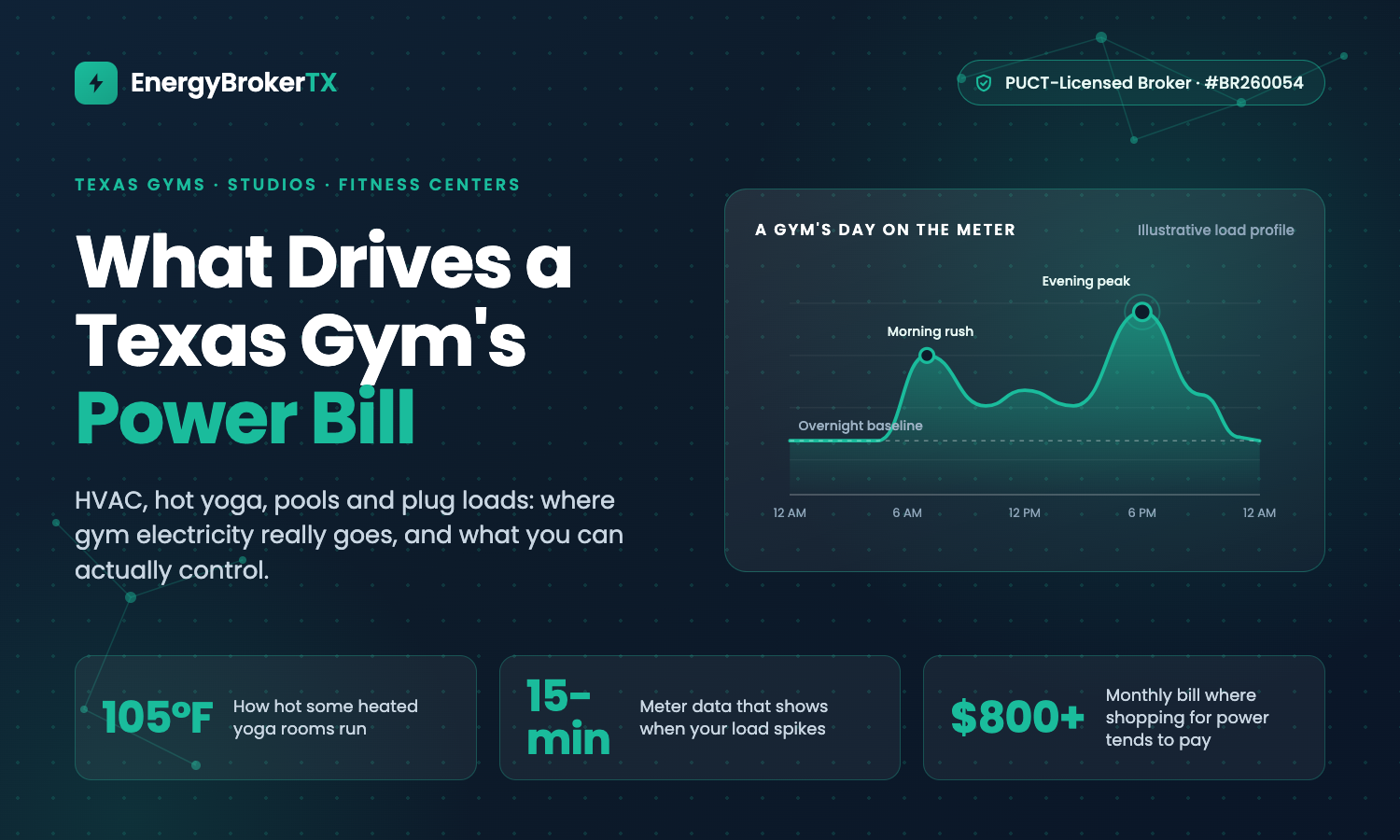
Texas Gyms, Yoga Studios and Fitness Centers: What Drives the Power Bill
What drives the power bill at Texas gyms, yoga studios and fitness centers, from HVAC and hot yoga to pools, and when shopping your rate pays off.

A church that also operates a Christian school — or a private school that leases or shares space on a church campus — is running two distinct organizations with two distinct electricity usage patterns under, in many cases, one roof and one meter. The congregation's heaviest usage typically concentrates on Sundays, with modest weekday activity from midweek Bible study, staff offices, and occasional evening events. The school runs the opposite pattern entirely: heavy weekday usage roughly 180 days a year, driven by classroom HVAC, cafeteria equipment, lighting, and — if the campus includes one — gymnasium use, then drops to near-nothing for roughly three months every summer.
Most electricity guidance written for churches doesn't account for this combined load shape, because it's written for congregations without an attached school. Most guidance written for schools doesn't account for the church side either. A campus running both needs a procurement approach that reflects the blended reality, not a plan built around either pattern in isolation.
The first practical question for any church-school campus is whether the two organizations share one electricity meter or run on separate accounts. Many smaller Christian schools operating directly as a ministry of their church — sharing the same sanctuary-adjacent building, the same fellowship hall for lunch, the same parking lot and HVAC system — are on a single combined meter with the church. Larger or more established Christian schools, especially those incorporated as their own 501(c)(3) entity with a dedicated school building, more often run on a separate account.
Neither structure is wrong, but each calls for a different procurement conversation. A combined meter means the church's weekend pattern and the school's weekday, school-year pattern are blended into a single usage profile — the rate structure needs to work for both without penalizing either one. A separate meter means the school can be shopped and rate-structured independently, which sometimes produces a better fit given how sharply the school's usage drops off in summer. We map this before recommending a strategy, the same way we map every meter on a multi-building parish for our diocesan and multi-parish clients — a campus with a church and a school attached is, structurally, a smaller version of the same problem.
In most cases, yes — though the specifics depend on how the school is structured. Under Texas Tax Code §151.310, the electricity sales tax exemption covers organizations operated primarily for religious, charitable, or educational purposes. A Christian school operated directly as a ministry of the church — using the church's own nonprofit status, on the church's own electricity account — is covered under the same exemption filing as the rest of the church's operations, using Texas Comptroller Form 01-339. This is the same exemption process detailed in our guide to the Texas church electricity sales tax exemption.
A school incorporated as its own, separate 501(c)(3) educational nonprofit — common for larger, independently governed Christian schools even when they lease space on a church campus — qualifies for the same exemption on its own basis as an educational nonprofit, covered in our guide to Texas nonprofit electricity rates and 501(c)(3) tax exemption. Either way, the form has to be filed against whichever electricity account actually serves the school building — if the school is on its own meter, its own exemption certificate needs to go to its own provider, separately from the church's filing.
A campus with a school attached typically sees its heaviest electricity usage from late August through May, then a sharp drop for roughly three summer months — the same seasonal pattern covered in more depth in our Texas education electricity broker guide for standalone K-12 campuses. For a church-school campus specifically, this seasonal swing interacts with the church's steadier, weekend-driven baseline usage, which doesn't drop off the same way in summer — Sunday services, vacation Bible school, and summer camp programming often keep the church side of the campus reasonably active even while the school building sits mostly empty.
A fixed-rate contract, priced against the full 12-month blended load, is usually the right structure for this kind of campus — it protects against ERCOT's summer price volatility during the months the church side is still drawing meaningful power, while the school's summer drop-off simply reduces the total bill for those months rather than requiring a separate rate plan. This is the same seasonal logic covered in our ERCOT summer commercial electricity outlook, applied to a campus with two overlapping usage calendars instead of one.
Beyond the basic classroom-versus-sanctuary contrast, most church-school campuses carry additional shared-use spaces that add real load on both sides of the calendar. A commercial kitchen serving school lunches five days a week during the school year often does double duty for church fellowship meals and events on weekends. A gymnasium or multipurpose hall typically hosts PE classes and school assemblies during the week and church youth programs, sports leagues, or special services on weekends and evenings. Extended-day or aftercare programs — increasingly common at Christian schools — add a block of weekday evening usage well past the school's official dismissal time, closer to the hours a church might otherwise be quiet.
None of this changes the basic procurement approach, but it does mean the usage data pulled for a campus like this needs a full 12 months of billing history, not a partial-year snapshot, to accurately capture how the shared spaces behave across both the church and school calendars. We build every campus's load profile from a full year of billing data before recommending a rate structure, for exactly this reason.
Whether the church and school share a meter or run separate accounts, the practical advantage of a combined procurement is the same one covered in our guide to reverse auctions for Texas churches: presenting a campus's full electricity picture to 25+ competing providers in a single reverse auction produces more competitive bids than shopping the church and school separately, simply because there's more total volume for providers to bid on. For campuses on separate meters, both accounts can still be run through the same auction event and land on aligned contract terms, even if the resulting rates or plan structures end up differing slightly between the two.
Our school and church share one electricity meter — do we need to separate them to save money?
Not necessarily. A combined meter can still be competitively bid as a single blended-load account. We evaluate whether separating the meters would produce a meaningfully better rate before recommending any change, since splitting a meter has its own administrative cost.
Is our school covered under the church's tax exemption, or do we need to file separately?
If the school operates as a ministry of the church on the church's own electricity account, it's covered under the same filing. If the school is its own separately incorporated nonprofit or sits on its own meter, it needs its own Form 01-339 filed with whichever provider serves that account.
Does a three-month summer drop in usage hurt us on a fixed-rate contract?
No — a fixed-rate contract charges the same per-kWh rate regardless of how much you use each month, so your bill naturally drops with usage in the summer. The rate itself doesn't change.
Can extended-day or aftercare programs affect our rate options?
They add usage into the early evening hours, which is factored into your overall load profile. It doesn't change what rate structures are available, but it does mean we need a full year of billing data to model your campus's usage accurately before recommending a plan.
If your church operates a Christian school on the same campus — or your private school leases space from a church — contact EnergyBrokerTX for a free bill review. We'll map your campus's metering, build a full-year load profile covering both the church and school usage patterns, confirm your sales tax exemption status, and run a competitive reverse auction with 25+ licensed Texas providers. There's no cost to your church or school. PUCT Licensed Broker #BR260054, based in Dallas, serving Christian and private schools across Texas.
Submit your account and we'll run a competitive auction with 25+ licensed Texas providers — full bid transparency, no pre-filtering, no obligation.
Get My Free Competing Bids →