Electricity for Texas RV Parks, Campgrounds and Cabin Parks
Master vs submetered billing, Texas rules for charging RV guests for power, seasonal contracts and buying a park, explained for park owners.

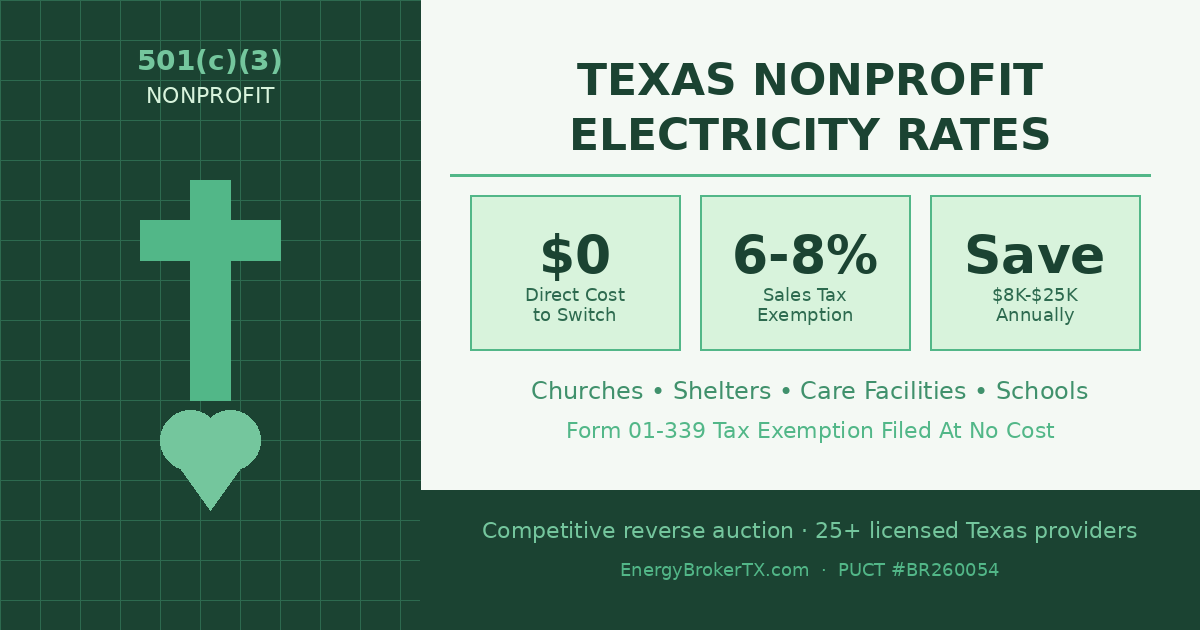
A 501(c)(3) nonprofit in Texas has access to the same deregulated commercial electricity market as every other business in the state. The same 100+ licensed retail electricity providers. The same competitive reverse auction process. The same ability to lock a fixed supply rate for 24, 36, or 48 months. The difference is that nonprofits have one additional advantage most of them never use: a permanent sales tax exemption that eliminates state and local taxes from their electricity bill entirely.
Most Texas nonprofits are paying above-market electricity rates and an avoidable tax on top of those rates. The combination costs the average nonprofit $8,000 to $25,000 per year in electricity expenses that a competitive procurement process and a one-page tax exemption form could eliminate. For organizations operating on donor funding and program budgets, that number represents real programmatic capacity being consumed by an administrative oversight.
This guide covers exactly how Texas nonprofit electricity procurement works, what the sales tax exemption is and how to file it, and what current market rates look like for the most common nonprofit facility types.
Texas deregulated its commercial electricity market in 2002 under Senate Bill 7, creating an open competitive market where businesses — including nonprofits — choose their retail electricity provider rather than buying from a regulated utility monopoly. This market covers approximately 85% of Texas electricity load through the ERCOT grid, including Dallas-Fort Worth, Houston, San Antonio, and virtually all major Texas commercial markets.
Nonprofits participate in this market identically to for-profit businesses. Your organization receives electricity from the same physical infrastructure — Oncor, CenterPoint Energy, or AEP Texas depending on your location — and selects a retail electricity provider to supply the energy itself. The REP charges your supply rate. The TDU charges a regulated delivery fee. The two combined produce your all-in electricity cost.
The competitive opportunity exists entirely on the supply side. Your TDU delivery charges are fixed regardless of which REP you choose. Your supply rate — typically 45-55% of your total bill — is the variable that a competitive reverse auction drives down by introducing 25+ providers competing simultaneously for your account.
For a complete explanation of how these two components appear on your bill, see our guide on how to read a Texas commercial electricity bill.
This is the most overlooked financial opportunity available to Texas nonprofits. Under Texas Tax Code Section 151.310, qualified nonprofit organizations are exempt from paying state and local sales tax on electricity purchases. For most Texas commercial electricity accounts, this tax represents 6-8% of the total bill.
On a nonprofit consuming $3,000/month in electricity, the sales tax exemption saves $180-240/month — $2,160-2,880 per year — permanently. Not as a one-time rebate. Not subject to market fluctuations. As a permanent reduction in your electricity cost that applies every month for as long as your exempt status is on file with your provider.
Who qualifies: Organizations that hold 501(c)(3) federal tax-exempt status as charitable, religious, educational, or scientific organizations. This includes churches, religious centers, private schools, community service organizations, shelters, food banks, hospice facilities, assisted living nonprofits, and most other charitable organizations operating in Texas.
How to file: The exemption requires submitting Texas Form 01-339 (Texas Sales and Use Tax Exemption Certificate) to your electricity provider. This is a one-page document available from the Texas Comptroller's office. The form requires your organization's name, address, federal EIN, and the nature of your exempt activity. Once submitted to your REP, the exemption applies immediately to future bills.
At contract transition: When your nonprofit switches electricity providers, Form 01-339 must be submitted to the new provider. The exemption does not automatically transfer. A PUCT-licensed broker who manages your contract transition will handle this submission at contract execution — confirm this explicitly before signing any new contract.
For Texas churches and religious organizations specifically, our detailed guide on the Texas church electricity sales tax exemption covers the specific filing process and common questions in depth.
Nonprofit electricity rates in competitive auctions vary by facility type, usage volume, and TDU territory. Here are current supply rate benchmarks from competitive auctions as of June 2026:
Churches and religious centers (Oncor territory, 10,000-80,000 kWh/month): Supply rates in competitive auctions range 6.5-8.5¢/kWh for 24-month fixed contracts. Multi-meter church campuses with combined volume above 50,000 kWh/month consistently produce the most competitive bids. Accounts that have never been competitively bid are frequently paying 10-13¢/kWh all-in. For the full church procurement approach, see our Texas church electricity broker page.
Nonprofit offices and administrative facilities (5,000-30,000 kWh/month): Standard small commercial accounts in Oncor or CenterPoint territory. Supply rates in competitive auctions: 6.8-8.8¢/kWh for 24-month fixed. Accounts on passive renewals of 24+ months are frequently at 9.5-12¢/kWh supply rate.
Shelter and residential care facilities (24/7 operational profile, 15,000-60,000 kWh/month): Continuous occupancy with HVAC, laundry, kitchen, and lighting loads running around the clock. Supply rates in competitive auctions: 6.5-8.0¢/kWh for 24-month fixed. High base load and consistent consumption attract competitive bids from most Texas REPs. Note: organizations operating group homes or individual residential units may have TDU-classified residential meters for those specific locations, which have different procurement options than commercial meters.
Educational nonprofits, private schools, tutoring centers (variable by facility size): Weekend and evening-heavy or seasonal load profiles. Supply rates: 7.0-9.0¢/kWh. Year-round operations with consistent load receive more competitive bids than purely seasonal facilities.
The most common reason Texas nonprofits pay above-market electricity rates is the same reason for-profit businesses do: passive renewal. When a contract expires and no competitive procurement is run, one of three outcomes typically follows — the organization signs the current provider's renewal offer without comparison, the contract auto-renews at a specified rate, or the account lapses onto a month-to-month variable holdover rate running 20-40% above competitive fixed contract pricing.
Nonprofits are particularly susceptible to the passive renewal trap for three structural reasons. First, electricity procurement is rarely anyone's primary job in a small nonprofit — it falls to whoever manages facilities or operations alongside many other responsibilities. Second, the dollar amounts, while significant, are often below the threshold that triggers formal board review. Third, the historical process of running competitive quotes required time and expertise most nonprofit staff don't have.
A PUCT-licensed broker removes all three barriers. The broker runs the competitive auction, presents every bid in a standardized comparison, and manages the contract transition. The nonprofit reviews a clear side-by-side comparison and signs the winning contract. Total time investment from the organization: less than 30 minutes. No cost. No service disruption.
For a complete explanation of how the passive renewal trap works and what it costs in dollar terms, see our guide on Texas commercial electricity contract auto-renewal.
Nonprofits operating multiple locations — a church with a main campus and satellite location, a community services organization with offices across multiple cities, a residential care nonprofit with several group homes — have a meaningful procurement advantage through portfolio aggregation.
Aggregating all commercial-classified meters into a single competitive auction produces lower per-kWh supply rates than individual location auctions because providers compete for more total revenue. A five-location nonprofit combining 100,000 kWh/month in aggregate receives more aggressive bids than any single 20,000 kWh/month location auctioned independently.
Portfolio aggregation also solves a common operational problem: staggered contract expiration dates. When different locations have contracts expiring at different times, tracking renewals across the portfolio becomes a management burden. A unified portfolio procurement aligns all locations under a single renewal window, eliminating the risk of individual locations lapsing onto holdover rates while others are under competitive fixed contracts.
Texas ERCOT forward market pricing follows seasonal patterns that create real procurement timing advantages. Forward contracts priced in spring — March through May — consistently produce lower rates than contracts priced in summer or fall because they're executed before peak summer demand risk is fully embedded in forward pricing.
For Texas nonprofits with contracts expiring between June and October, beginning procurement in April or May captures spring pricing on a forward-start contract that takes effect at your current contract's expiration. Waiting until July means locking a new contract at summer-peak pricing — typically 0.3-0.8¢/kWh higher than spring procurement for the same contract term. On a 15,000 kWh/month account that difference is $1,800 over a 24-month contract from timing alone.
For current ERCOT forward market context, see our ERCOT summer 2026 commercial electricity outlook.
A PUCT-licensed broker can run a competitive auction for your nonprofit with minimal preparation. Three things accelerate the process:
Your most recent electricity bill for each location. Contains your ESI ID (your meter's unique identifier), current usage, and current provider. The broker uses this to pull 12 months of usage history directly from your TDU.
Your contract expiration date for each location. Determines whether you need a forward-start contract or an immediate switch, and whether early termination fees are a consideration.
Your 501(c)(3) determination letter or EIN for the Form 01-339 tax exemption filing at contract execution.
From bill submission to executed contract for a standard nonprofit account: 3-5 business days. Service transitions at the next meter read boundary with zero operational disruption.
No — if your organization holds 501(c)(3) status. Texas Tax Code Section 151.310 permanently exempts qualified nonprofits from state and local electricity sales tax. You must file Form 01-339 with your electricity provider to activate the exemption. It does not apply automatically and does not transfer to a new provider without a new filing.
Yes, but direct negotiation consistently produces worse outcomes than a competitive reverse auction. A broker's auction with 25+ simultaneous blind bids produces 1.0-2.5¢/kWh lower supply rates than direct negotiation for the same account because blind competition eliminates the information asymmetry that allows providers to price conservatively in direct conversations.
No. Your TDU — Oncor, CenterPoint, or AEP Texas — delivers electricity through the same infrastructure regardless of which REP supplies your account. Switching providers changes only who bills you for the supply charge. There is zero service interruption, no meter change, and no operational impact of any kind.
Most of San Antonio (CPS Energy), Austin (Austin Energy), and El Paso are served by regulated utilities where competitive supplier choice is not available. If any of your locations are in these territories, the competitive procurement process does not apply to those specific meters. Locations in ERCOT deregulated territories can still be quoted competitively regardless.
Submit your most recent electricity bill to EnergyBrokerTX for a free nonprofit electricity audit. We'll identify your current all-in rate, run a competitive reverse auction with 25+ licensed Texas providers, and handle the Form 01-339 sales tax exemption filing at contract execution — at no cost to your organization. PUCT License #BR260054. Serving nonprofits across Dallas, Houston, Fort Worth, San Antonio, and all of Texas.
Submit your account and we'll run a competitive auction with 25+ licensed Texas providers — full bid transparency, no pre-filtering, no obligation.
Get My Free Competing Bids →