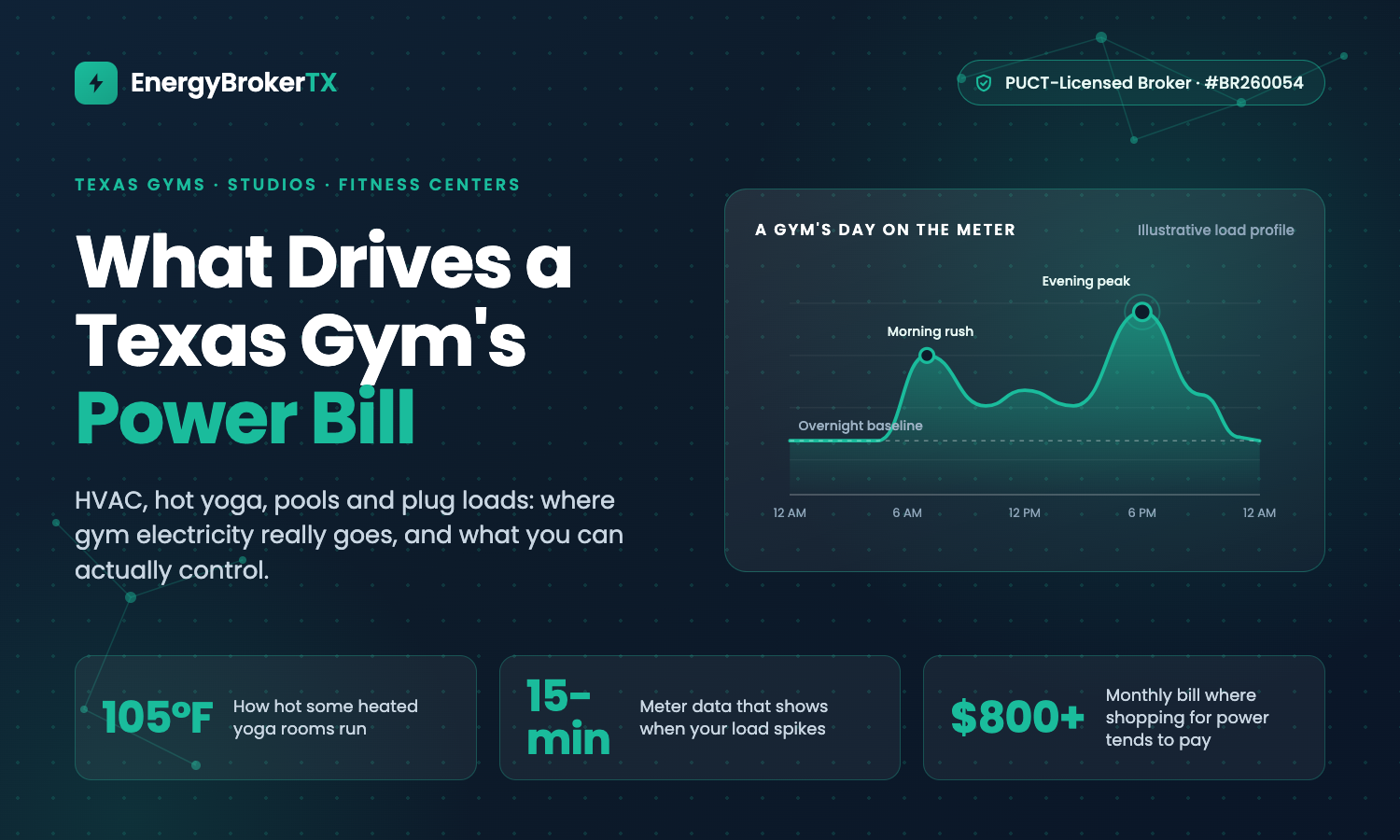
Texas Gyms, Yoga Studios and Fitness Centers: What Drives the Power Bill
What drives the power bill at Texas gyms, yoga studios and fitness centers, from HVAC and hot yoga to pools, and when shopping your rate pays off.


Texas has some of the lowest commercial electricity rates in the country. The state's deregulated ERCOT market, abundant natural gas production, and massive wind and solar capacity have kept Texas commercial rates consistently 15–25% below the national average for over a decade. Despite that structural advantage, most Texas commercial businesses are paying above-market rates on their specific accounts — not because Texas rates are high, but because they haven't been to competitive bid recently.
The gap between the best available rate for a Texas commercial account and what most businesses actually pay runs 1.0–2.5¢/kWh. At 60,000 kWh per month, that gap costs $720–1,500 per month. Understanding what drives Texas commercial electricity rates — and what's negotiable versus fixed — is the starting point for closing that gap.
To put that gap in concrete terms: for a mid-sized account consuming 50,000 kWh per month, even a modest 0.5¢/kWh rate differential adds up to roughly $3,000 in avoidable annual cost. Scale that to a 500,000 kWh/month industrial account and the same 0.5¢ spread becomes $30,000 a year — money that's sitting on the table simply because the account hasn't been put out to competitive bid.
Every Texas commercial electricity bill in the deregulated ERCOT market has four distinct cost components. Knowing which are competitive and which are fixed is essential for evaluating any quote you receive.
Supply charge (energy charge): The per-kWh rate your retail electricity provider (REP) charges for the electricity itself. This is the competitive component — it varies between the 100+ licensed REPs in Texas and is what a competitive auction drives down. For most Texas commercial accounts in April 2026, supply rates from competitive auctions range 7.0–9.5¢/kWh for 24-month fixed contracts, depending on account size, TDU territory, and load profile.
TDU delivery charge: The regulated fee your transmission and distribution utility charges to deliver electricity to your building. In most of Dallas-Fort Worth, that's Oncor. In Houston, it's CenterPoint. In West Texas and South Texas, it's AEP Texas. TDU delivery charges are set by PUCT rate proceedings and are identical for every business on the same rate class in the same territory regardless of provider. They are non-negotiable. No REP can reduce your TDU charges. Switching providers doesn't change them by a cent.
Demand charge: For commercial accounts above 20 kW — which includes most businesses beyond small retail — your bill includes a demand charge based on your peak 15-minute power draw during the billing period. The demand charge has a TDU component (fixed, regulated) and potentially a supply contract component that varies by provider and contract structure. For high-demand operations, the demand component can represent 30–50% of the total bill. See our detailed guide on Texas commercial demand charges for the full breakdown.
Taxes, fees, and pass-throughs: State and local taxes, system benefit fund charges, nuclear decommissioning fees, and any regulatory pass-through provisions in your supply contract. These are relatively small individually but collectively add 0.5–1.0¢/kWh to your total all-in rate.
For most Texas commercial accounts, the resulting all-in rates currently run: 11.0–14.0¢/kWh in Oncor territory, 11.5–14.5¢/kWh in CenterPoint territory, and 11.5–15.0¢/kWh in AEP Texas territory, depending on meter classification and account size. If your all-in rate exceeds the upper end of these ranges, your account hasn't been competitively bid recently.
Two businesses in the same city on the same street can have materially different electricity rates for legitimate reasons that have nothing to do with one paying a premium. Understanding these drivers helps you interpret quotes correctly.
Account volume. Larger accounts — measured in total kWh per month — attract more competitive bids because providers compete for more revenue. A 200,000 kWh/month manufacturing plant will receive more aggressive bids than a 10,000 kWh/month retail store. Volume matters in both single-location procurement and portfolio aggregation across multiple accounts.
Load factor. Load factor measures how consistently a business uses electricity relative to its peak demand — calculated as total kWh divided by peak kW multiplied by hours in the period. A high load factor (steady, predictable consumption like data centers or manufacturing) is favorable for procurement because providers can price the risk more precisely. A low load factor (erratic, peaky consumption like seasonal retail) requires providers to price in more uncertainty. For a given account size, higher load factor produces better rates.
TDU territory and meter classification. Oncor, CenterPoint, and AEP Texas each have different rate class structures for commercial accounts. The classification your meter falls under (Secondary Service under 10 kW, Secondary Service over 10 kW, Large Secondary Service, Primary Service) determines both your TDU delivery charges and which supply contract structures are available to you.
Contract term. Longer contracts (24 and 36 months) typically produce lower per-kWh supply rates than shorter terms (12 months) because providers can lock in their hedge over a longer forward period. In 2026, with ERCOT demand growth projections from data center buildout pushing forward prices higher, 24-month contracts are generally more favorable than 12-month contracts for Texas commercial accounts. See our ERCOT summer 2026 outlook for forward market context.
The following supply rate ranges reflect active reverse auction bids for Texas commercial accounts as of April 2026. These are energy-only supply rates — add your TDU delivery charges (typically 3.5–5.0¢/kWh depending on territory and rate class) to arrive at your all-in rate.
Oncor territory (Dallas-Fort Worth, Waco, Tyler, Midland): Small commercial (under 20 kW): 7.8–9.5¢/kWh. Medium commercial (20–200 kW): 7.2–8.9¢/kWh. Large commercial (above 200 kW): 6.8–8.0¢/kWh. Oncor territory benefits from strong provider competition and some of the most competitive auction results in the state.
CenterPoint territory (Houston, Galveston): Small commercial: 8.0–9.8¢/kWh. Medium commercial: 7.4–8.8¢/kWh. Large commercial: 7.0–8.2¢/kWh. CenterPoint delivery charges are somewhat higher than Oncor's, so all-in rates are slightly higher despite similar supply rates.
AEP Texas territory (Corpus Christi, West Texas, South Texas): Supply rates: 7.5–9.0¢/kWh for most commercial classifications. AEP Texas has multiple rate class structures that can significantly affect all-in rates — meter classification is particularly important for accounts in this territory.
Accounts not in deregulated territories — most of San Antonio (CPS Energy), Austin (Austin Energy), and El Paso — do not have competitive supply options. These are regulated monopoly utilities with fixed rates set by city or utility governance.
The gap between the competitive market rates above and what most businesses actually pay has a simple explanation: passive renewal. When a commercial electricity contract expires in Texas, the most common outcome is that the current provider sends a renewal offer and the business signs it — or the contract auto-renews at a higher rate, or the account lapses onto the holdover variable rate.
In every one of these scenarios, the business is paying a rate that was not set by competition. The provider set the rate based on what they expected the business to accept. That rate is almost always 1.0–2.5¢/kWh above what a competitive auction would produce for the same account at the same time.
The fix is a competitive reverse auction. Submit your account to 25+ licensed Texas REPs simultaneously, receive blind competitive bids, compare total delivered cost for your specific usage profile, and execute the contract that produces the lowest actual bill. The process takes 3–5 business days and has no cost to the business. For a full walkthrough of how the auction process works, see our guide on how Texas businesses save thousands through commercial energy brokers.
Texas commercial electricity contracts come in three primary structures, each with different risk profiles.
Fixed-rate contracts lock your supply rate for the full contract term. Your rate doesn't change regardless of wholesale ERCOT market movements. For most Texas commercial businesses, fixed-rate contracts are the appropriate choice — they produce predictable monthly bills and protect against the ERCOT summer price spikes that have historically hit the market in July and August.
Variable-rate contracts (holdover rates) reprice monthly based on market conditions. No fixed-rate protection. Suitable only for very short-term situations (1–2 months) while permanent procurement runs. A Texas business on a variable rate through summer 2026 faces significant bill volatility during ERCOT peak demand periods.
Indexed contracts link your supply rate to a market index (typically natural gas hub pricing) with a fixed adder. If the index falls, your rate falls; if it rises, your rate rises. Appropriate for large commercial accounts with sophisticated energy management capabilities that want to participate in wholesale market movements. Not appropriate for most small and medium commercial businesses without dedicated energy procurement staff.
For 2026, with ERCOT demand growth from data center buildout expected to push summer peak prices higher, fixed-rate contracts executed in spring produce the most favorable risk-adjusted outcomes for most Texas commercial accounts.
Commercial rates are priced differently from residential rates because commercial accounts have different load profiles, consumption volumes, and contract structures. Commercial supply rates are custom-quoted based on your actual usage history and load profile rather than published on a standard schedule. Most commercial accounts are not eligible for residential plans and vice versa.
Take your total monthly electricity charges (including all fees and taxes) and divide by your total kWh consumed that month. That's your effective all-in rate. Compare the supply portion (energy charge line on your bill) to the ranges above. If your supply rate is above the top of the range for your account size and territory, your account hasn't been competitively bid recently.
Your rate changes to whatever you negotiate or accept at renewal. If you accept your current provider's renewal offer directly, your new rate reflects their standard renewal pricing — typically above-market. If you run a competitive auction at renewal, your new rate reflects genuine competition among 25+ providers. The difference between these two outcomes is consistently 1.0–2.0¢/kWh for most Texas commercial accounts.
Yes. Fixed-rate plans backed by 100% renewable energy (wind RECs from Texas sources) typically run 0.3–0.8¢/kWh above equivalent fossil fuel plans for the same account. For businesses with sustainability commitments or green certification requirements, this premium is often manageable. A competitive auction will include both renewable and conventional options so you can evaluate the premium against your sustainability goals.
Submit your most recent electricity bill to EnergyBrokerTX and we'll identify your current all-in rate, compare it against current competitive market rates for your specific account, and run a reverse auction if the market supports improvement. No cost. No obligation. Results within 24 hours. PUCT License #BR260054. Serving Dallas, Houston, Fort Worth, San Antonio, Frisco, and all of Texas.
Submit your account and we'll run a competitive auction with 25+ licensed Texas providers — full bid transparency, no pre-filtering, no obligation.
Get My Free Competing Bids →