Electricity for Texas RV Parks, Campgrounds and Cabin Parks
Master vs submetered billing, Texas rules for charging RV guests for power, seasonal contracts and buying a park, explained for park owners.

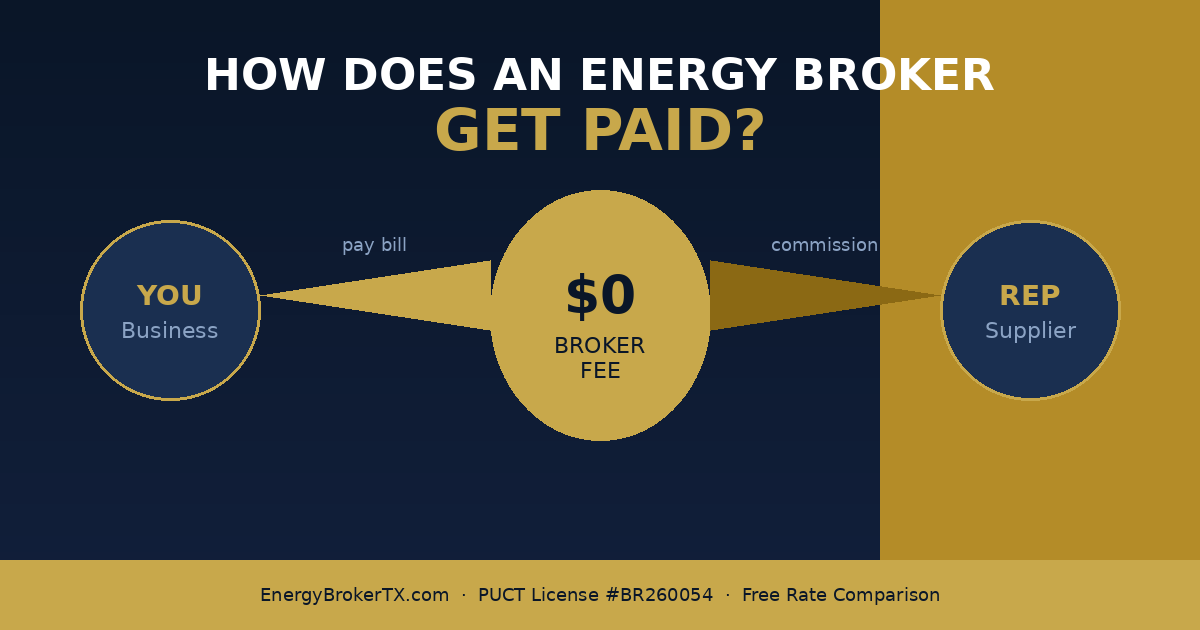
The most common reason Texas business owners hesitate to use an energy broker is the assumption that there must be a catch — that broker involvement adds a fee on top of their electricity rate, or that it creates some kind of obligation they don't fully understand.
Neither is true. This page explains exactly how commercial energy broker compensation works in Texas, where the money comes from, and why it's structured the way it is.
A licensed Texas commercial energy broker is compensated by the electricity supplier — not by you. There is no consulting fee, no retainer, no invoice, and no line item on your electricity bill labeled "broker fee." The broker's compensation is built into the rate the winning supplier charges for electricity, and it's paid by that supplier over the life of your contract.
From your perspective as the business owner, engaging a broker costs you nothing directly. What changes is who the electricity supplier pays their margin to: without a broker, they keep it as additional profit. With a broker, a portion of that margin flows to the broker as compensation for bringing them the account.
Texas commercial energy brokers are typically compensated through a per-unit margin — a fraction of a cent per kilowatt-hour — embedded in the electricity rate you're quoted. This margin is paid by the supplier to the broker on a monthly basis for each billing period during your contract term.
The typical broker margin in Texas commercial electricity ranges from 0.1¢ to 0.5¢ per kWh depending on account size, contract length, supplier relationship, and market conditions. For reference:
Larger accounts typically negotiate lower per-unit margins because the total compensation is still meaningful even at a smaller fraction. Smaller accounts may carry a slightly higher per-unit margin to make the procurement economics work for both the broker and the supplier.
Most Texas commercial energy brokers are paid on a residual basis — the monthly margin flows in throughout the contract term, tied to your actual electricity consumption. This structure aligns broker and client interests: if you use more electricity, the broker earns more; if you switch away from the contract early, the residual stops.
Some brokers receive a lump-sum upfront payment from the supplier at contract signing. From your perspective, the structure of broker compensation doesn't change your rate — both approaches result in the same embedded margin in your electricity contract.
This is the right question to ask, and the answer is counterintuitive: in most cases, using a broker results in a lower all-in rate than going direct to the same supplier, even after the broker's margin is embedded in the rate.
Here's why:
Texas retail electricity suppliers maintain pricing tiers that are not available to businesses shopping on their own. Brokers who bring suppliers consistent deal flow — multiple commercial accounts per month — receive access to wholesale-adjacent pricing that individual businesses cannot access through direct outreach.
When a single business calls a supplier directly, the supplier's sales team responds with their standard retail rate. There's no competitive pressure to offer their best price. When a broker submits the same account as part of a competitive auction with four other suppliers, each supplier must price aggressively to win the business. The rate a business receives through a broker-managed competitive process is typically 10–25% below what the same supplier would quote the same business going direct.
This is the structural reality of commercial electricity pricing: supplier margins are built into every electricity rate, brokered or not. When you go direct to a supplier, you're not getting a rate that's "clean" of markup — you're getting a rate where the full supplier margin stays with the supplier. A broker doesn't add margin on top of the supplier's pricing; they redirect a portion of existing supplier margin to themselves in exchange for bringing the account.
Put differently: the choice isn't between "paying a broker" and "not paying a broker." It's between a supplier keeping all the margin and a broker sharing some of it — in exchange for a competitive procurement process that typically drives the base rate down enough to more than offset the broker's share.
A legitimate Texas energy broker will disclose their compensation structure before you sign anything. If a broker won't tell you how they're paid or how much they're earning on your account, that's a problem — not because broker compensation is inherently problematic, but because opacity about it is.
Specifically, you should be able to ask and receive a clear answer to:
A broker running a genuine competitive process will answer all of these without hesitation. Their compensation comes from the supplier paying them to deliver good accounts — not from steering you toward a supplier that pays them more regardless of whether that supplier's rate is competitive for you.
When evaluating brokers, see our guide on how to choose the right energy broker for your Texas business — it covers the specific questions to ask and red flags to watch for.
In a properly run competitive procurement, multiple suppliers submit bids for your account simultaneously. The broker's margin is typically disclosed to you as part of this process — you see the all-in rate including broker compensation, and the competitive pressure of the auction pushes the energy component of that rate down.
In a reverse auction for commercial electricity, suppliers compete against each other in real time. Each supplier knows they're competing against others for the same account. The winning rate reflects the supplier's most aggressive pricing — not their standard retail offering — with the broker's margin embedded within it.
This is why competitive procurement through a broker routinely outperforms direct procurement. The transparency of multi-supplier competition forces the market to reveal its actual floor. A business going direct doesn't get that price discovery — they get whatever one supplier decides to quote them that day.
Some energy advisors operate as fee-based consultants rather than commission-based brokers. In this model, you pay the advisor a flat fee or hourly rate for their procurement services, and they theoretically shop the market on your behalf without a supplier-paid commission embedded in the result.
The fee-based model exists, but it's less common in Texas commercial electricity for a practical reason: the commission-based broker model produces equivalent or better outcomes for most commercial accounts, and the broker absorbs all the administrative cost of the procurement process, which can be significant.
For businesses that want complete transparency about the cost of procurement services and are willing to pay a direct fee in exchange for that clarity, fee-based advisors are an option worth evaluating. For the majority of Texas commercial businesses, the commission-based broker model — where the broker's compensation is supplier-paid and embedded in a competitively-procured rate — produces better economics than either direct procurement or fee-based advisory.
If you exit your electricity contract early — either through an early termination provision or due to a contract default — the broker's residual compensation stops when your billing with that supplier ends. The broker doesn't receive any make-whole payment for the remaining term.
This is another reason broker and client interests are aligned around residual compensation: the broker has a financial stake in ensuring you're in a contract you'll stay in for the full term. A broker who puts you in a bad contract — one with unfavorable terms, an above-market rate, or a supplier with poor service — risks losing the residual income from that account early.
For context on what contract terms you should understand before signing, see our guide on how Texas commercial electricity contracts auto-renew, and our overview of how to compare commercial electricity provider quotes so you can evaluate what you're being offered.
Broker economics are driven by monthly kilowatt-hour volume. Smaller accounts generate less monthly compensation, which affects how much time a broker can invest in procurement and ongoing account management.
In practice, most Texas commercial energy brokers work with accounts using 25,000 kWh/month or more — roughly equivalent to a small office building or mid-size retail location with a monthly electricity bill of $2,500 or higher. Below that threshold, some brokers will still help but may prioritize larger accounts for active management.
For smaller commercial accounts, the procurement process still works — suppliers will quote, the rate should still be competitive — but the broker's ongoing advisory involvement may be more limited. If you're running a very small operation and want broker-level rates, asking a broker directly whether your account size is a fit for their practice is the right first step.
For larger accounts and multi-location portfolios, broker value compounds. The more volume you bring, the more aggressively suppliers compete, and the lower your rates tend to go. A multi-location business that aggregates all its Texas locations into a single competitive procurement process often achieves pricing that individual locations could never access independently — see our breakdown of how Texas businesses save thousands through commercial energy brokers.
Texas energy brokers operating in the commercial electricity market are required to hold a valid license from the Public Utility Commission of Texas (PUCT). Licensing requires background checks, financial disclosures, and compliance with PUCT conduct rules — including rules about transparency with customers regarding compensation.
You can verify any broker's license status through the PUCT's online license lookup tool. Always confirm a PUCT license before engaging a broker. EnergyBrokerTX holds PUCT Broker License #BR260054.
PUCT licensing matters because it creates a layer of accountability that unlicensed referral sources — including some online electricity comparison platforms — don't have. Platforms that connect businesses with electricity suppliers may operate under different regulatory frameworks and disclosure requirements than licensed brokers.
Commercial energy broker compensation in Texas is supplier-paid, embedded in the electricity rate, and structured to align broker and client interests around competitive procurement. You pay no direct fee. The broker earns their margin by delivering a competitive rate that wins your business — and by running a process rigorous enough to produce a rate that's typically well below what you'd receive going direct.
The question to ask isn't "how much is the broker making?" It's "what is my all-in rate, how does it compare to the competitive market, and is this broker running a genuine multi-supplier process to get there?" A broker who answers those questions transparently and produces a verifiably competitive rate is earning their margin honestly.
To understand the full picture of how broker-managed procurement compares to going direct — including contract review, ongoing monitoring, and the access advantages brokers have in the supplier market — see our detailed comparison of energy brokers vs. going direct to a Texas electricity supplier.
To understand what to look for before engaging any broker, including the specific disclosures you should request, see how to choose the right energy broker for your Texas business.
No. Texas commercial energy brokers are compensated by the electricity supplier, not by the business. There is no consulting fee, retainer, or direct invoice from a broker to you. The broker's margin is embedded in the electricity rate and paid by the winning supplier over the life of your contract.
In most cases, no — the opposite is true. A broker's competitive procurement process typically produces rates 10–25% below what a business would receive going direct to the same supplier, because brokers access wholesale-adjacent pricing tiers and run multi-supplier auctions that create genuine competitive pressure. The broker's embedded margin is more than offset by the savings their process generates.
Broker margins typically range from 0.1¢ to 0.5¢ per kWh, paid monthly over the contract term. On a 100,000 kWh/month account at 0.3¢/kWh, that's $300/month or $3,600 over a 12-month contract. The exact margin varies by account size, supplier, and market conditions — a legitimate broker will disclose their margin if you ask.
Yes, and you should. A legitimate broker will tell you their per-unit margin or total compensation on your account before you sign. If a broker refuses to disclose how they're compensated, that's a red flag — PUCT-licensed brokers are subject to conduct rules that include transparency with customers.
Residual broker compensation stops when your billing with that supplier ends. If you exit a contract early, the broker doesn't receive the remaining term's compensation. This aligns broker incentives with keeping you in a good contract that you'll stay in for the full term.
Not necessarily. Fee-based advisors offer a different transparency model — you pay a direct fee and the advisor has no supplier-paid commission. But commission-based brokers who run genuine multi-supplier competitive processes typically produce equivalent or better economics for most Texas commercial accounts, because their access to supplier pricing tiers and their volume-based leverage are built into the commission model.
Submit your account and we'll run a competitive auction with 25+ licensed Texas providers — full bid transparency, no pre-filtering, no obligation.
Get My Free Competing Bids →