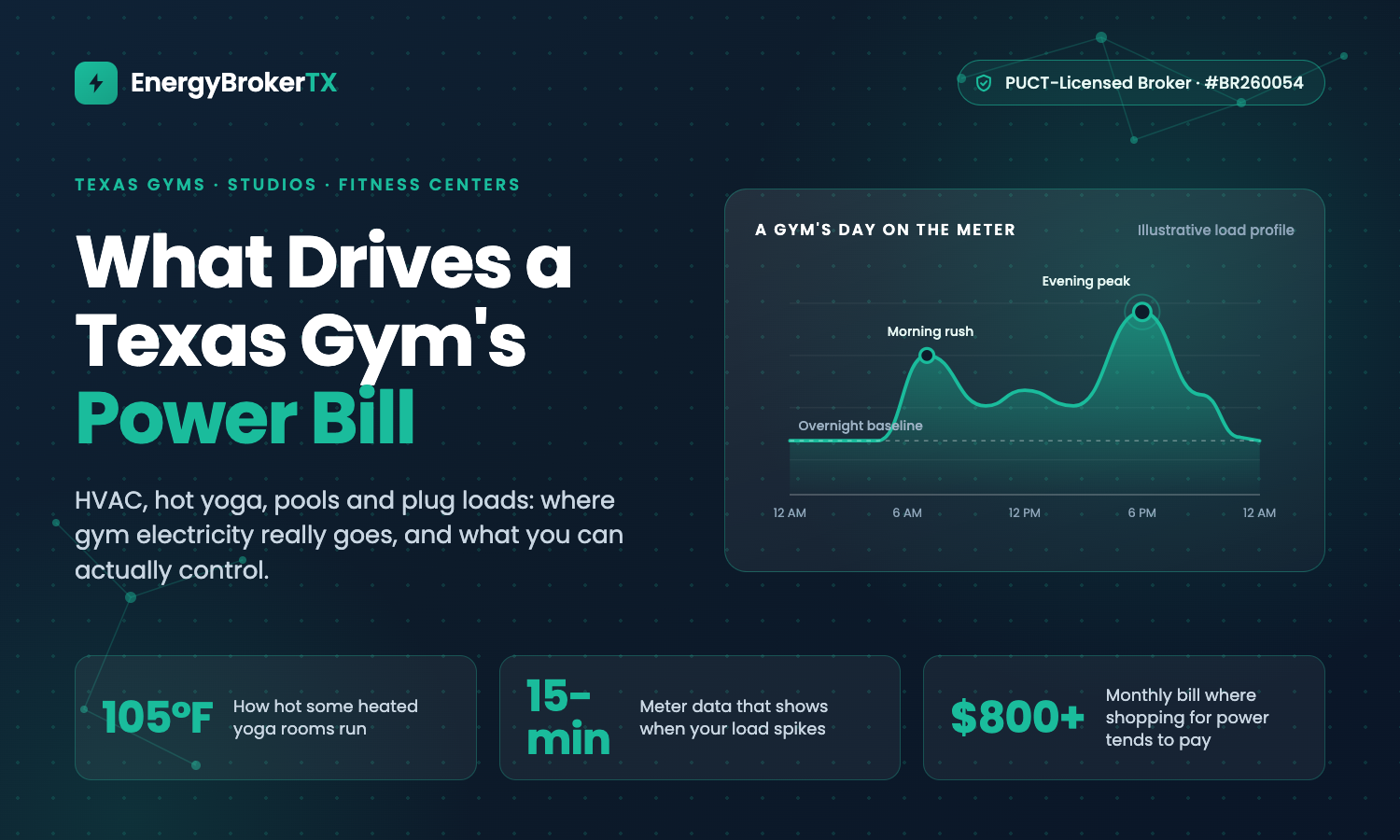
Texas Gyms, Yoga Studios and Fitness Centers: What Drives the Power Bill
What drives the power bill at Texas gyms, yoga studios and fitness centers, from HVAC and hot yoga to pools, and when shopping your rate pays off.

Texas agricultural operations run some of the most electricity-intensive commercial loads in the state — irrigation pumps that can draw as much power as a small factory, grain drying and storage systems concentrated into short harvest windows, and cold storage running continuously to protect perishable product. Despite that load intensity, agricultural electricity accounts are frequently overlooked in commercial energy procurement conversations, which tend to default to office, retail, or industrial examples. The mechanics of deregulation and the potential savings apply just as directly to a farm or ranch operation as to any other commercial account — plus one meaningful advantage most other industries don't have access to at all.
Electric irrigation pumps — center pivot systems, well pumps, and drip irrigation infrastructure — represent the largest single electrical load for most row-crop and specialty-crop operations. These systems draw substantial demand for extended periods during the growing season and largely sit idle the rest of the year, creating one of the most seasonally lopsided load profiles of any commercial vertical in Texas. That pattern has real implications for contract structure: a fixed-rate contract sized around a flat annual average will price differently than one that properly accounts for a heavy irrigation season followed by months of minimal draw, and getting that structure wrong in either direction leaves money on the table.
Grain elevators and on-farm storage and drying operations concentrate enormous electrical demand into harvest-season windows — grain dryers, aeration fans, and conveying equipment running continuously for weeks at a time. This is a demand-charge story more than an energy-consumption story: the peak 15-minute draw during harvest season, not the modest baseline usage the rest of the year, is what a standard demand-metered rate class will bill against. Operations running this kind of seasonal spike should evaluate whether their current rate class and contract structure actually fit a load this lopsided, rather than assuming a generic commercial contract handles it well by default. See our guide on how demand charges work for the underlying mechanics.
Packing houses, cold storage facilities, and dairy operations run continuous refrigeration loads that behave more like the grocery and supermarket vertical than like row-crop irrigation — steady, around-the-clock draw rather than seasonal spikes. These operations benefit from the same refrigeration-specific efficiency and procurement approaches covered in our grocery store electricity guide, adapted to agricultural-scale equipment.
Texas offers a sales tax exemption on electricity used exclusively on a commercial farm or ranch in the production of agricultural products for sale — a real, permanent reduction that has nothing to do with your supply rate and stacks on top of any competitive procurement savings. To claim it, the purchaser must provide their electricity provider with a properly completed Texas Agricultural Sales and Use Tax Exemption Certificate (Form 01-924) showing a current Ag/Timber Number issued by the Texas Comptroller's office. The exemption applies to electricity used for qualifying agricultural purposes — irrigation pumps, for example — but not automatically to every account on the property; electricity for a farmhouse or a business office on the same land generally doesn't qualify the same way. Ag/Timber Numbers expire and must be renewed roughly every four years, and if your provider doesn't have a current certificate on file, they're required to charge sales tax on the account regardless of whether the underlying use would otherwise qualify. If you're not certain whether your operation's accounts are currently coded correctly, it's worth checking directly with your electricity provider and, if needed, the Comptroller's office.
Most Texas commercial guidance recommends avoiding contract signings during summer ERCOT demand peaks, when REP hedging costs push rates higher. For agricultural operations, it's worth layering your own operational calendar on top of that general seasonal guidance — locking in a new contract or renewal ahead of your irrigation or harvest season, rather than during it, gives you rate certainty through your highest-consumption months instead of negotiating from a position where switching disruption during peak season isn't a real option.
Not every agricultural operation in Texas sits in deregulated territory. Many rural areas are served by member-owned electric cooperatives rather than one of the state's investor-owned TDUs, and cooperatives generally aren't part of the mandatory competitive retail market the way Oncor, CenterPoint, or AEP Texas are. If your operation is in or near a major metro's delivery footprint, you're very likely deregulated and can shop competitively; if you're in a more remote rural area, confirm your utility from your bill before assuming a reverse auction applies to your account the way it would in town.
For agricultural accounts in deregulated territory, the process is the same as any other Texas commercial account: submit usage history — accounting for the seasonal swings specific to irrigation, harvest, or cold storage operations — and let multiple licensed providers bid against each other for the account rather than relying on a single quote. Contact EnergyBrokerTX for a free rate comparison and a review of whether your agricultural sales tax exemption paperwork is current. PUC License #BR260054.
Submit your account and we'll run a competitive auction with 25+ licensed Texas providers — full bid transparency, no pre-filtering, no obligation.
Get My Free Competing Bids →