
Texas Gyms, Yoga Studios and Fitness Centers: What Drives the Power Bill
What drives the power bill at Texas gyms, yoga studios and fitness centers, from HVAC and hot yoga to pools, and when shopping your rate pays off.

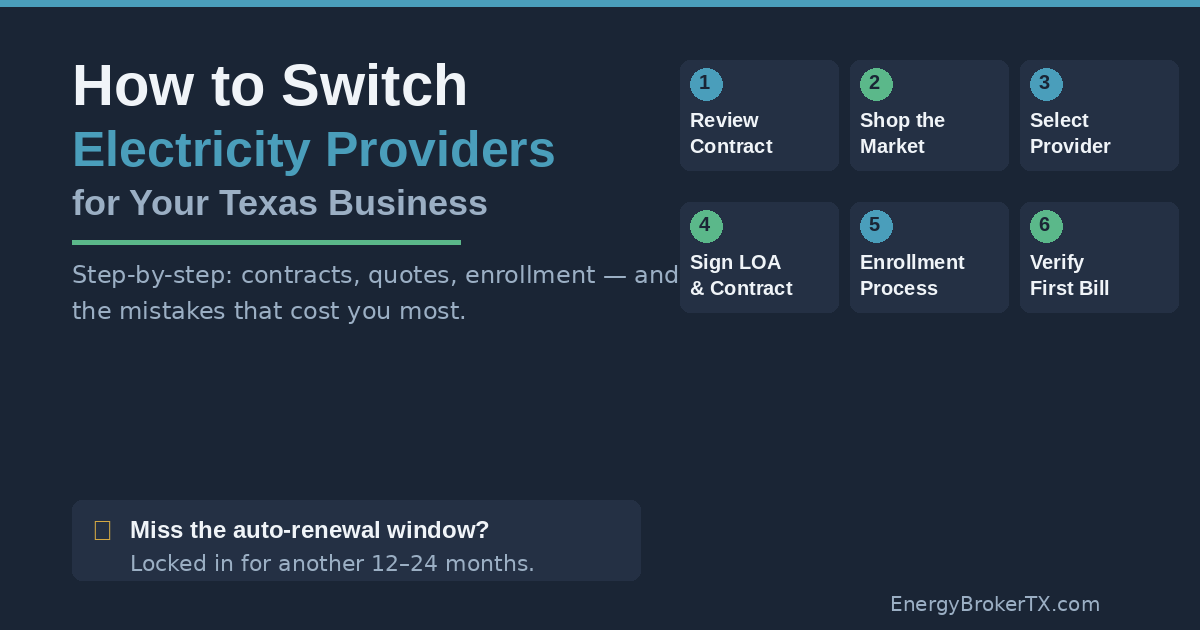
Switching commercial electricity providers in Texas is more straightforward than most business owners expect — but it’s also easier to get wrong than it looks. Missing a notification deadline, misunderstanding your contract terms, or accepting an enrollment error can create service interruptions or financial penalties that offset the savings you were trying to capture.
This guide walks through the actual process of switching electricity providers for a Texas commercial account: what happens when, who does what, and where the complications typically arise.
Before contacting any other electricity provider, you need to know the exact terms of your current contract. The two most important things to find:
This is the date your current fixed-rate contract ends. It’s on your original contract document — not on your monthly bill. If you can’t find the original contract, call your current supplier and ask for the contract end date.
Almost all Texas commercial electricity contracts include an auto-renewal provision. If you don’t provide written notice of your intent not to renew within a specific window before contract expiration (typically 30–60 days), your contract automatically renews for another term at the supplier’s then-current rate. Once that renewal triggers, you’re locked in — even if you haven’t received formal notice.
If you’re planning to switch, you must provide written notice before this deadline. Missing it by even one day can lock you in for another 12–24 months. This is the most common and most expensive mistake Texas businesses make with electricity contracts.
For a complete explanation of how this provision works and how to protect yourself, see our guide on Texas commercial electricity contract auto-renewal.
If your contract has more than 30–60 days remaining and you want to switch now anyway, check whether it allows early termination and what the penalty is. Early termination can make financial sense if the savings from a new lower-rate contract exceed the termination penalty — but you need to do that math explicitly before proceeding.
Once you know your contract status, the next step is obtaining competitive quotes. For a Texas commercial account, this means submitting your usage information to multiple retail electricity providers (REPs) simultaneously and evaluating their quotes.
You can contact suppliers directly or work through a licensed Texas energy broker. The broker approach is almost always more effective because brokers access pricing tiers not available to businesses going direct, and submitting your account to 8–10 suppliers simultaneously creates genuine competitive pressure. A reverse auction process typically produces the most competitive rates of any procurement method.
When evaluating quotes, compare on a total all-in cents-per-kWh basis including energy charges, TDSP pass-throughs, and all fees. See our complete guide to comparing commercial electricity providers in Texas for detailed guidance.
Rate is the primary factor, but not the only one. Before signing with a new supplier, review these contract elements:
Contract length: 12, 24, and 36-month contracts are most common. Longer terms typically offer lower rates but reduce flexibility.
Price structure: Fixed-rate contracts lock in your energy cost for the contract term. Most commercial businesses should be on fixed-rate contracts for budget certainty.
Swing tolerance: Most fixed-rate contracts include a provision specifying how much your actual usage can vary from your contracted usage estimate before surcharges apply. A contract with tight swing tolerance (±10%) can trigger extra charges if your business has seasonal usage variation. Contracts with wider tolerance (±20–25%) provide more protection.
Auto-renewal terms on the new contract: The same auto-renewal provisions that affect your current contract will apply to the new one. Note the notification window in your new contract and mark the deadline on your calendar the day you sign.
TDSP pass-through structure: Some contracts price TDSP charges as fixed components; others pass them through at actual cost. Fixed all-in contracts protect against utility rate increases during your contract term.
To enroll with a new electricity supplier, you’ll typically need to:
Review both documents for accuracy before signing: your ESI ID(s), the contracted rate, contract start and end dates, and auto-renewal provisions.
Once you’ve signed with a new supplier, the enrollment process is handled between your new REP and your utility (TDSP):
The common point of confusion: many businesses expect something visible to happen when they switch electricity providers. Nothing physical changes. The switch is purely administrative — who you’re buying power from changes in the ERCOT system, but the power itself is delivered identically by the same TDSP infrastructure.
After your new contract starts, verify your first bill carefully:
Errors on commercial electricity accounts do happen — usually in the form of billing during the transition period at incorrect rates. Catching these early is much easier than untangling them months later. See our guide on how to read a Texas commercial electricity bill for help interpreting what you’re seeing.
Missing the auto-renewal notification window. The most common and most expensive mistake. Calendar the notification deadline the day you sign your current contract.
Accepting the first quote you receive. Switching providers is an opportunity to run a competitive process. Always get multiple quotes before making a decision.
Switching too close to renewal without enough time to shop. Competitive procurement takes 2–4 weeks from data submission to executed contract. Starting 10 days before expiration doesn’t give you time to do it properly.
Not reading the new contract before signing. Especially the auto-renewal clause, swing tolerance provisions, and contract start date.
Working with a licensed Texas energy broker simplifies most of this process. The broker reviews your current contract, identifies your notification deadlines, submits your usage data to multiple suppliers, runs the competitive process, presents you with evaluated quotes, and manages the LOA and enrollment paperwork. You make the final decision on which rate to accept; the broker handles everything else.
For more on how working with a broker compares to switching providers on your own, see our detailed comparison of energy brokers vs. going direct to a Texas electricity supplier. To understand what to look for in a broker, see how to choose the right energy broker for your Texas business.
Submit your account and we'll run a competitive auction with 25+ licensed Texas providers — full bid transparency, no pre-filtering, no obligation.
Get My Free Competing Bids →