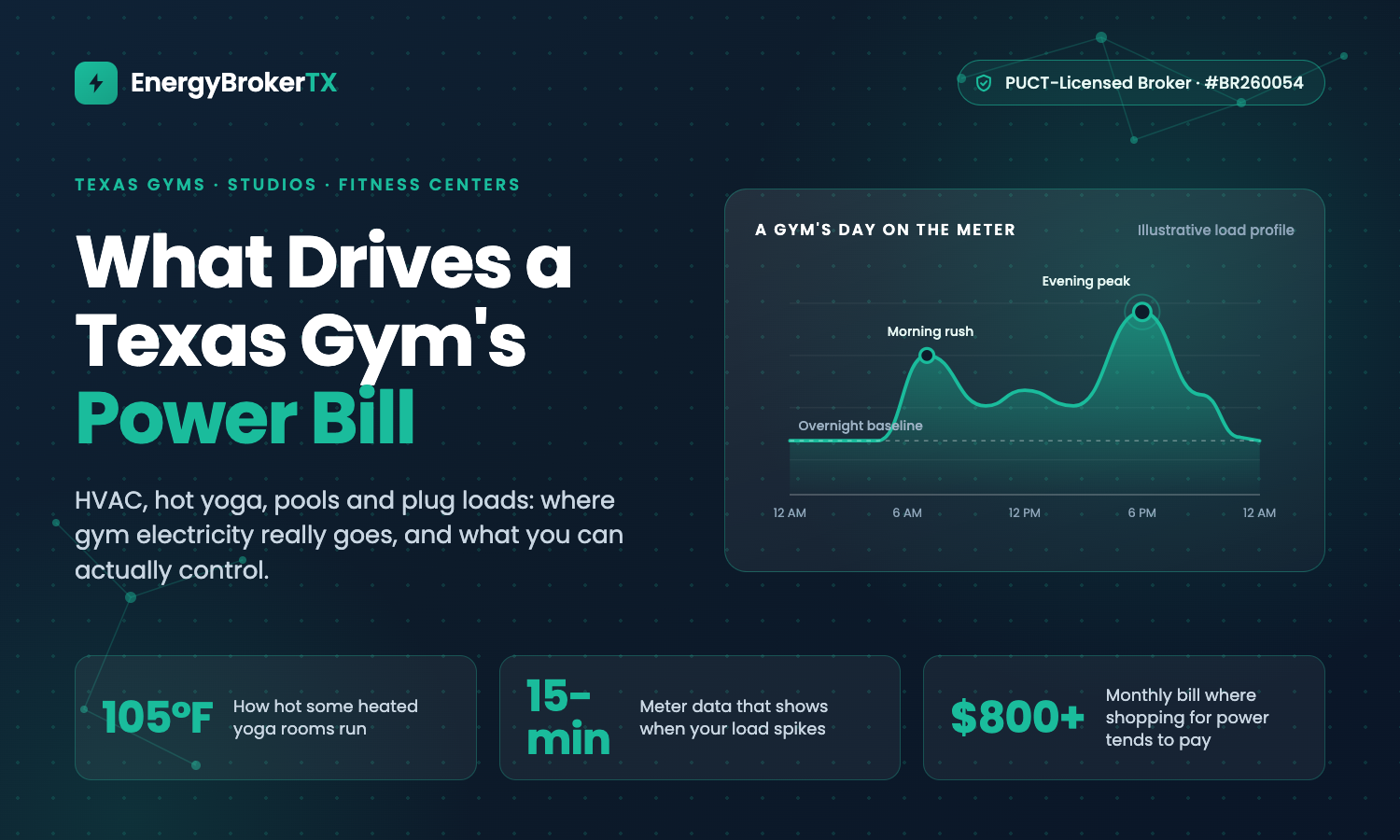
Texas Gyms, Yoga Studios and Fitness Centers: What Drives the Power Bill
What drives the power bill at Texas gyms, yoga studios and fitness centers, from HVAC and hot yoga to pools, and when shopping your rate pays off.

Texas auto dealerships have a usage profile that makes them consistently good candidates for electricity savings — and consistently bad candidates for just accepting whatever rate their current supplier renews them at. The combination of large facilities, extended operating hours, high-consumption equipment, and multiple meters on a single property creates real complexity that most dealership owners aren’t equipped to navigate alone.
This guide covers the specific factors that drive electricity costs for Texas auto dealerships, what competitive rates look like for dealership-class commercial accounts, and how to approach procurement to maximize savings.
A typical Texas auto dealership — showroom, service bays, parts department, detail area, and lot lighting — has several characteristics that affect electricity pricing:
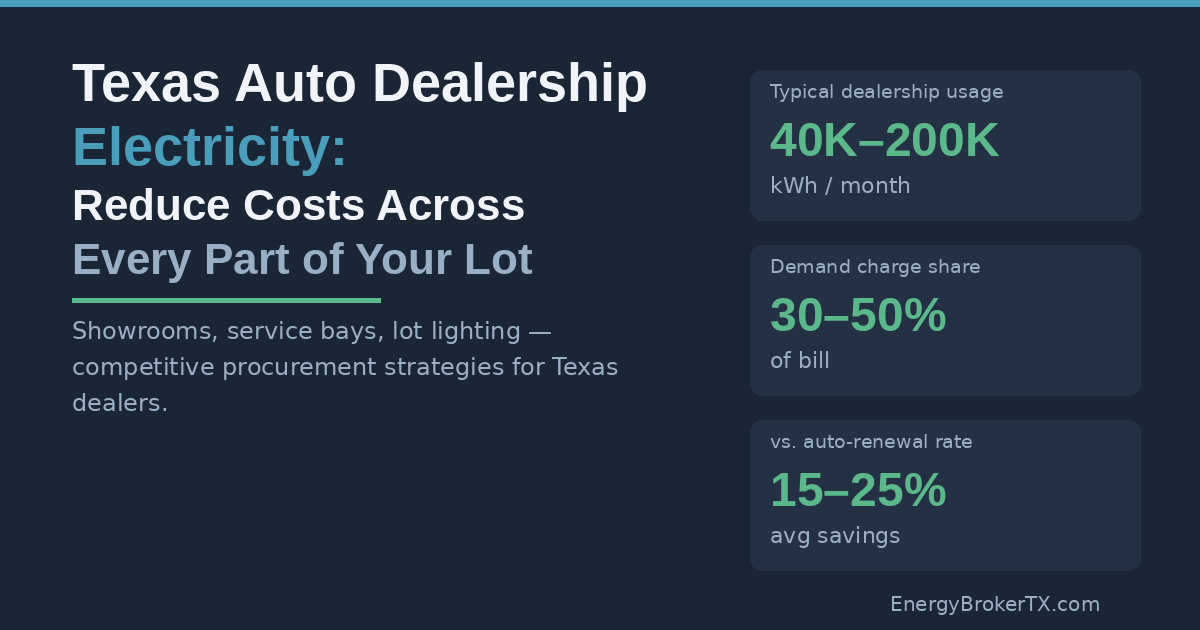
Service departments run heavy equipment: vehicle lifts, air compressors, diagnostic computers, paint booths. HVAC systems must condition large open spaces including showrooms and service bays. Lot lighting often runs from dusk to midnight or later. The result is a meaningful peak demand — and in Texas commercial billing, that peak demand creates a demand charge on your monthly bill that can represent 30–50% of total electricity costs.
Understanding how demand charges work on Texas commercial electricity bills is foundational to evaluating any rate quote, because suppliers handle demand charges differently in their contract structures. Some bundle demand charges into an all-in fixed rate; others pass them through at actual cost. The total impact on your bill differs significantly depending on which structure you’re under.
Many dealerships — especially those with separate showroom buildings, service facilities, and used car lots — have two to five electricity accounts on a single property. These accounts are often priced and contracted independently, which misses the opportunity to aggregate them for better pricing leverage.
A procurement process that consolidates multiple accounts under a single supplier relationship typically produces better rates than contracting each account individually, because suppliers are competing for larger total volume.
Dealerships operate longer hours than many commercial businesses and maintain more consistent electricity consumption patterns. Showrooms keep lights on late; service departments run equipment through the day; lot lighting operates every evening. This relatively consistent, predictable load profile is attractive to suppliers — consistent usage is easier to price and hedge than highly variable usage — which means dealerships with good historical usage data can access competitive pricing.
Texas auto dealerships in Oncor, CenterPoint, AEP, and other utility territories can access commercial electricity rates through the ERCOT market’s deregulated pricing. Typical dealerships fall in the mid-size commercial category — monthly consumption often ranging from 40,000–200,000 kWh depending on facility size and service volume.
For accounts in this range, competitive market rates currently run 7.5–11.0¢/kWh all-in for 12–24 month fixed-rate contracts. Where your dealership falls in that range depends on your load factor, meter type, utility territory, and the competitiveness of your procurement process.
Dealerships that have auto-renewed with the same supplier multiple times frequently find they’re paying 15–25% above competitive market rates when they finally shop. On a dealership spending $15,000/month on electricity across multiple accounts, a 20% gap is $3,000/month — or $36,000 over a 12-month contract period.
Most commercial electricity contracts in Texas include auto-renewal clauses that activate 30–60 days before the contract end date. If you don’t provide written notice of your intent not to renew within that window, you’re locked in for another term — at rates determined by the supplier, not by competitive market pressure.
Dealerships are particularly vulnerable to this problem because electricity management rarely has a dedicated owner. The general manager is focused on vehicle sales and service volume; the office manager is handling title work and accounts payable. Nobody is tracking a contract expiration date 90 days out.
For a detailed explanation of how auto-renewal clauses work and how to protect your business from them, see our guide on Texas commercial electricity contract auto-renewal.
The highest-impact action any dealership can take is running a proper competitive procurement process 90–120 days before contract expiration. This means submitting your usage data to multiple suppliers simultaneously and evaluating their quotes on an equivalent all-in basis. A reverse auction process formalizes this by having suppliers compete in real time for your account.
Doing this through a licensed Texas energy broker is both more effective (brokers access supplier pricing tiers not available directly to businesses) and more practical (the broker manages the process, freeing your time for dealership operations).
If your dealership property has multiple electricity meters currently on separate contracts — possibly with different suppliers and different expiration dates — synchronizing those contracts and consolidating them under a single supplier relationship creates better pricing leverage and simplifies management significantly.
This consolidation process typically happens at renewal and requires coordinating expiration dates across accounts. A broker can manage this across your accounts simultaneously.
In the current ERCOT market, the decision between 12-month, 24-month, and 36-month fixed-rate contracts carries real financial implications. Longer contracts provide price certainty but expose you to rate changes if market prices decline. Shorter contracts offer flexibility but require more frequent procurement cycles.
The right choice depends on current forward market prices for electricity and your assessment of rate trends. This is a judgment call your energy broker can help you make based on current market data — not something to decide based on a supplier’s suggestion, since the supplier has its own financial interest in the contract length you choose.
Texas commercial electricity bills contain multiple line items, not all of which are affected by your choice of supplier. Your TDSP charges (the cost of delivering power through your utility’s infrastructure) are fixed regardless of which REP you use. Your energy charges (the actual electricity commodity) are where competitive pricing applies.
Understanding this distinction helps you evaluate rate quotes accurately. See our guide on how to read a Texas commercial electricity bill for a full breakdown.
To get accurate supplier quotes for your dealership, you’ll need:
With this information, a broker can go to market on your behalf and return competitive quotes within 3–5 business days.
Auto dealership groups operating multiple stores across Texas — or even a single metro area — have significant procurement leverage that single-location dealers don’t. Aggregating the electrical load of multiple stores into a single competitive procurement process concentrates your volume and forces suppliers to compete harder for the combined account.
Dealership groups often represent 500,000–2,000,000 kWh/month in total consumption when all locations are included. At that scale, pricing access and negotiating leverage improve substantially. A broker who manages multi-location commercial accounts can structure the procurement to capture that leverage while managing the complexity of coordinating multiple accounts, utilities, and contract terms.
The first step is identifying your current electricity contract expiration date. If you’re within 90 days of expiration or if you’ve already auto-renewed without shopping, you should be in the market immediately.
A licensed Texas energy broker can audit your current accounts, identify your contract status, and run a competitive procurement process — all at no cost to you. Broker compensation is built into the supplier’s margin structure; you pay the same or less than going direct, with better rates and a managed process.
For context on how this process works across different business types in Texas, see our overview of how Texas businesses save on commercial electricity through brokers.
Submit your account and we'll run a competitive auction with 25+ licensed Texas providers — full bid transparency, no pre-filtering, no obligation.
Get My Free Competing Bids →