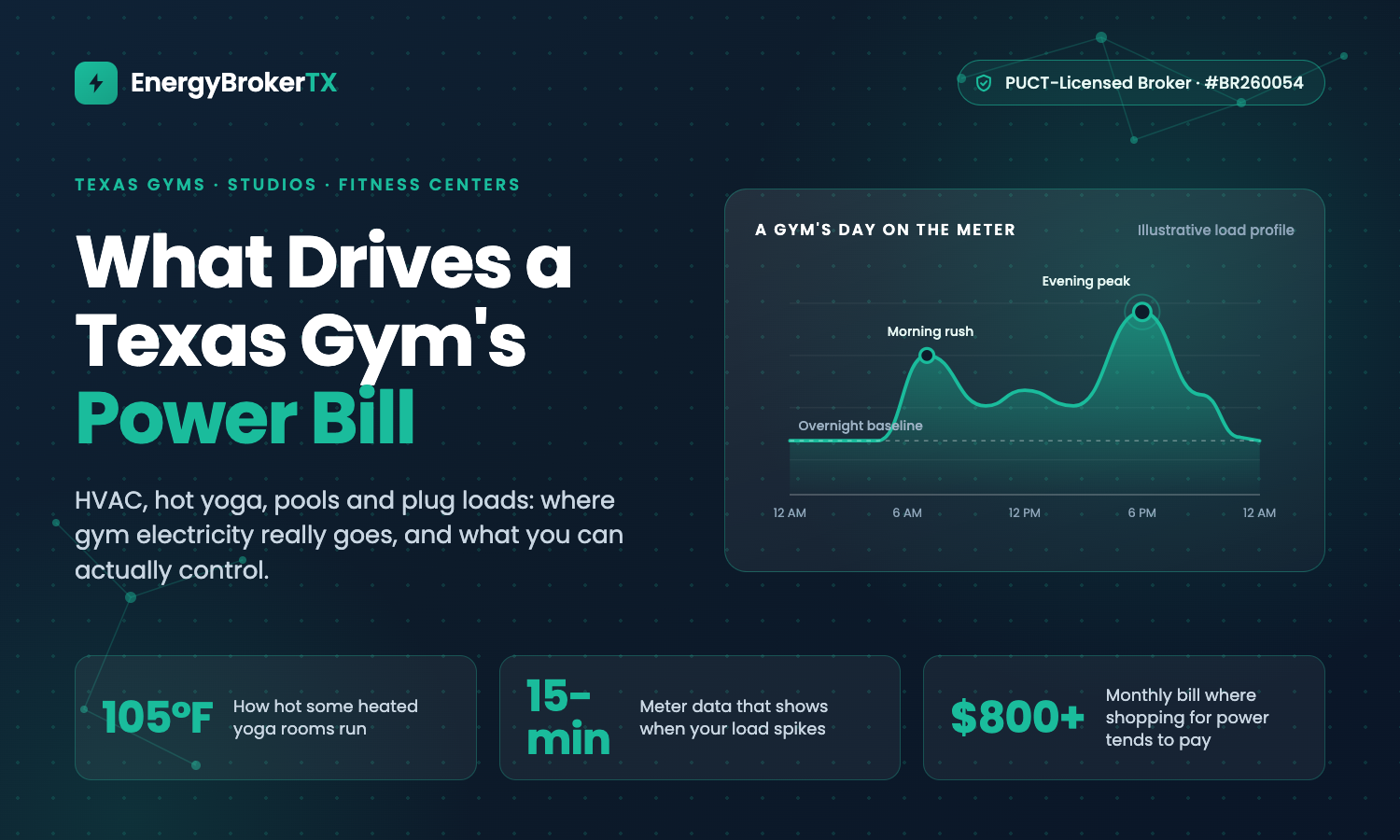
Texas Gyms, Yoga Studios and Fitness Centers: What Drives the Power Bill
What drives the power bill at Texas gyms, yoga studios and fitness centers, from HVAC and hot yoga to pools, and when shopping your rate pays off.


If you manage or own a commercial building in Texas — whether it's an office complex, a strip center, a warehouse, an industrial park, or a multifamily property — your electricity bill is probably one of your top three operating expenses. And in most cases, you're overpaying for it.
Not because you made a bad decision. Because commercial energy procurement is confusing by design, contracts auto-renew at higher rates, and most building owners simply don't have time to shop 25+ providers every 12 to 36 months. That's the gap a commercial electricity broker fills.
Here's a plain-English breakdown of what a broker actually does for commercial buildings, which property types benefit most, and what to look for when choosing one in Texas.
An electricity broker is an independent third party — licensed by the Texas Public Utility Commission — who represents your building when shopping for electricity contracts, not the providers. That distinction matters.
When you go directly to a retail electricity provider (REP) for a quote, you get one quote, from one company, with no competitive pressure to offer you their best rate. When a licensed broker submits your account profile to 25+ providers simultaneously and runs a competitive bid process, you get what's called a reverse auction — providers compete against each other for your business. The lowest qualified offer wins.
The broker's compensation comes from the winning provider, built into the rate — not from you. That means you access the same (or better) pricing you'd get going direct, plus independent market expertise, without writing a single additional check.
For Texas commercial buildings specifically, this matters because the state's deregulated energy market under ERCOT gives you genuine choice between dozens of licensed REPs. That competition only benefits you if you actually use it — which is exactly what a broker facilitates.
The honest answer is: most of them. But a few property types see the most significant impact:
Office buildings and commercial campuses — typically have predictable usage patterns, which makes them ideal candidates for fixed-rate plans. A broker can lock in a multi-year rate before summer peaks drive prices up, protecting operating budgets across an entire lease cycle.
Industrial and manufacturing facilities — these are often the highest-usage accounts, and the savings potential per kWh reduction is amplified by sheer volume. A manufacturer using 500,000 kWh per month saving even half a cent per kWh recaptures $30,000 a year. Brokers who understand demand charges and load factor pricing can find manufacturing-specific plans that generic comparison sites don't offer.
Retail and convenience store chains — multi-location operators face the added complexity of aligning contract expirations across different TDU territories. A broker can aggregate multiple accounts, negotiate volume pricing, and manage renewal timelines so nothing auto-renews at a default rate. Learn more about retail and convenience store energy options.
Multifamily and apartment properties — common-area electricity for lighting, HVAC, elevators, laundry, and amenities represents a real cost center for property managers. Multifamily energy brokerage can reduce those costs without touching resident units.
Commercial real estate portfolios — property managers overseeing multiple buildings benefit most from a broker who can manage procurement across the portfolio rather than piecing together individual contracts one at a time. See our commercial real estate energy page for more on how this works.
According to the U.S. Energy Information Administration, commercial buildings account for roughly 36% of total U.S. electricity consumption. In Texas, the average commercial rate sits around 8.6¢/kWh in energy supply costs — but that figure is nearly meaningless without context.
A 5,000 sq ft professional office in Frisco paying 9.2¢/kWh is in a completely different situation than a 200,000 sq ft cold storage facility in Fort Worth paying 8.1¢/kWh with a heavy demand charge on top. Your total all-in cost includes:
A good broker understands all three components and targets plans designed for your specific load profile — not just the lowest headline rate.
Here's what actually happens when you work with EnergyBrokerTX to broker electricity for a commercial building:
Step 1 — Share your usage data. You provide a recent utility bill or just your building's ZIP code and average monthly kWh. This takes about 60 seconds. The more detail you provide, the more precisely providers can quote.
Step 2 — We build your profile. We analyze your usage patterns, peak demand, contract history, and current rate to identify which plan types and contract lengths make sense for your property.
Step 3 — Providers bid. Your profile goes to 25+ licensed Texas REPs simultaneously. They submit competitive bids — fixed, variable, indexed, and green options. You see all of them, side by side, with no filtering on our end.
Step 4 — You choose. Pick the rate and contract structure that fits your building's needs and risk tolerance. There's no obligation to accept any quote.
Step 5 — We handle the switch. We coordinate all paperwork with your chosen provider and your TDU. Service is never interrupted. For most buildings, the entire process from first contact to signed contract takes 24–48 hours.
See our full breakdown of how the reverse auction process works for more detail on the mechanics.
Not all brokers operate the same way. Before you hand over your utility bills, ask a few pointed questions:
Are they licensed with the Texas PUC? In Texas, energy brokers must be registered with the Public Utility Commission of Texas. This is non-negotiable — unlicensed brokers have no regulatory accountability if a deal goes sideways.
How many providers do they work with? A broker accessing 5–10 providers is giving you a fraction of the market. You want access to 20+ REPs, ideally including both large national suppliers and competitive regional providers.
How are they compensated? Legitimate brokers are compensated by the winning provider through a residual built into the rate — not by charging you a consulting fee on top. The rate you see should be all-in.
Do they monitor contract expirations? One of the most common ways commercial buildings overpay is auto-renewal into month-to-month or rollover rates. A broker who actively tracks your contract calendar and alerts you 90–120 days before expiration is worth more long-term than one who disappears after the first deal closes.
Do they understand your industry? A broker who works with office buildings, manufacturers, restaurants, and car washes all the same way probably isn't digging into the nuances of your specific load profile. Industry-specific expertise matters when it comes to demand charge optimization and plan structure.
Does using a broker cost more than going directly to a provider? No. Brokers are compensated by the provider through a small margin built into the contract rate — the same mechanism used whether you go direct or through a broker. In practice, brokers often negotiate rates at or below what you'd get going direct, because providers price competitively to win auction business.
How far in advance should I start shopping my commercial building's electricity contract? 90 to 120 days before your current contract expires is the sweet spot. This gives providers enough time to quote accurately, gives you time to compare options without pressure, and ensures you don't accidentally roll into an auto-renewal. If you don't know your expiration date, your current provider is required to notify you — check your most recent bill or call your REP's commercial line.
What if my building is in a regulated (non-deregulated) area of Texas? Roughly 85% of Texas falls under ERCOT's deregulated market. Major exceptions include El Paso (served by El Paso Electric, under AEP) and some municipal utility territories like Austin Energy and CPS Energy in San Antonio. If you're in a regulated area, your supply rate is set by the utility and not brokerable — but delivery charges and usage optimization strategies still apply.
Can a broker help with multiple buildings under one account? Yes — this is one of the strongest use cases for brokerage. Aggregating multiple meters under a single contract negotiation often unlocks volume pricing that individual buildings wouldn't qualify for on their own.
How long do commercial electricity contracts typically run? In Texas, commercial contracts most commonly range from 12 to 36 months. Longer terms (48–60 months) are available and can lock in favorable rates if the market timing is right — as we did for one local church that secured a 48-month contract saving over $40,000. See our commercial energy rates page for more on contract structures.
Commercial buildings in Texas are sitting in one of the most competitive electricity markets in the world — but most are still paying default rates because they haven't taken 60 seconds to let providers compete for their account. That's exactly what EnergyBrokerTX was built to fix.
If your building's electricity contract is coming up in the next six months — or if you genuinely don't know when it expires — now is the right time to find out what the market will actually offer you.
Run a free, no-obligation reverse auction with EnergyBrokerTX. Most buildings get competing quotes within 24 hours — and switching is free, with no interruption to service.
Get My Free Commercial Building Quote → Or call us directly at (737) 295-9735. We're available Monday–Friday, 8:30 a.m. to 5 p.m.
EnergyBrokerTX is a licensed Texas energy broker (PUCT registered), serving commercial buildings across Dallas, Fort Worth, Houston, Austin, San Antonio, and across the Oncor, AEP, and CenterPoint service territories.
Submit your account and we'll run a competitive auction with 25+ licensed Texas providers — full bid transparency, no pre-filtering, no obligation.
Get My Free Competing Bids →