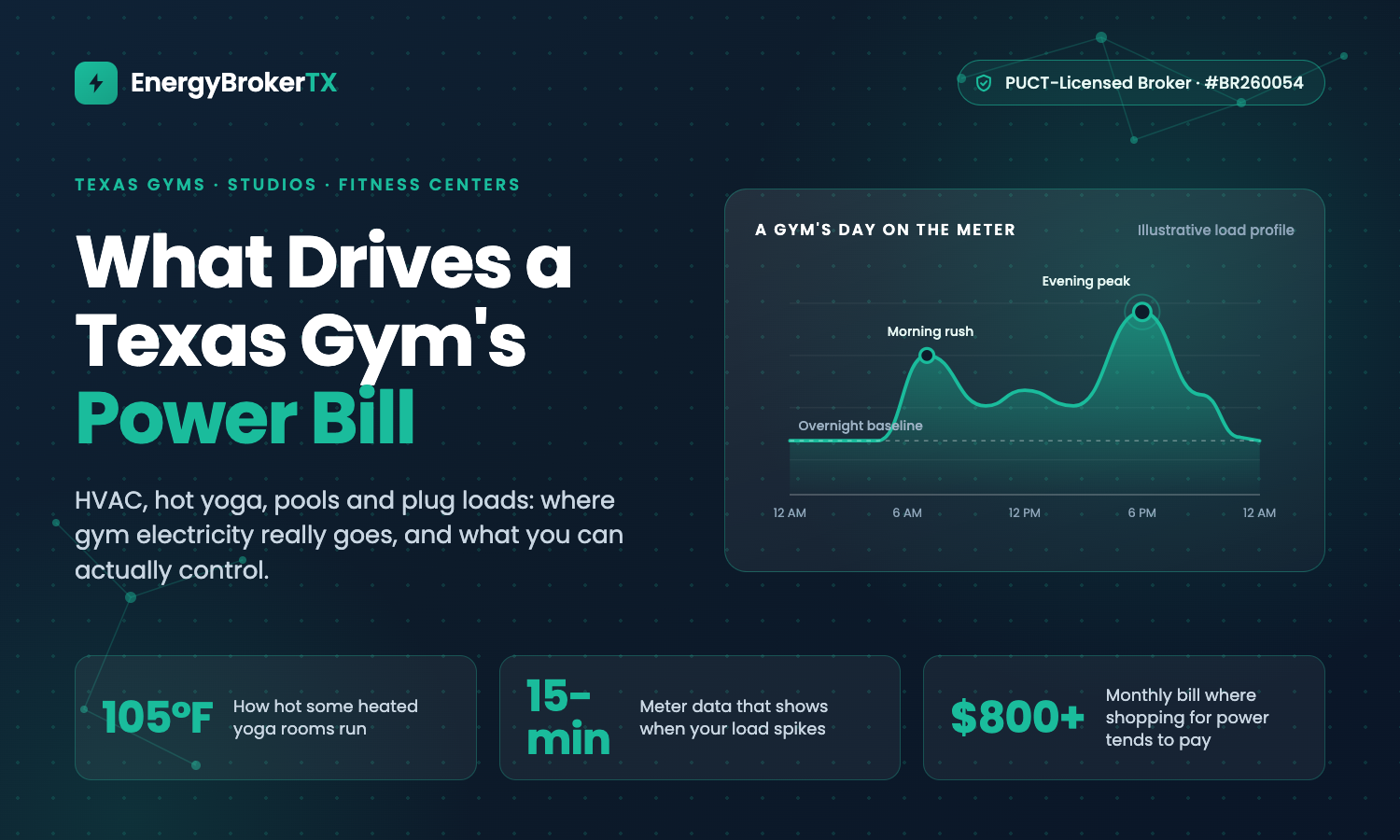
Texas Gyms, Yoga Studios and Fitness Centers: What Drives the Power Bill
What drives the power bill at Texas gyms, yoga studios and fitness centers, from HVAC and hot yoga to pools, and when shopping your rate pays off.


As a hotel owner or general manager in Texas, you know the hospitality industry runs on razor-thin margins. Between staffing, maintenance, marketing to fill rooms, and keeping guests happy with top-notch amenities, every dollar counts. Electricity? It's often one of your top three expenses—right up there with labor and property taxes. In a state where summer heat can push AC systems to the limit and ERCOT grid volatility sends rates soaring, overpaying on power isn't just frustrating; it's a direct hit to your RevPAR and bottom line.
I've spent the last decade helping Texas hotels—from boutique properties in Austin to full-service chains in Dallas—navigate the deregulated electricity market. As a licensed broker with EnergyBrokerTx, I've seen firsthand how smart rate shopping can slash bills by 15–30%, freeing up cash for what really drives occupancy: better guest experiences, room upgrades, or even staff incentives. This guide isn't about theory—it's a practical roadmap based on real data from the Public Utility Commission of Texas (PUCT) and ERCOT reports, plus strategies that have worked for hundreds of hospitality clients.
Whether you're managing a 100-room motel in Corpus Christi or a multi-property portfolio across Houston and Fort Worth, you'll learn how to identify hidden costs, negotiate better deals, and lock in stability before the next summer spike. Let's dive in.
Texas has one of the most competitive electricity markets in the U.S., with about 85% of the state deregulated under the ERCOT grid. That means you aren't stuck with a single utility provider like in regulated areas (think core Austin with Austin Energy or San Antonio with CPS Energy). Instead, you can choose from dozens of retail electricity providers (REPs) who compete on price, plan types, and terms.
The setup is simple: Your local utility (e.g., Oncor in Dallas or CenterPoint in Houston) owns the wires and delivers power—handling outages and meter reads. But the REP supplies the electricity and sets your rate. This competition is a game-changer for hotels, where high-usage loads like guest-room AC, pools, kitchens, elevators, and 24/7 lobby lighting can rack up massive bills.
According to the U.S. Energy Information Administration (EIA), Texas commercial rates averaged 8.6¢ per kWh in 2025—35% below the national average of 14.1¢—thanks to deregulation. But for hotels, that's just the starting point. Many properties are overpaying because they're on default variable plans or auto-renewed contracts that spike during high-demand periods. ERCOT's 2025 annual report showed wholesale prices hitting $9,000 per MWh during extreme weather events, indirectly inflating retail bills for unprotected plans.
If your hotel is in a deregulated area (most major metros and suburbs are), you have real leverage. Tools like our Dallas commercial electricity rates page or Houston rates guide can show you current benchmarks. The key? Don't just renew—shop competitively to capture those savings.
Texas hospitality is booming, with occupancy rates hitting 68% statewide in 2025 (per Texas Hotel & Lodging Association data). But rising energy costs are a silent killer. Here are the most common challenges I hear from hoteliers:
First, summer cooling demands. Texas heat waves push HVAC systems to the max—guest rooms, lobbies, event spaces, pools, and spas all running nonstop. Bills can surge 40–60% from June to September, per ERCOT's seasonal forecasts. For a 150-room hotel, that's often $5,000–$15,000 extra per month in peak season, eating into profits when occupancy is highest.
Second, peak demand charges. Hotels have spiky usage: morning checkouts with elevators buzzing, evening kitchen rushes, and late-night pool lighting. These "demand" fees—based on your highest 15-minute power draw—can make up 30–50% of the bill. PUCT rules allow utilities like Oncor or AEP Texas to charge $10–$20 per kW, turning a single rush hour into a monthly penalty.
Third, 24/7 operations and variable occupancy. Unlike offices that shut down at night, hotels run around the clock. Low-occupancy weeks still incur full common-area costs, and unpredictable guest loads (e.g., event bookings) make budgeting tough. Add ERCOT's volatility—wholesale prices jumped 25% during 2025's heat dome—and fixed costs become anything but fixed.
Fourth, tenant/guest pass-through issues. In extended-stay or corporate housing hotels, sub-metering or allocating costs fairly is complex. Overpaying means higher rates passed to guests, hurting competitiveness, or absorbed losses that hit your NOI.
Fifth, sustainability pressures. Guests increasingly demand eco-friendly stays—TripAdvisor surveys show 78% of travelers prefer green hotels. But renewable plans often come at a premium unless negotiated properly.
These aren't abstract issues; they're showing up in balance sheets. A mid-tier Houston hotel we worked with was losing $28,000/year to demand spikes alone. By switching providers, they cut costs 22% and reinvested in solar pool heating for a greener profile.
The deregulated market gives you options—here's how to use them. As a broker who's negotiated hundreds of hospitality contracts, I recommend starting with a full audit, then layering strategies for maximum impact.
Strategy 1: Run a Competitive Reverse Auction for the Lowest Rates: Don't renew with your current provider—let competition work for you. Our reverse auctions page pits 25+ PUCT-approved REPs against each other in a private bidding process. You provide usage data, we run the auction (often in 24 hours), and you get side-by-side offers with no markups. Fixed-rate plans are ideal for hotels, locking in stability for 12–36 months and avoiding ERCOT spikes. Clients in Frisco and other DFW suburbs have saved 18–25% this way, without lifting a finger.
Strategy 2: Optimize for Peak Demand and Shift Loads: Demand charges are killers—reduce them by staggering high-load activities. For example, run laundry cycles or pool pumps during off-peak hours (use smart timers or EMS software). Install variable-frequency drives (VFDs) on HVAC and elevators to smooth power draws. ERCOT's Emergency Response Service (ERS) pays hotels to curtail non-essential loads during grid stress—up to $50,000/MW per season. A Corpus Christi beachfront hotel shifted pool heating to nights and cut demand 15%, saving $9,200/year.
Strategy 3: Upgrade Efficiency Without Breaking the Bank: Texas incentives make upgrades affordable. The PUCT's Standard Offer Program rebates up to $0.15/kWh saved on LED lighting, ENERGY STAR appliances, and efficient HVAC retrofits. For hotels, focus on guest-room sensors (auto-off AC/lights when unoccupied) and smart thermostats—they can drop usage 10–20%. A Waco hotel near Baylor University upgraded to LEDs and sensors, qualifying for $8,500 in rebates while saving $14,000/year.
Strategy 4: Explore Green & Renewable Options for Guest Appeal: Sustainability sells—79% of business travelers prefer eco-hotels, per a 2025 Deloitte report. Many REPs offer 100% renewable plans at little premium when negotiated. Wind-rich areas like West Texas (Xcel territory) make green energy cost-effective. Pair with our auction to find plans that meet ESG goals without inflating OpEx. A San Antonio-area resort switched to 100% wind and marketed it as "green hospitality," boosting bookings 12% while saving 18% on rates.
Strategy 5: Consolidate Multi-Property Portfolios for Bulk Savings: For chains or portfolios, aggregate usage across properties to qualify for volume discounts. Sub-metering common areas vs. guest rooms allows precise allocation and better rates. We helped a DFW hotel group consolidate 5 properties, securing a master fixed-rate plan that saved $52,000 over 48 months—check our hotel case studies on the hospitality landing page for more details.
Combining these—starting with an auction—yields the best results. A Houston convention hotel audited peaks, upgraded HVAC, and switched via auction, reducing costs 27% ($68,000/year saved).
Case Study 1: Midscale Hotel in Dallas Suburbs: A 120-room property was on a variable plan, with summer bills spiking 45% from pool and AC loads. We ran a reverse auction, landing a 24-month fixed rate at 7.4¢/kWh (down from 9.6¢/kWh), saving $24,800 in the first year. Savings funded lobby renovations, improving guest reviews and occupancy by 8%.
Case Study 2: Boutique Resort in Corpus Christi: Coastal humidity drove constant dehumidification and cooling costs. Our auction secured a green fixed-rate plan 22% lower, saving $38,000 annually. They marketed the switch as "eco-friendly hospitality," attracting more tourists and boosting RevPAR 11%.
Case Study 3: Extended-Stay Hotel in Frisco: High tenant loads and common-area usage led to unpredictable bills. We consolidated metering and auctioned for a 36-month fixed rate, cutting costs 25% ($55,000 over 48 months). Redirected funds went to Wi-Fi upgrades and marketing, increasing long-term bookings.
These examples—from our dedicated hospitality blog hub—show how deregulation turns costs into opportunities.
ERCOT's 2026 forecast predicts tighter supply due to growing demand from data centers and EVs, potentially driving wholesale spikes. PUCT data shows average commercial rates at 8.6¢/kWh, but hotels with outdated plans pay 10–12¢ or more. With occupancy rebounding post-pandemic (Texas Hotel & Lodging Association reports 72% projected for 2026), now is the time to lock in fixed rates and protect your budget.
Don't go it alone—providers won't volunteer their lowest offers. Use expert negotiation to your advantage.
You've got the insights—now let's put them to work. At EnergyBrokerTx, we've helped hundreds of Texas hotels reduce electricity costs 15–30% through our free reverse auction. It's no-obligation, takes 60 seconds to start, and delivers results in 24 hours.
Visit our contact us page to get your free rate comparison today. Or explore more on our Dallas, Houston, and Frisco city pages for local insights. Questions? Call (737) 295-9735 or email sales@energybrokertx.com—we're here to help Texas hospitality thrive.
Submit your account and we'll run a competitive auction with 25+ licensed Texas providers — full bid transparency, no pre-filtering, no obligation.
Get My Free Competing Bids →