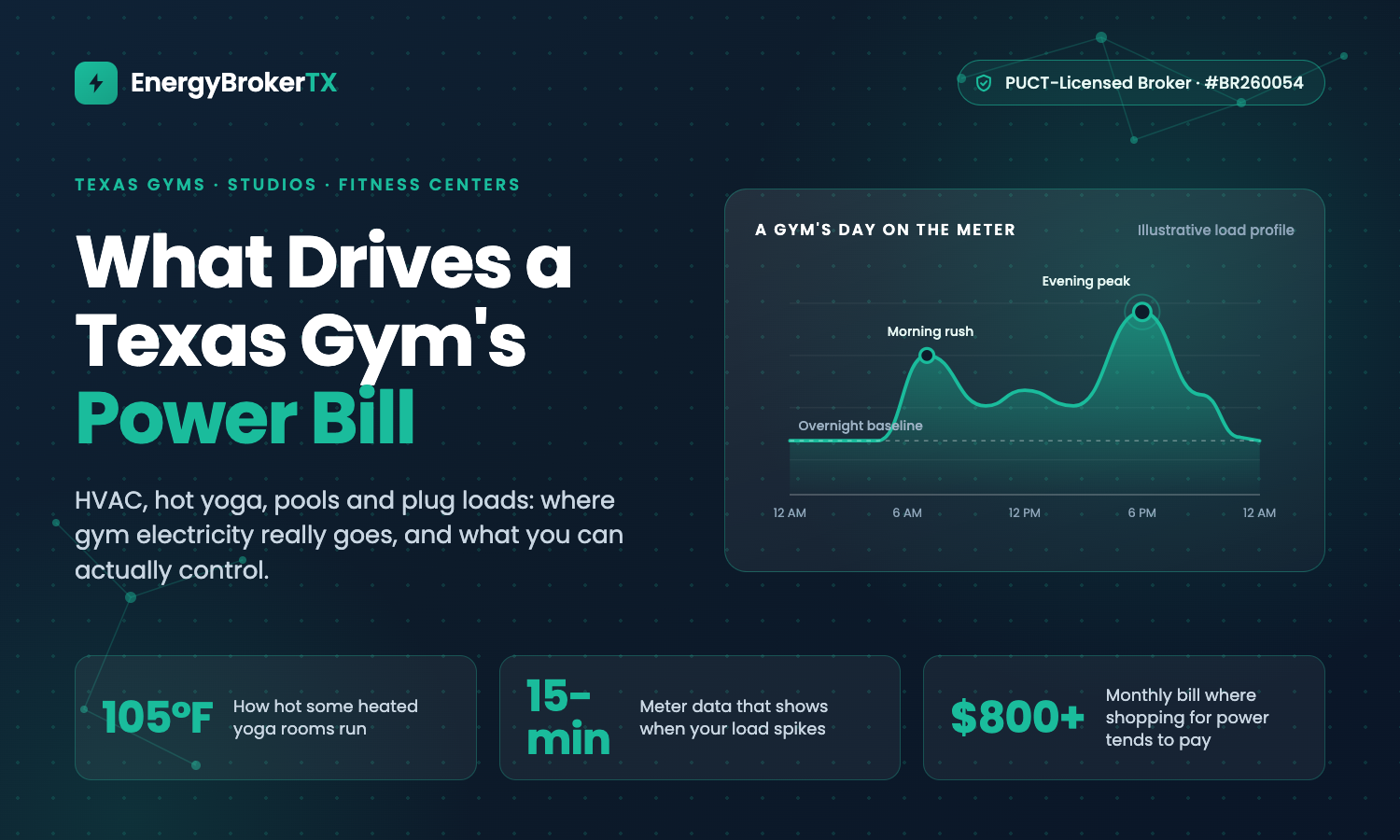
Texas Gyms, Yoga Studios and Fitness Centers: What Drives the Power Bill
What drives the power bill at Texas gyms, yoga studios and fitness centers, from HVAC and hot yoga to pools, and when shopping your rate pays off.

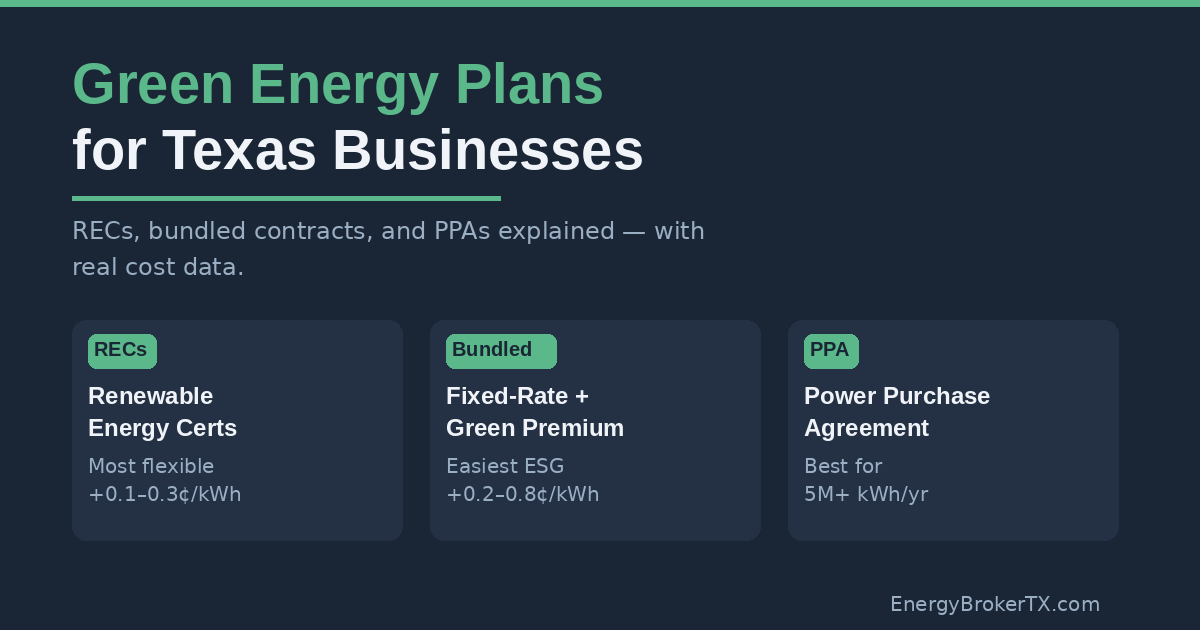
If your business has sustainability goals or ESG commitments, or if your customers or investors are asking about your energy sourcing, you’ve probably looked at green electricity options in Texas. What you’ve likely found is a confusing mix of claims, certificate programs, and pricing that’s difficult to evaluate.
This guide cuts through the confusion and explains how green energy actually works in the Texas deregulated electricity market, what the different options cost, and how to evaluate whether a green electricity plan makes financial sense for your business.
In the ERCOT market, electrons from a wind farm and electrons from a natural gas plant are physically identical once they enter the grid — you can’t route “your” renewable electricity to your meter. What green electricity programs actually sell is the environmental attribute of renewable generation, separate from the physical energy.
This separation is managed through Renewable Energy Certificates (RECs). When a renewable energy facility — a wind farm in West Texas, a solar installation in the Permian Basin — generates one megawatt-hour of electricity, it also generates one REC. That REC can be sold separately from the underlying electricity. A business that purchases RECs is claiming the environmental attributes of that renewable generation, even though the physical electricity flowing to their meter comes from wherever on the ERCOT grid it happens to be cheapest at any given moment.
This is not a scam or a workaround — it’s the standard, regulated mechanism for tracking and claiming renewable energy consumption. The system is called ERCOT’s Generation Attribute Tracking System (GATS), and it’s how the state maintains the integrity of renewable claims.
These contracts price the energy component and the RECs together, offering you a fixed all-in rate that includes renewable credits matched to 100% of your consumption. They’re structurally identical to standard fixed-rate commercial contracts, with the addition that your supplier purchases and retires RECs on your behalf.
Cost premium over equivalent non-green contracts: typically 0.2–0.8¢/kWh in current market conditions, which translates to 2–8% above a standard fixed rate depending on your usage profile and the supplier.
This is the simplest option and the easiest to document for ESG reporting purposes, because your electricity bill reflects your renewable commitment directly.
Some businesses choose to sign a standard competitive electricity contract (optimizing for lowest energy cost) and then separately purchase RECs to cover their consumption. This approach allows you to shop the electricity market and the REC market independently, potentially at lower total cost.
Texas wind RECs currently trade at relatively low prices — often $1–3 per MWH — because Texas generates significant wind capacity relative to REC demand. A business consuming 100,000 kWh monthly (100 MWH) could cover its consumption with RECs at a cost of $100–$300/month, or roughly 0.1–0.3¢/kWh, which is often cheaper than a bundled green contract premium.
The tradeoff: managing a separate REC purchase adds administrative complexity, and some third-party ESG frameworks require specific forms of renewable procurement that may not recognize unbundled RECs purchased independently.
A Power Purchase Agreement is a long-term contract (typically 10–20 years) directly with a renewable energy project developer. The business agrees to purchase the electricity output of a specific renewable facility at a fixed price. PPAs are common for large energy users — universities, data centers, large manufacturers — because they provide long-term price certainty and the strongest form of renewable attribution (a direct contract with an identified facility).
For most Texas commercial businesses using under 1 million kWh annually, PPAs are not practical. The minimum contract sizes, long terms, and complexity of negotiation make them cost-effective only at scale. If your business uses 5+ million kWh annually and has a strong interest in long-term renewable commitment, a PPA is worth evaluating through a specialized energy advisor.
Community solar programs allow businesses to purchase a share of a local solar installation’s output, typically with a 10–20 year commitment and a guaranteed subscription rate. Texas community solar is less developed than in some other states due to ERCOT’s market structure, but several programs exist and more are being developed as solar capacity expands in Texas.
The premium for green electricity in Texas has narrowed significantly over the past several years as renewable supply has increased. For a commercial business today, the realistic cost comparison looks like this:
Assume a mid-size Frisco office building using 80,000 kWh/month on a 24-month fixed-rate contract, currently paying 9.5¢/kWh all-in on a standard contract. A green-bundled contract for the same account might price at 9.8–10.1¢/kWh — a premium of $240–$480/month.
Alternatively, purchasing 80 MWH of Texas wind RECs separately at $2/MWH adds $160/month to their electricity cost while they maintain the standard competitive rate.
The total annual cost difference between “going green” and standard procurement ranges from roughly $1,900 to $5,800 for this account — meaningful but not prohibitive for a business with genuine sustainability goals.
Regardless of whether you sign a green-bundled contract or purchase RECs separately, your Oncor TDSP charges remain the same. The distribution infrastructure that delivers electricity to your meter is operated the same way for green and non-green accounts.
Green electricity also doesn’t change how demand charges work on your bill. If your operation has peak-demand billing, that cost structure is independent of your energy sourcing choice.
And procurement strategy still matters the same way it does for standard contracts. A competitive procurement process for a green-bundled contract can produce rates 10–20% lower than accepting the first quote you receive, the same as for standard contracts. Shopping multiple suppliers for a green contract is just as important as shopping for a non-green one.
If your business is pursuing carbon reporting under a framework like GHG Protocol, CDP, or a specific industry standard, the type of renewable attribution you claim matters. Key distinctions:
Market-based accounting allows you to use RECs, green-bundled contracts, or PPAs to claim zero or reduced Scope 2 emissions for your purchased electricity. This is the more flexible approach and is valid under GHG Protocol’s Market-Based Method.
Location-based accounting uses the grid average emissions factor regardless of what you purchased. If you’re reporting Scope 2 emissions on a location-based basis, your renewable purchase doesn’t reduce your reported footprint under that method, even though it’s still environmentally meaningful.
Most corporate sustainability frameworks accept market-based accounting using RECs or bundled contracts. If your business is working toward a Science-Based Target or other formal commitment, verify what documentation your specific framework requires before choosing your procurement approach.
A practical checklist for Texas commercial businesses evaluating green electricity:
The same procurement strategy that produces competitive rates on standard commercial electricity contracts applies to green contracts. Running a reverse auction process with multiple suppliers simultaneously forces competitive pricing on both the energy component and the REC premium.
A licensed Texas energy broker can run this process for green contracts the same as for standard ones — at no cost to you. If sustainability is a priority for your business and you want to understand your specific options and costs, the most efficient path is running a competitive procurement that includes both standard and green-bundled options side by side, so you can see the exact premium and make an informed decision.
For context on the broader procurement process for Texas commercial businesses, see our complete guide to comparing commercial electricity providers in Texas.
Submit your account and we'll run a competitive auction with 25+ licensed Texas providers — full bid transparency, no pre-filtering, no obligation.
Get My Free Competing Bids →