Texas Gyms, Yoga Studios and Fitness Centers: What Drives the Power Bill
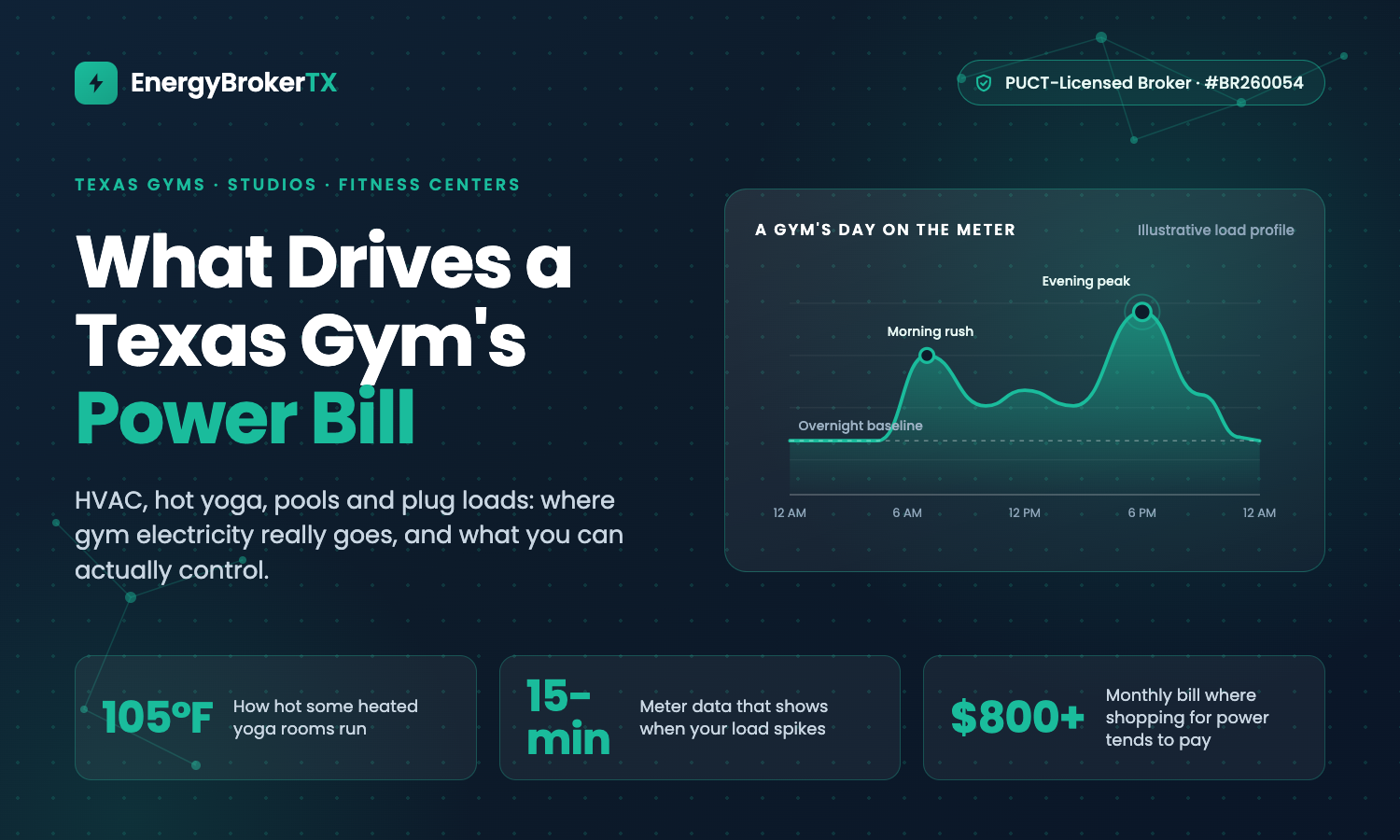
What drives the power bill at Texas gyms, yoga studios and fitness centers, from HVAC and hot yoga to pools, and when shopping your rate pays off.


The Permian Basin runs some of the most electricity-intensive commercial and industrial operations in Texas — drilling rigs, electric-powered artificial lift, gas processing facilities, and increasingly, the electrification of fleets that used to run entirely on diesel. Despite the region's reputation as oil and gas country, Midland and Odessa themselves sit squarely inside Oncor's deregulated delivery territory, meaning the same competitive market that serves Dallas-Fort Worth applies here — a fact that surprises a lot of operators who assume West Texas works differently.
It's a common assumption that West Texas falls under AEP Texas North, since AEP does serve nearby Abilene and San Angelo. Midland and Odessa themselves, however, are Oncor Electric Delivery territory — the same TDU that serves Dallas-Fort Worth, just extended west along Oncor's service footprint. That means the same delivery tariff structure, the same 4CP transmission cost mechanics, and the same competitive REP market apply to a Midland office or processing facility as apply to a business in Fort Worth. Confirm your specific TDU from your bill's ESI ID regardless — see our AEP Texas & TNMP territory guide for how to read that identifier if you're near a zone boundary.
The city centers of Midland and Odessa are deregulated Oncor territory, but a meaningful share of remote wellsite and drilling operations across the wider Permian Basin are served by rural electric cooperatives rather than one of Texas's major investor-owned TDUs. Member-owned co-ops are generally not part of the mandatory competitive retail market the way Oncor, CenterPoint, or AEP Texas are — meaning a remote compressor station or wellsite pad several miles outside city limits may not have retail choice at all, even though the nearest town does. If you operate across multiple sites in the region, don't assume uniform deregulation status — confirm the utility on each specific location's bill before building a procurement strategy around it.
The shift toward electric drilling rigs, electric frac fleets, and grid-powered artificial lift (rather than diesel or field gas generation) has meaningfully increased grid-connected load across the Basin over the past several years. These operations behave more like large industrial demand accounts than traditional oilfield load — concentrated, high-kW draws that make demand charge structure and 4CP exposure genuinely material to total cost, in the same way they are for manufacturing facilities elsewhere in the state. A facility running continuous electric artificial lift benefits from the same forecasting and load-shedding strategies covered in our 4CP guide, scaled to a much larger baseline draw.
Gas processing plants and midstream compression facilities in the Basin typically run 24/7 baseline loads with less seasonal variation than most commercial verticals, which makes them strong candidates for longer fixed-term contracts if current rates sit below the forward market curve. The stability of the load profile also makes these accounts attractive to REPs in a competitive bid — a predictable, high-volume account is exactly the kind of load providers price aggressively to win.
West Texas transmission capacity has been a persistent constraint as Permian Basin electrical demand has grown, occasionally producing negative or near-zero wholesale pricing during high-wind, low-demand periods and tighter conditions during summer peaks. That volatility cuts both ways for a large account: it rewards businesses that can flex consumption to take advantage of low-price windows, and it penalizes those caught unaware during scarcity events. See our guide on ERCOT load growth for the statewide context driving this pattern.
Electric and dual-fuel frac fleets have displaced a meaningful share of traditional diesel-powered completions equipment across the Basin, driven by both cost and emissions considerations. From a procurement standpoint, this shift moves a chunk of what used to be an operator's fuel budget into an electricity budget instead — meaning oilfield service companies that never used to think about competitive electricity procurement now have a genuine reason to. If your operation has added grid-connected equipment in the past few years that wasn't there during your last electricity contract, that's a strong signal to re-evaluate your rate structure rather than assume the old contract still fits.
Most of it, but not all. The core Midland-Odessa metro area is Oncor territory within ERCOT. Some remote sites, particularly toward the New Mexico border, may fall under different grid interconnections or non-deregulated rural cooperatives — always confirm the specific utility for each individual location rather than assuming uniform status across a multi-site operation.
Yes — the mechanism doesn't distinguish by industry, only by account size and metering class. Large primary-metered oilfield and midstream accounts are subject to the same four-coincident-peak transmission cost allocation as any other large commercial or industrial account in ERCOT.
Often, yes, for sites within the same deregulated territory — aggregating multiple accounts into a single portfolio auction typically produces better pricing than bidding each site separately, though sites on different TDUs or non-deregulated cooperatives may need to be handled separately.
Large industrial and oilfield-adjacent accounts in Midland-Odessa benefit from the same competitive bid process as any other Texas commercial account — submitting usage history and interval data to 25 or more licensed providers rather than negotiating with a single supplier in isolation. For multi-site operators, aggregating accounts across several field locations into a single portfolio auction typically produces better pricing than bidding each site individually. Contact EnergyBrokerTX for a free rate comparison for your Permian Basin operation. PUC License #BR260054.
Submit your account and we'll run a competitive auction with 25+ licensed Texas providers — full bid transparency, no pre-filtering, no obligation.
Get My Free Competing Bids →