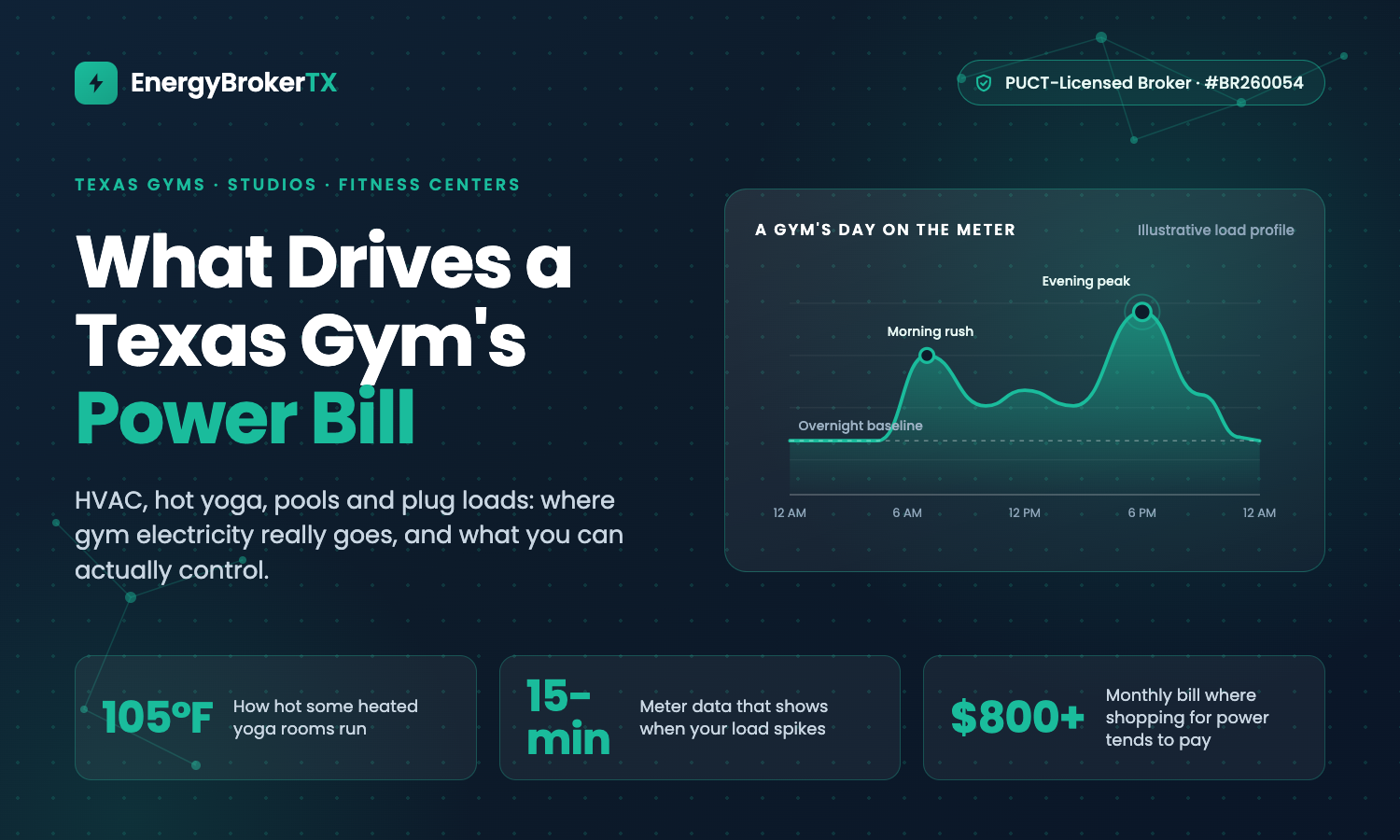
Texas Gyms, Yoga Studios and Fitness Centers: What Drives the Power Bill
What drives the power bill at Texas gyms, yoga studios and fitness centers, from HVAC and hot yoga to pools, and when shopping your rate pays off.


Texas manufacturing facilities consume electricity at an intensity that puts them in a category of their own among commercial customers. EIA commercial building energy data shows manufacturing operations averaging 95–400 kWh per square foot annually depending on production type — compared to 14–52 kWh per square foot for most other commercial building types. High base load, continuous production cycles, and peak demand from motor-driven equipment create an electricity cost structure with specific vulnerabilities that generic commercial procurement doesn't address.
The good news for Texas manufacturers: that same intensity makes your account more attractive to retail electricity providers in a competitive auction. Larger, steady, high-load-factor accounts attract more aggressive bids than small, volatile ones. A Texas manufacturing operation that runs competitive procurement at contract renewal consistently outperforms passive renewals by 1.0–2.0¢/kWh — and at 200,000 kWh per month, that's $2,000–4,000 per month in savings, $48,000–96,000 over a 24-month contract.
Texas manufacturing operations in deregulated ERCOT territory have the same two-component bill structure as all commercial accounts, but the proportions are different and the demand charge component is substantially larger.
Supply charge: The per-kWh energy rate from your retail electricity provider. This is the competitive piece. For Texas manufacturing accounts in 2026, competitive auction supply rates range 7.0–8.2¢/kWh for 24-month fixed contracts. Large accounts above 500 kW consistently see rates in the 6.8–7.5¢/kWh range in competitive auctions.
Oncor (or CenterPoint/AEP Texas) delivery charges: Fixed, regulated, non-negotiable. For manufacturing accounts in Oncor territory, delivery charges for Secondary Service (10–200 kW) run approximately 3.5–4.5¢/kWh. Primary Service accounts (above 200 kW, customer-owned transformer) see lower delivery charges and better all-in economics. Whether your facility qualifies for Primary Service classification is worth verifying with your TDU if you haven't recently.
Demand charges: For manufacturing operations, demand charges are the single most important line item to optimize. The TDU demand charge is based on your peak 15-minute kW draw and is assessed by Oncor, CenterPoint, or AEP Texas at rates that vary by rate class. The supply contract may also include a demand-related component depending on contract structure. Combined, demand charges can represent 40–60% of total electricity cost for energy-intensive manufacturing operations. A 500 kW peak demand account at a $15/kW demand charge rate pays $7,500/month in demand charges alone — before any kWh energy charges.
See our detailed guide on Texas commercial demand charges for the complete mechanics of how these are calculated and how contract structure affects total cost.
Manufacturing electricity demand is driven primarily by motor loads: compressors, conveyors, pumps, machine tools, HVAC, and process heating equipment. The peak demand event that sets your monthly demand charge is typically not a sustained operational high — it's often a startup transient. When a plant opens for a shift and multiple high-draw motors start simultaneously, instantaneous demand spikes well above normal operating levels for 1–3 minutes before settling into steady-state operation.
This startup spike, if it falls within the billing period's worst 15-minute interval, sets your demand charge for the entire month from one brief event. At $15–18/kW — typical demand charge rates in Texas commercial procurement — a startup spike that pushes demand 30 kW above normal operating level costs $450–$540 in demand charges for the month from a few minutes of transient load.
Two approaches address this at the procurement level rather than the operational level. First, some Texas supply contracts offer demand charge structures with ratchet provisions or demand caps that reduce the penalty for infrequent high peaks. A broker who understands manufacturing load profiles can identify these contract structures and include them in the auction comparison. Second, requesting your 15-minute interval data from Oncor (available through Smart Meter Texas) shows exactly which events are creating your peak demand and lets you evaluate whether operational changes (staggered startup sequences) could reduce the demand charge without affecting production.
For a manufacturing-specific analysis of how ERCOT demand charges are calculated and reduced, see our detailed guide on ERCOT manufacturing demand charges.
Supply rate benchmarks from competitive auctions for Texas manufacturing accounts as of April 2026, organized by account size:
Small manufacturing (20,000–80,000 kWh/month, under 100 kW demand): 7.8–9.0¢/kWh supply rate for 24-month fixed in Oncor territory. Secondary Service meter classification. Accounts on passive renewals of 24+ months frequently at 9.5–11¢/kWh. Auction improvement: 1.0–2.0¢/kWh.
Medium manufacturing (80,000–300,000 kWh/month, 100–500 kW demand): 7.2–8.4¢/kWh supply rate for 24-month fixed. Large Secondary Service or Primary Service depending on transformer ownership. Volume and load factor attract more aggressive bidding. Auction improvement over passive renewal: 1.0–1.8¢/kWh.
Large manufacturing (300,000+ kWh/month, 500+ kW demand): 6.8–7.8¢/kWh supply rate for 24-month fixed. Primary Service classification typical. These accounts attract the most competitive bidding in Texas commercial auctions. Forward contracts with index components may be appropriate for operations with dedicated energy management staff.
Facilities in Dallas and the broader Fort Worth industrial corridors along I-35W, I-20, and SH-360 represent some of the largest manufacturing account volumes we serve in competitive auctions.
Texas ERCOT forward market pricing for manufacturing accounts follows the same seasonal pattern as other commercial accounts — spring pricing is consistently more favorable than summer pricing as forward contracts reflect expected ERCOT demand risk over the contract term. Manufacturing operations with contracts expiring between June and October should begin procurement in April at the latest.
The additional timing consideration for large manufacturing accounts: forward contracts for Primary Service accounts are more actively traded in Texas commercial markets, and the bid spread between spring and summer pricing for large accounts can run 0.5–1.0¢/kWh — which at 500,000 kWh/month is $2,500–5,000/month, $30,000–60,000 over the contract term, from procurement timing alone. See our ERCOT summer 2026 outlook for current forward market context.
Texas manufacturers with multiple facilities — production plants, distribution centers, office locations — have a procurement advantage through portfolio aggregation. Submitting all facilities to a single competitive auction produces lower supply rates across every account compared to individual facility auctions, because combined volume and load are more attractive to providers.
Portfolio procurement also allows contract term alignment across facilities, creating unified renewal windows that simplify energy management and eliminate the risk of individual facilities lapsing onto holdover rates. For manufacturers with some facilities in Oncor territory and others in CenterPoint or AEP Texas territory, many Texas REPs are licensed across multiple territories and can supply all facilities under a single supply contract.
Yes. Provider switching in Texas changes only who bills you for the supply charge — your TDU (Oncor, CenterPoint, or AEP Texas) continues delivering electricity through the same infrastructure without interruption. The transition happens at a meter read boundary, typically overnight. Production operations, equipment, and systems experience zero disruption. There is no reconnection, no meter change, and no notification required to your production staff.
Most Texas manufacturing operations without dedicated energy management staff benefit from fixed-rate contracts — they provide cost certainty for budget planning and protect against the ERCOT summer demand spikes that have historically produced significant wholesale price volatility. Large operations above 1 MW with in-house energy management may benefit from indexed contracts that allow participation in lower wholesale price periods. A broker can model both options against your specific load profile.
Favorably. Manufacturing operations with steady, high-utilization production schedules (high load factor) receive more competitive bids than operations with erratic or seasonal load profiles. Providers can price steady loads more precisely because the risk of over- or under-hedging is lower. If your facility runs two or three production shifts daily with consistent output, your load factor is likely favorable for procurement.
Accounts spending $2,000 or more per month on electricity see meaningful dollar savings from a competitive auction. Below that threshold the absolute improvement is smaller. For multi-facility manufacturers, the relevant threshold is total portfolio spend, not individual facility spend.
Submit your most recent electricity bill to EnergyBrokerTX for a free manufacturing electricity rate audit. We'll pull your interval data, analyze your demand charge structure, run a competitive auction with 25+ licensed Texas providers, and present a total-cost comparison that accounts for both supply rate and demand structure. No cost. No obligation. PUCT License #BR260054. Serving manufacturing operations across Dallas, Fort Worth, Houston, and all of Texas.
Submit your account and we'll run a competitive auction with 25+ licensed Texas providers — full bid transparency, no pre-filtering, no obligation.
Get My Free Competing Bids →