What Frisco Businesses Actually Pay for Electricity — and Why It Varies So Much
If you've compared electricity rates across multiple providers for your Frisco business and found quotes ranging by 20–30%, you're not misreading the numbers. That spread is real, and it reflects how the Texas deregulated electricity market actually functions in Oncor territory.
Frisco sits entirely within Oncor's distribution territory. That means your Transmission and Distribution Service Provider (TDSP) charges — the line items on your bill for delivering power to your meter — are fixed and non-negotiable regardless of which retail electricity provider (REP) you choose. What does vary significantly is the energy component of your rate, which is where the competitive market applies.
This guide covers what commercial electricity rates actually look like in Frisco right now, the factors that determine where your business lands in that range, and how procurement strategy affects your final cost.
Current Commercial Electricity Rate Ranges in Frisco (Oncor Territory)
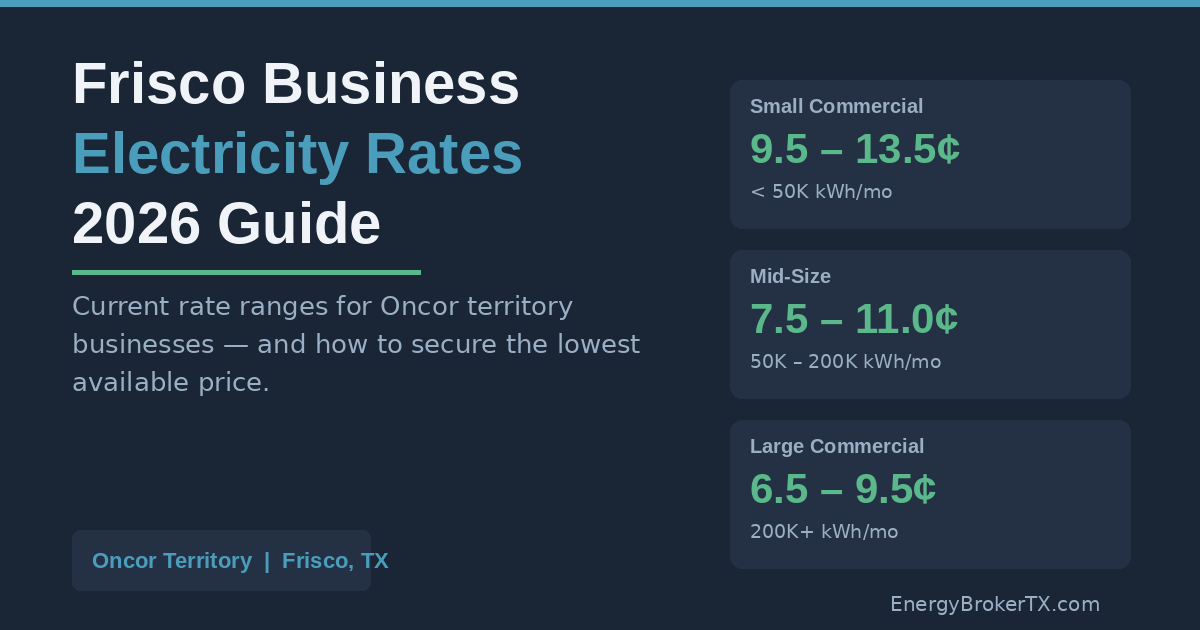
Commercial electricity rates in Texas are quoted as an all-in cents-per-kilowatt-hour figure that blends your energy charges, TDSP pass-through costs, and any applicable fees. In Frisco and the broader Oncor territory, current market rates for commercial fixed-rate contracts typically range:
These ranges reflect what's achievable through competitive procurement. Businesses that accept a renewal quote from their current supplier without shopping the market typically land at the top of these ranges or above them.
TDSP charges in Oncor territory currently run approximately 2.5–3.5¢/kWh depending on your demand profile, which means the energy component of a competitive commercial rate in Frisco is roughly 5–10¢/kWh before TDSP costs are layered in.
Why Frisco Businesses Often Overpay
The two most common reasons commercial businesses in Frisco pay above-market electricity rates:
Auto-Renewal Without Shopping
The majority of commercial electricity contracts in Texas include automatic renewal provisions. If you don't provide written notice within a specified window — often 30–60 days before expiration — your contract renews at whatever rate the supplier chooses. That rate is almost never their most competitive offering.
Businesses that have stayed with the same supplier through multiple auto-renewals frequently find, when they finally shop the market, that they've been paying 15–25% above what competitive procurement would have secured. On a mid-size commercial account spending $5,000/month on electricity, that gap is $750–$1,250 per month in avoidable overpayment.
For a full breakdown of how auto-renewal works and what your notification obligations are, see our detailed guide on Texas commercial electricity contract auto-renewal.
Quoting Only One Supplier
Without comparing multiple supplier quotes simultaneously, you have no market context for evaluating whether a rate is competitive. A quote that looks reasonable in isolation may be well above what a competitive process would produce. The ERCOT market has 50+ retail electricity providers; limiting yourself to one or two quotes means leaving most of the market's competitive pressure unrealized.
What Drives Rate Differences in Frisco
Beyond procurement process, several factors specific to your operation determine where your rate falls:
Load Factor
Load factor is the ratio of your average demand to your peak demand, expressed as a percentage. A business that uses electricity at a consistent rate 24/7 has a high load factor and is attractive to suppliers — they can price it predictably. A business with high peak usage and long idle periods has a lower load factor and represents more pricing risk for suppliers.
Frisco office buildings, professional services firms, and retail locations typically have moderate load factors. Manufacturing and restaurant operations vary significantly. A higher load factor generally means access to better rates, because suppliers compete more aggressively for predictable, consistent load.
Contract Length
Longer-term contracts (24–36 months) typically carry lower rates than 12-month contracts because suppliers can price out the forward market more confidently. However, in a volatile rate environment, locking in for 36 months also exposes you to the risk of rates dropping significantly mid-contract. The right term length depends on current market conditions and your operational stability.
Usage Volume
Higher monthly usage gives a broker more leverage when procuring rates on your behalf. A business using 300,000 kWh/month commands better pricing than one using 30,000 kWh/month, because suppliers earn more margin on larger accounts and compete harder to win them.
Demand Charges
If your Frisco business has a commercial meter with demand billing, your electricity bill includes both an energy charge (per kWh) and a demand charge (per kW of peak demand). Understanding how demand charges work on Texas commercial electricity bills is essential before evaluating any rate quote, because some contract structures pass demand charges through at cost while others bundle them.
Oncor Territory Specifics for Frisco Businesses
Frisco businesses connect to the ERCOT grid through Oncor's distribution infrastructure. A few Oncor-specific details relevant to your electricity costs:
Service territory: Oncor serves most of North Texas including Frisco, Plano, McKinney, Prosper, Celina, and The Colony. If your business has locations in multiple of these cities, they're all in the same TDSP territory — useful for consolidating procurement.
Meter types: Most Frisco commercial meters above a certain usage threshold are interval-demand meters, which log your usage every 15 minutes. This data is what suppliers use to price your load profile. If your meter doesn't have interval data, you may receive less competitive pricing because suppliers have to build more uncertainty into their quotes.
TDSP charges: Oncor's distribution charges are regulated and apply to all commercial customers regardless of which REP they choose. These charges appear on your bill as TDSP or TDU charges. When comparing quotes from different suppliers, ensure you're comparing total all-in rates — some quotes exclude TDSP pass-throughs, which makes them appear lower than they actually are.
The Procurement Process for Frisco Commercial Businesses
Here's what a competitive electricity procurement process actually looks like for a Frisco commercial account:
How Much Can Frisco Businesses Save Through Competitive Procurement?
The answer depends on your baseline rate and how long you've been with your current supplier. For businesses that have auto-renewed one or more times without shopping, savings of 15–25% are common. For businesses that recently signed a competitively-procured contract and are now renewing again, the savings opportunity is smaller but still typically 5–12%.
On a concrete basis: a Frisco business spending $8,000/month on electricity that secures a rate 15% below their current contract saves $1,200/month — or $14,400 over a 12-month contract period. Over a 24-month contract, that's $28,800 in retained margin.
These are real numbers from real procurement outcomes. They're not guaranteed, because market conditions vary, but they represent what's achievable when a business runs a full competitive process rather than accepting whatever rate their current supplier presents at renewal.
Frisco-Specific Considerations by Business Type
Office and professional services: Typically moderate load with predictable usage patterns. Good candidates for 24-month fixed-rate contracts. Demand charges are usually a smaller percentage of total bill than energy charges.
Retail and restaurant: Usage peaks during business hours and drops significantly overnight. Lower load factor means slightly less favorable pricing, but still significant savings available through competitive procurement. See our guide on electricity cost savings for Texas restaurants for industry-specific strategies.
Medical and dental offices: Often high-consumption operations with specialized equipment. Strong candidates for competitive procurement given meaningful monthly spend. See our resource on cutting electricity costs for Texas dental and medical practices.
Light manufacturing and warehouse: Usage patterns vary widely. Interval data is particularly important for accurate pricing. Demand charges may represent a significant portion of total bill.
Multi-location operations: Frisco businesses with additional locations in Plano, McKinney, Allen, or other Oncor-territory cities can aggregate that load for better pricing leverage. See our guide on commercial energy procurement for Oncor territory businesses.
Getting Started
If your commercial electricity contract expires in the next 90 days, you should be in the market now. If it's further out, tracking your expiration date and setting a calendar reminder to initiate procurement 90 days before that date is the single most useful thing you can do today.
A licensed Texas energy broker can run a competitive procurement process for your Frisco business at no cost to you — broker compensation is built into the supplier's margin structure, not added to your rate. For context on how that works, see our explanation of how Texas commercial energy brokers are paid.
To understand what you're currently paying versus what's available in the market, start with your most recent 12 months of electricity bills and your contract expiration date. Those two data points are enough to begin a competitive procurement process.