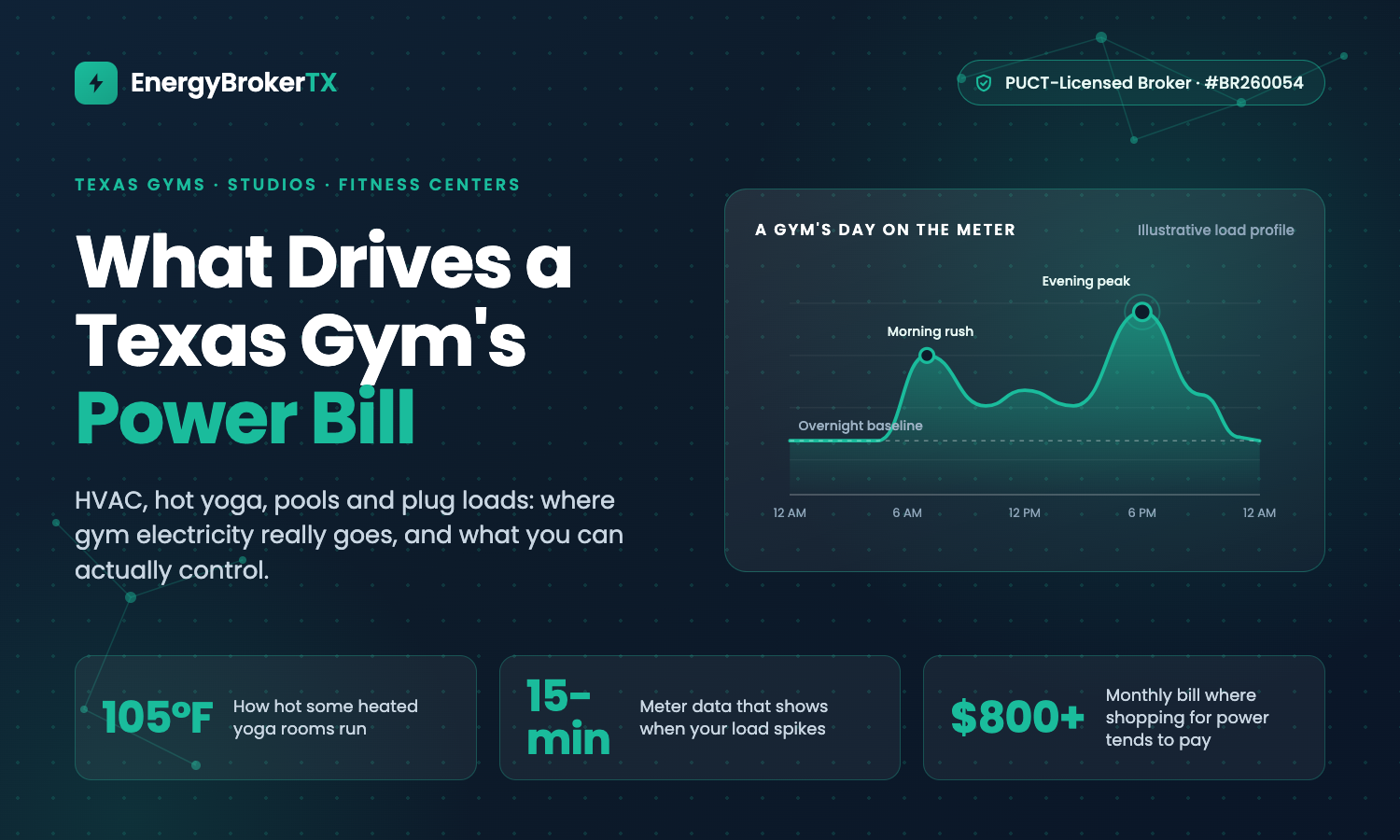
Texas Gyms, Yoga Studios and Fitness Centers: What Drives the Power Bill
What drives the power bill at Texas gyms, yoga studios and fitness centers, from HVAC and hot yoga to pools, and when shopping your rate pays off.

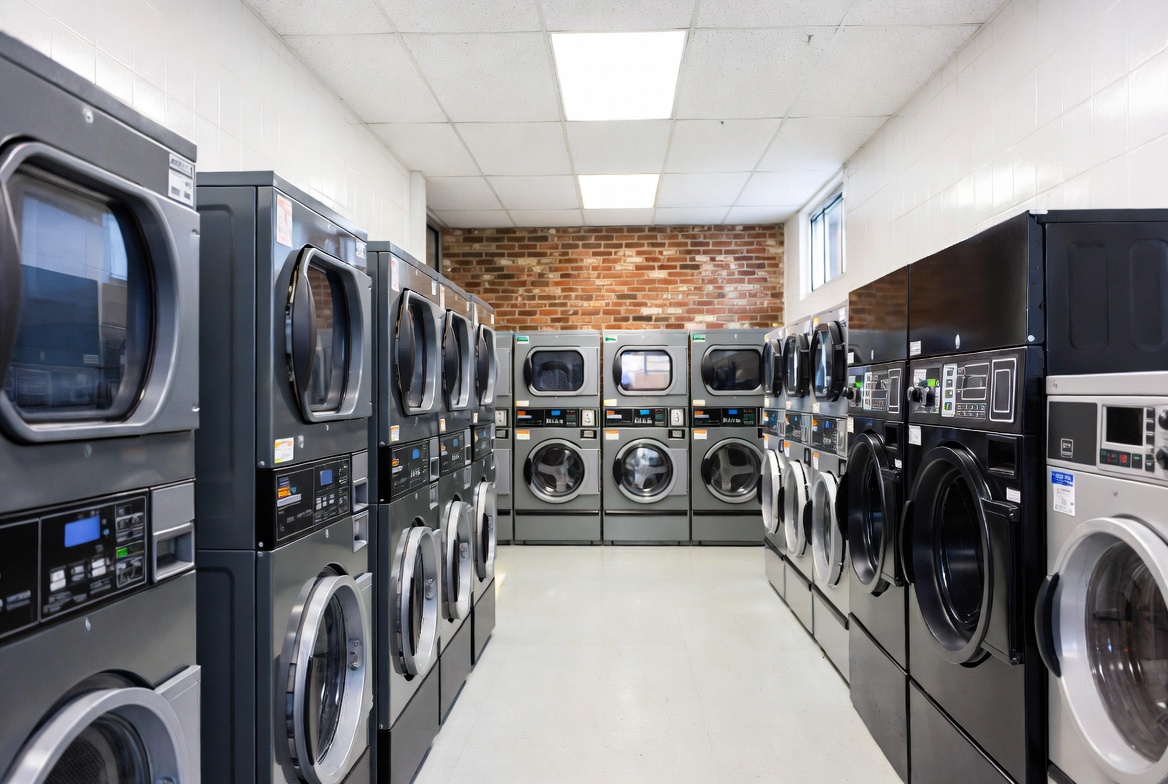
A typical Texas laundromat consumes between 15,000 and 35,000 kWh per month depending on equipment count, operating hours, and whether the facility offers hot water washing or commercial dryers. That intensity puts laundromats among the most electricity-cost-exposed businesses in the state — and because most laundromat operators set up electricity service when they opened and renewed passively since then, the majority are paying above-market rates on accounts that have never been competitively bid.
In Texas's deregulated ERCOT market, competitive reverse auctions consistently produce supply rates 1.0–2.0¢/kWh below passive renewal rates for commercial accounts. On a 25,000 kWh/month laundromat, that's $250–$500 per month in savings, or $6,000–12,000 over a 24-month contract, from the procurement process alone — without changing a single machine, operating hour, or process.
This guide covers the specific electricity cost structure of Texas laundromats, what drives your bill beyond the headline rate, and the exact steps that produce sustained savings for laundromat operators in Oncor, CenterPoint, and AEP Texas territories.
Understanding your laundromat's electricity cost structure is the prerequisite to reducing it. The bills have three primary cost drivers that are distinct from most other commercial operations.
Washer-extractor and commercial dryer loads. Front-load commercial washers draw 2.0–3.5 kW each during the wash cycle and the high-speed extraction cycle. Large-capacity machines draw more. Dryers — especially gas-heated electric dryers — draw 4.5–6.5 kW continuously during the drying cycle. A 30-machine laundromat with a mix of washer-extractors and dryers can draw 60–80 kW of continuous load during peak operating hours. That baseline load runs for 12–16 hours per day, 7 days per week.
Water heating. Electric water heaters for hot water washing draw 4.5–9.0 kW each and cycle on and off throughout operating hours. In Texas, where cold water supply temperatures are mild even in winter, electric water heating is common. During peak operating hours when multiple machines run hot-wash cycles simultaneously, water heater cycling adds to your instantaneous demand draw.
HVAC. Laundromats generate significant interior heat from dryers — even vented dryers produce radiant heat that raises interior temperature. In Texas, where ambient temperatures hit 100–108°F across Dallas, Houston, and most of the state from May through September, HVAC works aggressively to maintain customer comfort while competing with dryer heat output. Summer HVAC adds 15–25% to your monthly electricity consumption compared to winter months.
The combination of these three creates a load profile that is high, sustained, and difficult to shift off-peak. Unlike offices that shut down at 5 PM or restaurants with defined service windows, most laundromats operate 12–18 hours per day with relatively consistent load throughout. This creates a high load factor — which is actually favorable for electricity procurement because providers price steady, predictable loads more competitively than volatile, peaky ones.
For laundromat accounts above 20 kW — which includes virtually every commercial laundromat in Texas beyond very small operations — your electricity bill includes a demand charge based on your peak 15-minute power draw during the billing period. This charge can represent 25–40% of your total monthly bill.
The demand charge has two components: your TDU demand charge (fixed, regulated, non-negotiable) and any demand component embedded in your supply contract. These are structurally different. The TDU demand charge is set by your utility (Oncor, CenterPoint, or AEP Texas) and is the same regardless of your provider. The supply contract demand structure varies between REPs and contract types.
The peak that drives your demand charge is set by your single highest 15-minute interval in the billing period. For laundromats, this peak typically occurs when a Saturday morning rush combines simultaneous machine starts. If 20 washers and 15 dryers all start within the same 15-minute window, instantaneous demand can spike 40–60% above your normal operating draw. That spike — even if it lasts only 15 minutes — sets your demand charge for the entire month.
Understanding your demand charge exposure matters when evaluating electricity contracts. A contract with a slightly higher supply rate but a more favorable demand structure can produce a lower total bill than a lower headline rate with standard demand terms. For a detailed explanation of how demand charges work and how contract structure affects them, see our guide on demand charges on Texas commercial electricity bills.
Texas laundromats benefit from the deregulated electricity market for the same reason every commercial account does: over 100 licensed providers compete for your account, and genuine competition produces lower rates than any single-provider relationship can. Here's what a competitive reverse auction produces specifically for laundromat accounts:
Single-location laundromat (15,000–25,000 kWh/month): Supply rates in competitive auctions typically run 7.8–9.2¢/kWh for 24-month fixed contracts in Oncor or CenterPoint territory. Accounts on passive renewals of 24+ months are frequently at 9.5–11¢/kWh. The improvement from auction is 1.0–2.0¢/kWh.
Multi-location laundromat chain (3+ locations, 60,000+ kWh/month combined): Portfolio aggregation across all locations produces meaningfully better pricing. Providers price larger aggregate accounts more competitively because they represent more total revenue with lower per-account acquisition cost. Combined volume auctions typically produce 0.3–0.6¢/kWh better rates than individual location auctions for the same accounts.
Dollar impact at a typical Texas laundromat: A 20,000 kWh/month laundromat saving 1.5¢/kWh through a competitive auction saves $300/month, $3,600 annually, and $7,200 over a standard 24-month contract. That's net new margin that goes directly to profitability, not to electricity costs.
Texas ERCOT forward pricing is not constant throughout the year. Forward contracts priced in spring (March through May), before summer demand risk is fully embedded in market pricing, consistently produce lower rates than contracts priced in June or July when ERCOT summer exposure peaks.
For a Texas laundromat, this means contracts expiring between June and October should begin procurement in April or May at the latest. Waiting until the contract expires in July to start shopping means locking in a new contract at summer-peak forward pricing. Running the auction in April with a forward start date aligned to your July expiration captures spring pricing on a contract that starts in summer. The difference can be 0.3–0.8¢/kWh, which on a 20,000 kWh/month laundromat represents $720–1,920 over the 24-month contract term just from timing the procurement correctly.
For the full analysis of ERCOT summer 2026 forward pricing and its implications for Texas commercial procurement, see our ERCOT summer 2026 commercial electricity outlook.
Texas laundromat operators with multiple locations have a procurement advantage that single-location operators don't: portfolio aggregation. Instead of running separate auctions for each location, a broker aggregates all locations into a single competitive auction presenting the combined load to every bidding provider.
The combined load is more attractive to providers for two reasons. First, it represents more total revenue. Second, the aggregated load profile is more predictable and stable than any single location — multiple locations average out the demand spikes and usage variability of individual stores. Providers price predictable, high-volume accounts more competitively.
Portfolio aggregation also solves a contract management problem common to multi-location operators: staggered expiration dates. With five locations under separate contracts signed at different times, you have five different renewal deadlines to track. Miss one and that location lapses onto a holdover rate while the others are under competitive fixed-rate contracts. Consolidating all locations under a single portfolio contract with a unified expiration date eliminates that risk and simplifies management. See our guide on Texas laundromat and car wash energy brokerage for more detail on the portfolio procurement approach.
If your laundromat's electricity contract has expired and you haven't signed a new one, you're on a holdover rate — your provider's default month-to-month variable pricing. Holdover rates in Texas run 20–40% above competitive fixed contract pricing for the same account.
On a 20,000 kWh/month laundromat, a holdover rate that's 2.0¢/kWh above market costs $400/month extra — $4,800 per year. Every month on the holdover rate while deferring the procurement is money that doesn't come back.
The fix is the same as a standard procurement: submit your bill, run a competitive auction, execute the contract. Most Texas laundromat accounts on holdover rates complete this process in 3–5 business days. The new contract takes effect at your next meter read boundary. The holdover billing stops immediately.
No. When you sign a new supply contract, your new REP submits an enrollment request to your TDU (Oncor, CenterPoint, or AEP Texas). The TDU processes the switch at your next meter read boundary. Your current provider is notified through the TDU's enrollment system. You don't need to contact your current provider separately, though it's courteous to do so.
No. Your TDU owns the physical infrastructure and delivers electricity to your building regardless of which provider supplies it. The switch happens at a meter read boundary, typically overnight. There is zero operational disruption — machines continue running, lights stay on, everything operates exactly as before. The only thing that changes is who sends your supply invoice.
Yes, consistently. Portfolio aggregation across multiple locations produces better pricing than individual location auctions for the same accounts. We aggregate all your Texas locations into a single competitive auction and align all contract expiration dates under a unified renewal date, improving pricing and eliminating the risk of individual locations lapsing onto holdover rates at different times.
Pull your most recent bill and identify the energy charge (supply rate) per kWh — it's separate from delivery charges. If your all-in rate exceeds 13¢/kWh and your contract is more than 12 months old, submit your bill for a free audit. We'll compare your current rate against what a competitive auction would produce today and tell you within 24 hours whether a switch makes economic sense.
Submit your most recent electricity bill to EnergyBrokerTX and we'll run a competitive reverse auction with 25+ licensed Texas providers, identify your demand charge exposure, and present every bid transparently — within 24 hours and at no cost to your operation. PUCT License #BR260054. Serving laundromat operators across Dallas, Houston, Fort Worth, San Antonio, and all of Texas.
Submit your account and we'll run a competitive auction with 25+ licensed Texas providers — full bid transparency, no pre-filtering, no obligation.
Get My Free Competing Bids →