Texas Gyms, Yoga Studios and Fitness Centers: What Drives the Power Bill
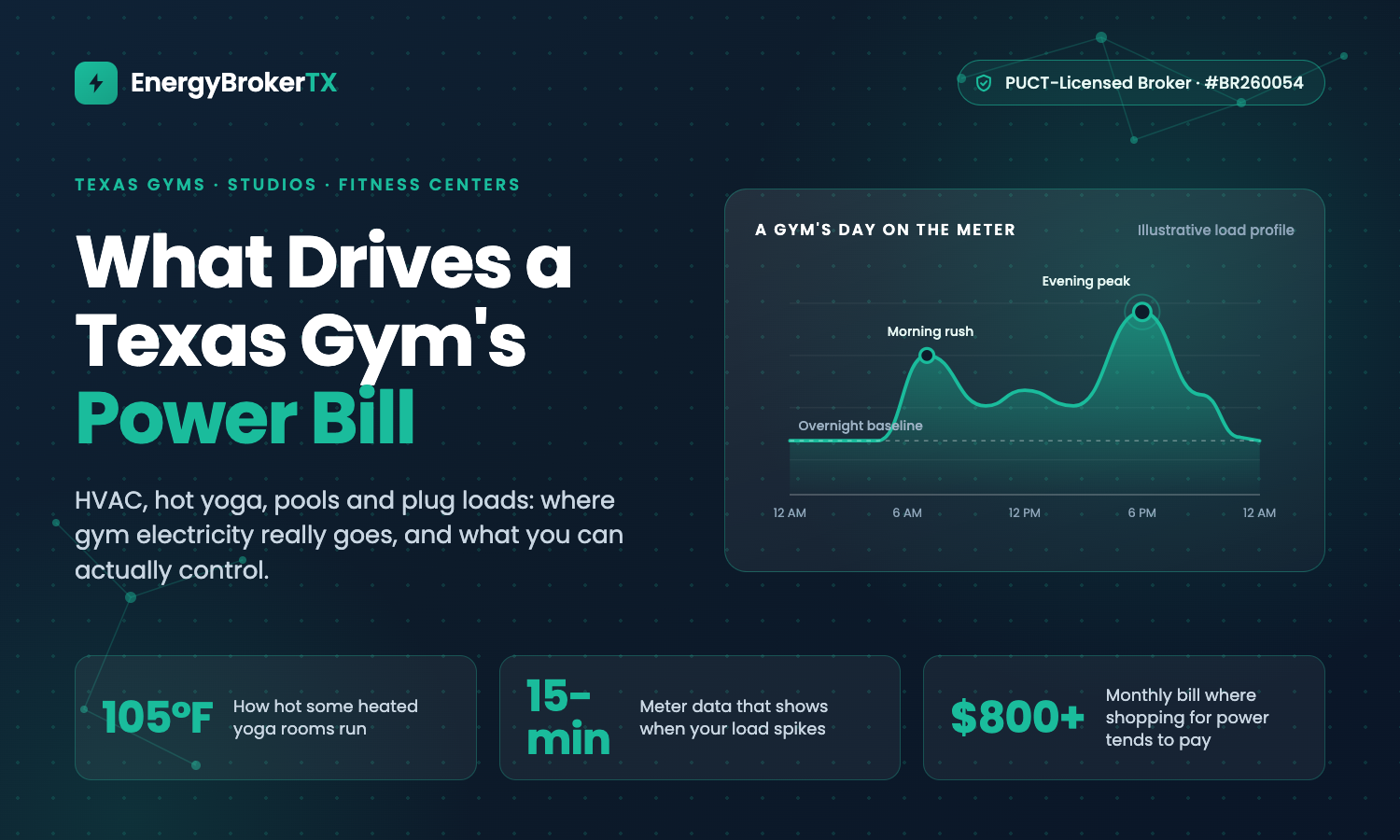
What drives the power bill at Texas gyms, yoga studios and fitness centers, from HVAC and hot yoga to pools, and when shopping your rate pays off.

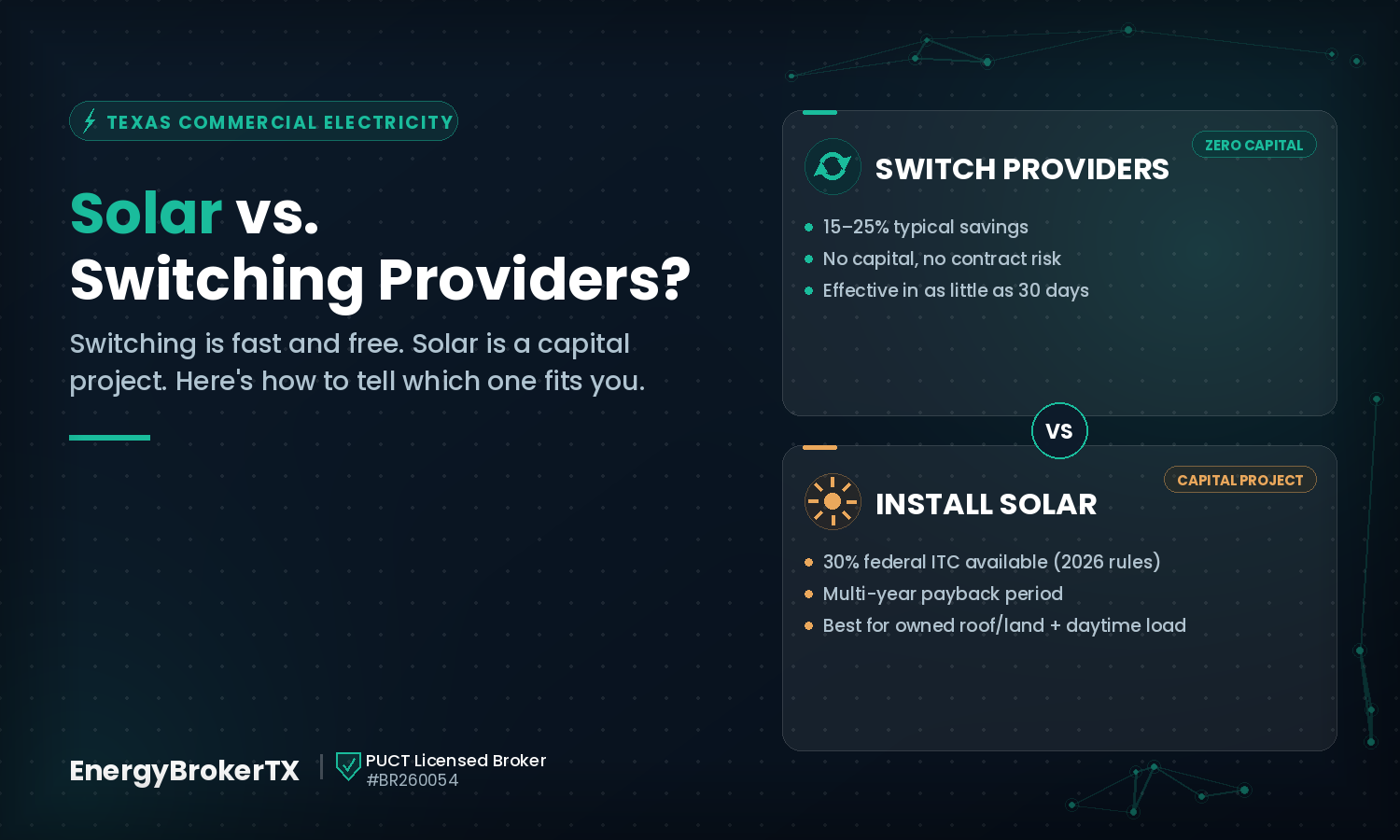
These get treated as the same question — "how do I lower my electricity cost" — but they're genuinely different decisions with different timelines, different capital requirements, and different risk profiles. Switching providers through a competitive bid is a near-term, zero-capital move that most businesses should do regardless. On-site solar is a capital project with a multi-year payback that only makes sense for specific facility and ownership situations. Treating them as substitutes for each other leads to the wrong decision either way.
Before evaluating solar at all, every Texas business should confirm it's on a competitively bid rate. Running a reverse auction across licensed providers costs nothing, requires no capital, and typically produces 15–25% savings for accounts that haven't been competitively bid in the past two years. This isn't a step to skip on the way to a bigger decision — it's very likely a larger and faster return than solar will produce, and it changes the baseline rate that any solar payback calculation should be measured against.
Installing solar on your facility is fundamentally different from choosing a green-tagged retail plan. A retail green plan changes nothing physically — you're still fully grid-connected, still paying the same TDSP delivery charges, still exposed to the same demand charges. On-site solar generates power at your facility, directly reducing how much you draw from the grid during sunlight hours. It's a capital project, not a plan choice, and the economics depend on your roof or land availability, your daytime usage pattern, and current financing and tax treatment — not on which REP you happen to be with.
Unlike many states, Texas does not require utilities or retail providers to offer net metering. In the deregulated ERCOT market, whether and how much you get paid for excess solar generation you send back to the grid is entirely up to your REP's voluntary buyback plan — and those plans vary enormously, from a few cents per kWh up to something closer to the retail rate, depending on the provider and structure you choose. This matters enormously for commercial solar sizing: a system sized to produce more than your facility consumes during daylight hours is betting on a buyback rate that isn't guaranteed to be favorable, while a system sized closer to your actual daytime load avoids relying on the buyback question at all. Municipal utilities like Austin Energy and CPS Energy in San Antonio run their own separate solar credit programs outside the deregulated market, worth checking specifically if your facility happens to sit in one of those service areas.
Federal incentives for solar shifted meaningfully in 2025 and 2026, and the details matter for timing a commercial project. The residential solar tax credit expired at the end of 2025. The commercial credit — the Investment Tax Credit under Section 48E — remained available at 30% through 2026, but required projects to formally begin construction by July 4, 2026 to lock in that rate without being subject to an accelerated phase-out; projects that met that threshold generally have until the end of 2027, or in some safe-harbored cases into 2030, to actually be placed in service. If your business is evaluating solar now, after that deadline has passed, confirm current credit availability and requirements directly with a tax advisor and your solar contractor before assuming the same 30% figure still applies to a newly started project — the rules around this have moved more than once in the past year and are worth verifying rather than assuming.
Solar economics are strongest for businesses that own their building outright (leased space complicates both the capital investment and who captures the benefit), have substantial roof or land area relative to their electricity usage, run daytime-heavy consumption patterns that line up with solar production hours, and can take advantage of accelerated depreciation alongside any available tax credit. Warehouses and distribution centers with large flat roofs, manufacturing facilities with daytime-shift-driven load, and agricultural operations with land available for ground-mount systems are common strong fits.
Businesses in leased space without landlord buy-in, facilities with limited roof or land area relative to usage, and any business that hasn't yet run a competitive bid on its supply contract should generally exhaust the switching option first. It's faster, requires no capital outlay, and for most commercial accounts produces a larger and more certain near-term return than a solar installation would.
For businesses that do move forward with solar, it's still worth running a competitive procurement for the electricity you continue to draw from the grid — solar rarely covers 100% of a commercial facility's load, and the supply contract covering the remainder should still be competitively bid rather than left on a default rate. If sustainability commitments matter to your business independent of the solar-versus-switching decision, our guide to green energy plans for Texas businesses covers the retail-side renewable options that require no capital investment at all.
Contact EnergyBrokerTX for a free competitive rate comparison — the right first step regardless of whether solar makes sense for your facility down the line. PUC License #BR260054.
Submit your account and we'll run a competitive auction with 25+ licensed Texas providers — full bid transparency, no pre-filtering, no obligation.
Get My Free Competing Bids →