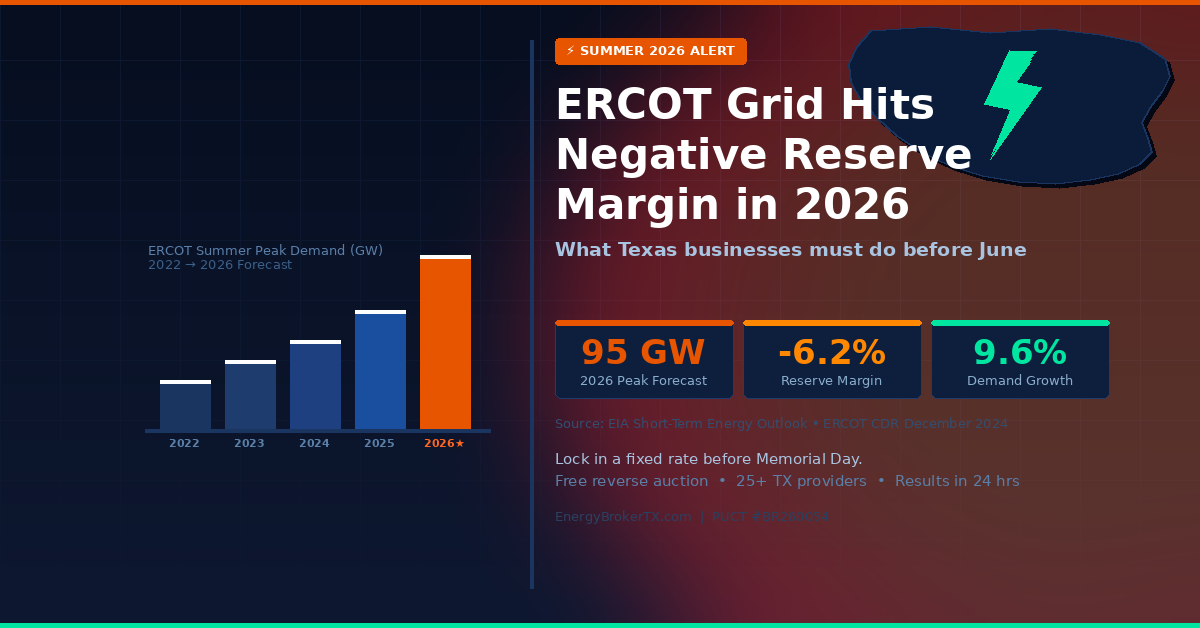
ERCOT Summer 2026 Commercial Electricity Rates: What Texas Businesses Must Do Before June
ERCOT's 2026 peak demand forecast signals summer rate spikes for Texas businesses. Learn what's driving the risk and how to lock in a fixed rate before June.


Professional services firms across Texas — law offices, accounting practices, insurance agencies, consulting groups, and other office-based businesses — are facing rising electricity costs in 2026. Whether you’re in a modern Class A building in Dallas, a growing office park in Frisco or Plano, a medical office in Houston, or a professional suite in Fort Worth or Corpus Christi, power bills have become one of the largest controllable operating expenses after rent and salaries.
The good news is that Texas’s deregulated energy market gives office tenants and building owners more leverage than ever. Many professional services firms are successfully reducing their electricity costs by 15–25% in 2026 without disrupting daily operations or client experience.
At Energy Broker TX (PUC License # BR260054), we’ve worked with law firms, accounting practices, insurance offices, and consulting companies in Dallas, Houston, Frisco, Fort Worth, Plano, Corpus Christi, and across the state to lower their power bills. This guide is written specifically for professional services firms and office tenants in Texas deregulated markets. It focuses on the strategies that work best for typical office loads — high daytime HVAC usage, computers, lighting, and evening/weekend occupancy — and shows how they differ from retail, restaurants, or industrial facilities.
Office buildings in Texas have very specific energy patterns. Most usage happens between 8 AM and 6 PM when attorneys, accountants, consultants, and support staff are working at full capacity. HVAC systems run heavily to keep conference rooms and open-plan offices comfortable, while computers, printers, and task lighting add consistent daytime demand.
Many firms simply renew with the same provider each year or accept the rate offered by their building’s master-metered contract. This often results in paying 15–25% above current market rates, especially when demand charges spike during afternoon hours in Dallas, Houston, or Frisco.
Unlike retail stores with heavy evening loads or restaurants with kitchen equipment, professional services offices have more predictable patterns that make them excellent candidates for competitive bidding and targeted load management.
For a broader look at general business electricity options in Frisco, see our recent guide: Best Business Electricity Providers in Frisco for Office and Retail Tenants.
The fastest way most Texas office tenants reduce costs is by running a reverse auction instead of accepting the rate offered by the building or the first provider quote.
A licensed broker can present your actual usage data — including daytime peaks from HVAC and computers — to 25+ retail electricity providers. Suppliers compete directly, often offering better pricing when they understand your office schedule and ability to shift non-critical loads.
We recently helped a mid-sized law firm in Dallas with 22,000 square feet drop from 10.8¢/kWh to 8.1¢/kWh. That single change is projected to save them approximately $16,800 per year while keeping all office systems fully operational. Similar results have been achieved for firms in Houston, Plano, Fort Worth, and Corpus Christi.
Simple steps for professional services firms:
Demand charges frequently account for 35–50% of an office building’s electricity bill in Texas. Professional services firms can often reduce these peaks with minimal changes to daily workflow.
Practical, low-disruption tactics:
One accounting firm in Plano reduced its recorded peak demand by 26% through simple scheduling and smart thermostat adjustments, saving over $11,400 annually with almost no impact on staff productivity. Similar strategies have delivered strong results for offices in Fort Worth and Houston.
For more on reading and optimizing your bill, see our commercial bill analysis & savings guide.
ERCOT’s time-of-use pricing rewards offices that can shift even modest loads away from peak afternoon hours.
Most professional services firms in Dallas, Houston, Frisco, and other markets can easily move non-client-facing tasks to shoulder or off-peak periods while keeping client areas comfortable during business hours.
Effective office strategies:
These small shifts, when paired with the right TOU plan, frequently deliver 10–18% additional savings for Texas office tenants.
Texas utilities offer strong incentives that professional services buildings and tenants are well-positioned to use.
High-impact upgrades most Texas offices should consider:
Oncor and CenterPoint rebates can cover 30–50% of many of these projects. We’ve seen multiple professional services firms in Dallas, Houston, and Plano achieve full payback in under 18 months.
The most successful Texas office tenants treat energy as a strategic line item rather than a reactive expense. They combine competitive procurement, smart load management, and efficiency upgrades to create predictable costs that support growth instead of competing with it.
How much can a typical Texas professional services firm save in 2026? Most offices we work with achieve 15–25% total savings through better procurement, demand management, and efficiency upgrades.
Are demand charges a major issue for office buildings? Yes — they often represent 35–50% of the monthly bill due to daytime HVAC and equipment use.
Will changing electricity providers disrupt daily office operations? No. The process is designed to be completely seamless with zero interruption to power or HVAC systems.
Are there rebates specifically for office buildings in Texas? Yes. Oncor and CenterPoint offer targeted rebates for LED lighting, HVAC upgrades, and smart controls that many professional services tenants can use.
Should small professional services firms work with an energy broker? Yes. Even smaller offices benefit significantly from competitive bidding and expert contract guidance.
How soon can we expect to see savings? Many firms see meaningful reductions within 30–60 days of switching contracts, with full optimization typically achieved in 3–6 months.
You don’t have to accept high power bills as the cost of operating a successful professional services firm in Texas. With the right combination of competitive procurement, smart load management, and available incentives, many law firms, accounting practices, insurance offices, and consulting groups in Dallas, Houston, Frisco, Fort Worth, Plano, and beyond are saving 15–25% while maintaining excellent working environments.
At Energy Broker TX, we specialize in helping Texas office tenants and professional services firms navigate the deregulated energy market. Our PUC-licensed team (BR260054) will review your actual usage, run a free reverse auction, and design a simple, practical energy strategy tailored to your office schedule and needs.
Visit our contact page today to request a free bill analysis and savings projection. It takes less than 60 seconds, with no obligation and results in 24 hours.