Electricity for Texas RV Parks, Campgrounds and Cabin Parks
Master vs submetered billing, Texas rules for charging RV guests for power, seasonal contracts and buying a park, explained for park owners.

If you've ever looked closely at a Texas commercial electricity bill, you've seen a line labeled TDSP charges — sometimes called TDU charges or delivery charges depending on your provider's billing format. For most businesses, this is the second-largest line item on the bill after the energy supply charge itself. It's often larger than the taxes and fees combined. And almost nobody knows exactly what it is, what drives it, or whether it can be reduced.
TDSP stands for Transmission and Distribution Service Provider. In Texas's deregulated electricity market, your TDSP is the utility company that owns the physical infrastructure delivering electricity to your building — the poles, wires, transformers, substations, and meters. Depending on where in Texas your business is located, your TDSP is one of five companies: Oncor Electric Delivery (most of Dallas-Fort Worth and North Texas), CenterPoint Energy (Houston and surrounding area), AEP Texas (West Texas and South Texas including Corpus Christi), Texas-New Mexico Power or TNMP (parts of East Texas and the Gulf Coast region), or Lubbock Power and Light (Lubbock area only).
Understanding what your TDSP charge covers, how it's calculated, and why it appears on your bill the way it does is essential for evaluating any competitive electricity quote and understanding your true all-in electricity cost.
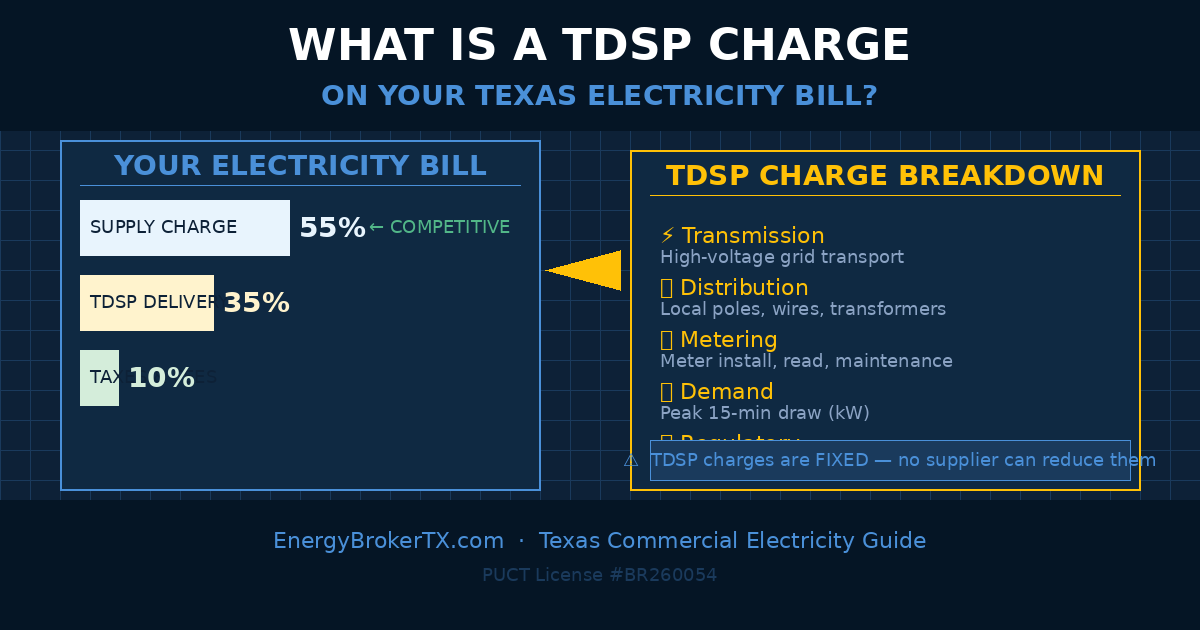
TDSP charges are the regulated fees your utility company charges to physically move electricity from the wholesale generation grid to your building's meter. This infrastructure function is entirely separate from the energy supply — the actual electrons you're consuming — which is the competitive piece that a retail electricity provider and a broker's reverse auction addresses.
Specifically, TDSP charges cover several distinct cost categories that are bundled together in the line item that appears on your bill:
Transmission charges: The cost of moving electricity across the high-voltage transmission grid — the large towers and lines that carry power across long distances from generation facilities to local distribution systems. These charges are set by ERCOT and passed through to customers via their TDSPs.
Distribution charges: The cost of the local distribution infrastructure — the neighborhood poles, underground cables, transformers, and service connections that step down voltage and deliver electricity to individual buildings. This is the largest single component of most TDSP charges for commercial accounts.
Metering charges: The cost of installing, maintaining, reading, and operating your electricity meter. Commercial accounts with smart meters (Advanced Metering Infrastructure) also include data communication costs.
Demand charges: For commercial accounts above a certain size — typically 20 kW peak demand or higher — TDSP charges include a demand component based on your highest 15-minute power draw during the billing period. This is separate from any demand charge embedded in your supply contract. The TDSP demand charge is regulated, non-negotiable, and applies regardless of which REP you choose.
Regulatory fees and assessments: Pass-through charges for PUCT assessments, system benefit fund contributions, nuclear decommissioning fees (where applicable), and other state-mandated regulatory costs. These are set by the state and applied uniformly.
For a complete breakdown of how all these components appear on your actual bill, see our detailed guide on how to read a Texas commercial electricity bill.
This is the most important thing to understand about TDSP charges: they are 100% fixed and non-negotiable, regardless of which retail electricity provider you choose.
When a broker or supplier presents you with a competitive electricity quote, that quote addresses only the supply charge — the per-kWh rate for the energy itself. Your TDSP delivery charges will be identical on your bill whether you're with TXU Energy, Gexa Energy, ENGIE, Branch Energy, or any of the other 100+ licensed Texas REPs. Switching providers does not change your TDSP charges by a single cent.
This distinction matters enormously when evaluating quotes and understanding your savings potential. Here's a simplified example for an Oncor territory commercial account consuming 50,000 kWh/month:
Current situation (passive renewal):
After competitive auction:
The $1,150/month savings comes entirely from the supply charge reduction. The TDSP charges didn't move at all — and couldn't.
This is why brokers who present quotes showing only the supply rate — without explaining the TDSP component — can create confusion. A supply rate of 7.2¢/kWh sounds dramatically different from an all-in rate of 11.5¢/kWh, but both numbers refer to the same contract. The difference is just the TDSP component that exists independently of any supply decision.
TDSP delivery charges vary by utility territory and by meter rate classification. Here are approximate delivery charge ranges for commercial accounts in each major Texas TDSP territory as of 2026. These figures are estimates — exact charges depend on your specific rate class, demand level, and metering configuration:
Oncor Electric Delivery (Dallas-Fort Worth, North Texas, West Texas):
Secondary Service (under 10 kW): approximately 3.5-5.0¢/kWh all-in delivery
Secondary Service (10-200 kW): approximately 3.0-4.5¢/kWh plus a per-kW demand charge
Large Secondary Service (above 200 kW): lower per-kWh rate with higher demand component
Primary Service (customer-owned transformer): lowest delivery rate, requires infrastructure investment
CenterPoint Energy (Houston, Galveston, surrounding areas):
Generally slightly higher delivery charges than Oncor for comparable rate classes
Secondary Service commercial: approximately 3.8-5.5¢/kWh all-in delivery
CenterPoint's distribution infrastructure in the Houston metro involves significant underground cabling, contributing to modestly higher delivery costs than above-ground systems
AEP Texas (Corpus Christi, Laredo, San Angelo, Abilene, Bryan/College Station area):
Multiple rate class structures with meaningful differences between AEP Texas Central and AEP Texas North territories
Commercial delivery rates: approximately 3.5-5.5¢/kWh depending on rate class and location
Meter classification is particularly important in AEP territory — rate class verification is strongly recommended before any procurement
TNMP (Parts of East Texas, Panhandle):
Commercial delivery rates broadly comparable to Oncor and AEP Texas
Smaller territory with fewer commercial accounts means less competitive supply auction activity
For context on how these delivery charges affect your total cost relative to current competitive supply rates, see our Texas commercial electricity rates guide.
For commercial accounts above 20 kW in peak demand — which includes most businesses beyond small retail or professional offices — your TDSP charges include a demand component that deserves specific attention.
The TDSP demand charge is assessed based on your highest 15-minute power draw during the billing period, measured in kilowatts (kW). This charge is set by your utility based on your rate class and is completely separate from any demand charge that may exist in your supply contract. Both demand charges can appear on the same bill, set by different entities, calculated the same way but assessed independently.
The practical implication: your TDSP demand charge is driven by your peak event — the single worst 15-minute window during the billing period. A manufacturing plant that runs three shifts at steady-state consumption but starts up all equipment simultaneously each Monday morning may have a TDSP demand charge set entirely by that Monday morning startup event, even if it represents a tiny fraction of total monthly usage.
Because TDSP demand charges are non-negotiable, the only way to reduce them is operational: shifting peak loads, staggering equipment startups, or installing demand management systems. A broker cannot negotiate your TDSP demand charge. What a broker can do is present supply contract options that account for demand structure in the all-in cost comparison, ensuring you're evaluating total delivered cost rather than supply rate alone.
For a full explanation of how demand charges work and how contract structure affects total cost, see our dedicated guide on demand charges on Texas commercial electricity bills.
Understanding TDSP charges is essential for three specific situations that Texas commercial buyers encounter regularly.
Evaluating all-in vs. supply-only quotes: Some brokers and providers present quotes as supply-only rates. Others present all-in rates that include an estimate of TDSP delivery charges. These two formats are not directly comparable without understanding what's included. Always confirm whether a quoted rate includes TDSP charges or not before making a comparison.
Understanding why your rate differs from a neighboring business: Two businesses on the same street can have meaningfully different all-in electricity rates even with identical supply contracts because their TDSP rate class is different. A building with a larger service entrance may be on a higher-demand rate class with a different delivery charge structure. Rate class differences are legitimate and not a billing error.
Calculating true savings from switching providers: A supplier claiming you'll save 3¢/kWh by switching — when your current all-in rate is 13¢/kWh and the new supply rate is 7¢/kWh — may not be accounting for TDSP charges correctly. If your TDSP charges are 4.5¢/kWh and your current supply rate is 8.5¢/kWh, your actual savings from switching to a 7¢/kWh supply rate is 1.5¢/kWh, not 3¢/kWh. The math only works correctly when you isolate the supply component.
This is why working with a broker who presents total delivered cost — supply rate plus estimated TDSP charges plus taxes for your specific meter — produces better procurement decisions than comparing headline supply rates in isolation. For more on the broker evaluation process, see our guide on how to choose the right energy broker for your Texas business.
Yes — but not through supplier selection. There are two legitimate mechanisms for reducing TDSP charges for commercial accounts.
Rate class reclassification: If your facility qualifies for a different TDU rate class — for example, moving from Secondary Service to Primary Service by installing customer-owned transformer equipment — your TDSP rate structure changes and delivery charges may decrease significantly. This is most relevant for large industrial accounts (above 500 kW demand) where the capital investment in transformation equipment can produce meaningful long-term delivery charge savings. Requires working directly with your TDU to evaluate eligibility and process.
Demand reduction: Since the demand component of TDSP charges is based on your peak 15-minute draw, operational changes that reduce that peak — staggered equipment startups, demand management systems, load shifting — can reduce the demand component of TDSP charges month over month. For high-demand operations, demand management produces both TDSP demand charge reductions and supply contract demand charge reductions simultaneously.
F
or manufacturing operations where demand charges represent 40-50% of total electricity cost, both mechanisms are worth evaluating seriously. See our guide on how Texas manufacturing operations can cut electricity costs for a detailed treatment of demand charge management in industrial settings.
The per-kWh components of your TDSP charge vary with your monthly usage volume — you pay more in absolute dollars in high-usage months. The demand component varies based on your peak 15-minute draw each billing period. Some regulatory fees are fixed monthly amounts that don't vary with usage. The combination produces month-to-month variation even though the rate structure itself is fixed.
Yes — TDSP and TDU (Transmission and Distribution Utility) refer to the same entity and the same charges. Different providers label the line item differently on bills. You may also see it called "delivery charges," "Oncor charges," "CenterPoint charges," or simply "distribution charges" depending on your provider's billing format. All refer to the same regulated utility delivery fee.
No. TDSP charges are set by the Public Utility Commission of Texas through rate case proceedings and are identical for every business on the same rate class in the same territory regardless of which REP supplies their account. No retail electricity provider has the authority to reduce, negotiate, or waive TDSP charges. Any supplier claiming to offer lower TDSP charges than competitors is either misrepresenting the situation or bundling a supply rate reduction in a misleading way.
Your TDSP rate class appears on your electricity bill in the account detail section — look for a designation like "Secondary Service," "Large Secondary Service," or "Primary Service." You can also call your TDU directly with your ESI ID and they will confirm your rate class. A PUCT-licensed broker can pull this information when they access your account data through their platform.
Understanding your TDSP charges is the foundation for understanding your total electricity cost and evaluating any competitive quote accurately. Submit your most recent electricity bill to EnergyBrokerTX and we'll break down your current supply rate, TDSP charges, and total all-in cost — then run a competitive reverse auction with 25+ licensed Texas providers to show you exactly what competitive supply procurement would produce for your specific account. PUCT License #BR260054. Serving Dallas, Houston, Fort Worth, Frisco, San Antonio, and all of Texas.
Submit your account and we'll run a competitive auction with 25+ licensed Texas providers — full bid transparency, no pre-filtering, no obligation.
Get My Free Competing Bids →