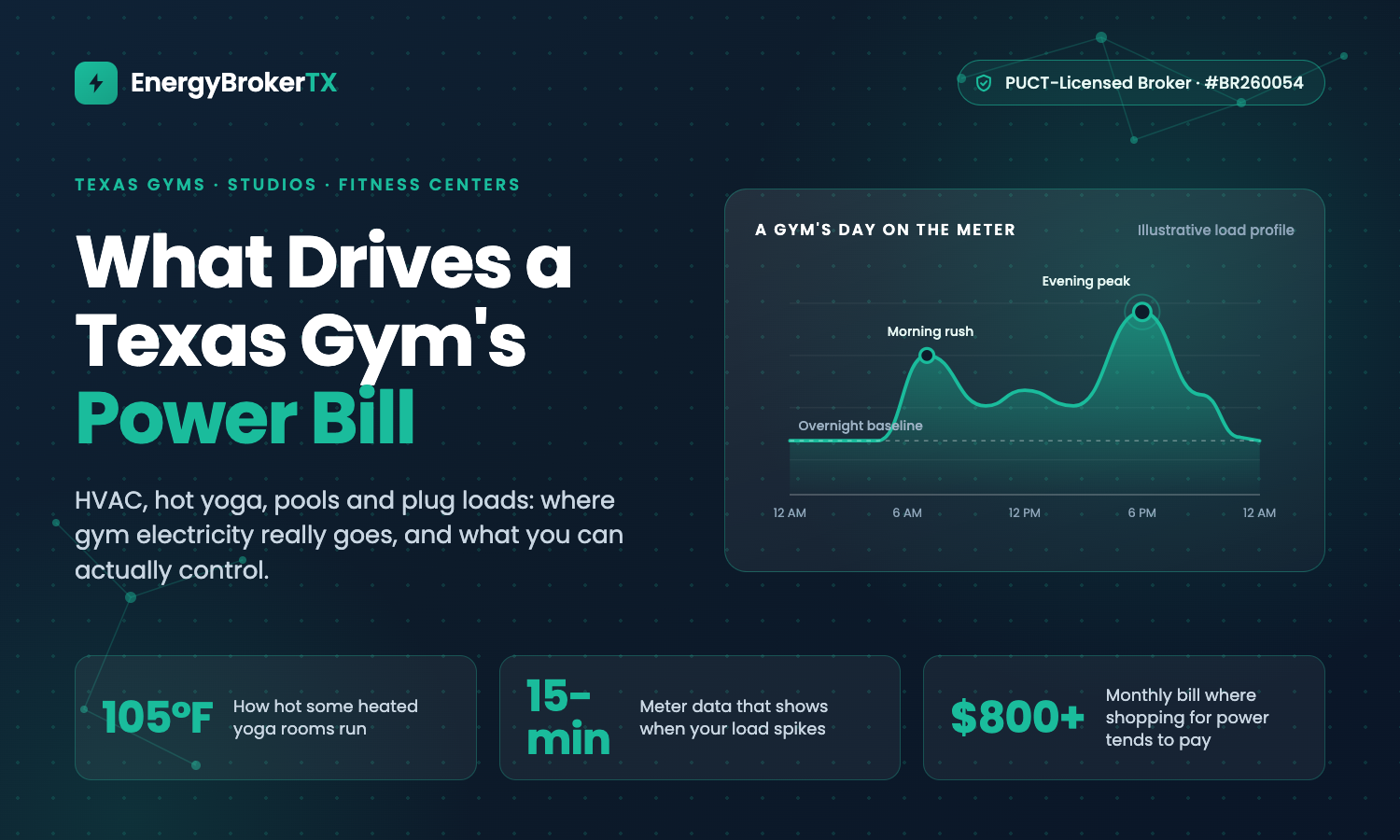
Texas Gyms, Yoga Studios and Fitness Centers: What Drives the Power Bill
What drives the power bill at Texas gyms, yoga studios and fitness centers, from HVAC and hot yoga to pools, and when shopping your rate pays off.

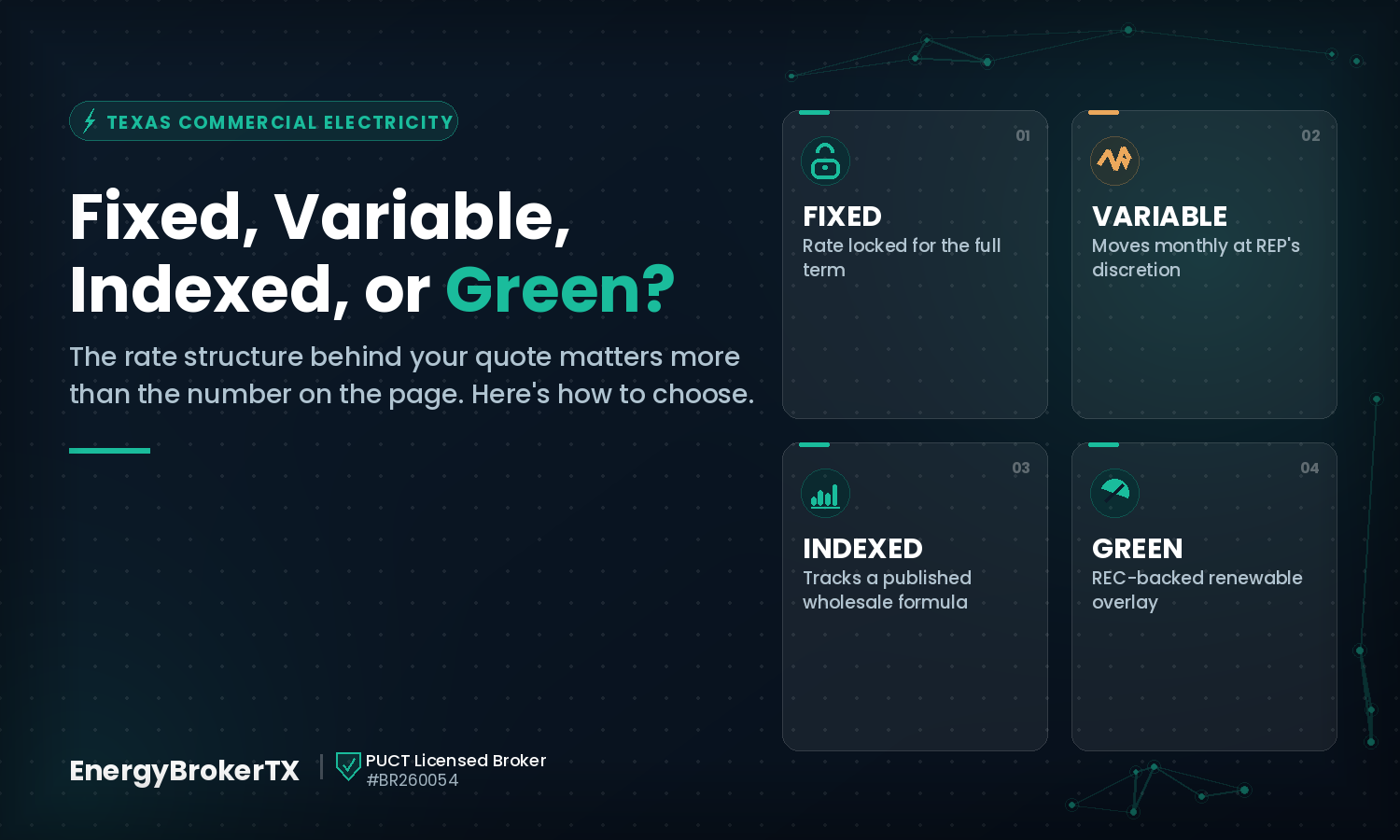
Every Texas commercial electricity quote you receive falls into one of four structural categories, and the category matters more than the headline rate. Two providers can quote you the identical 7.9¢/kWh rate on a fixed and an indexed plan, and you'd be signing up for two completely different risk profiles. Most businesses compare the number on the page without realizing they're comparing apples to a moving target.
This guide breaks down what each plan type actually means, who it fits, and where businesses get burned by picking the wrong one for the wrong reasons — usually because a lower teaser rate looked better on paper than the structure behind it.
A fixed-rate plan locks your per-kWh energy charge for the full contract term — typically 12, 24, 36, or 60 months. Your rate doesn't move with ERCOT wholesale prices, summer heat waves, or natural gas spikes. That doesn't mean your total bill is flat every month — TDSP delivery charges and demand charges still move independently — but the energy portion, usually 45–60% of your bill, is predictable for the life of the contract.
Fixed is the right default for most commercial accounts because budget predictability has real value, and because most businesses aren't set up to actively manage exposure to a moving wholesale price. The tradeoff is that you give up the ability to benefit if the market falls after you sign — and you lock in whatever risk premium the market was pricing at the moment of signing, which is exactly why timing your renewal around seasonal pricing matters as much as the rate itself.
A variable-rate plan lets your REP adjust your per-kWh rate month to month, typically with 30 days' notice, based on their own cost of supply. Some businesses choose variable deliberately — short-term operations, businesses expecting to close or relocate, or accounts betting the market will soften. Most businesses end up on a variable rate by accident: it's the default holdover rate a contract rolls onto when it expires without a new agreement in place, and holdover rates commonly run 20–40% above what a competitively bid fixed contract would cost.
If you're on a variable rate right now and didn't choose it deliberately, that's usually the single most expensive thing happening on your account. Check your contract status before reading further — it's worth more than anything else in this article.
An indexed plan sits between fixed and variable. Your rate isn't locked, but it isn't set arbitrarily by your REP either — it moves according to a published formula tied to a wholesale price index (often an ERCOT hub price or a natural gas index), plus a fixed adder. You know exactly how your rate is calculated every month, even though you don't know in advance what it will be.
Indexed plans make sense for larger accounts with real exposure to wholesale price movement, sophisticated enough to hedge or forecast their own usage, and willing to trade predictability for the potential to catch a falling market. For most small and mid-size commercial accounts, the formula complexity isn't worth the risk — the same reasons that make fixed the right default apply here.
Fixed, variable, and indexed describe how your rate is calculated. Green describes where the underlying generation comes from — and it's not a separate rate structure so much as an overlay that can be applied to a fixed, variable, or indexed plan. A "100% renewable" plan typically means your REP purchases Renewable Energy Certificates (RECs) matching your usage, not that electrons from a specific wind farm are physically routed to your building — the ERCOT grid doesn't work that way for any customer, REP claims aside.
Renewable-tagged plans in Texas's deregulated market sometimes carry a small premium over conventional plans, sometimes don't — Texas's enormous wind and solar buildout means green power is often priced competitively rather than at a markup, unlike many other states. For a full breakdown of what "green" actually costs and how to evaluate REC-backed claims, see our dedicated guide on green energy plans for Texas businesses.
It's worth separating "green retail plan" from "installing your own solar." Buying a green-tagged retail plan changes nothing physically about your building — you're still on the grid, still paying TDSP delivery charges, still subject to demand charges. Installing on-site solar is a capital project that can reduce your grid draw directly, with a completely different cost-benefit calculation involving upfront investment, current federal tax credit deadlines, and Texas's lack of mandated buyback rates for excess generation. If you're weighing that decision specifically, see our guide on solar versus switching providers for the fuller comparison.
Start with your risk tolerance, not the rate on the page. If a 3% swing in your electricity cost would meaningfully affect your budget or you simply don't want to think about it again for two years, fixed is right, full stop. If you have the size and sophistication to actively manage exposure — and the potential upside is worth the attention — indexed is worth evaluating alongside fixed quotes in the same competitive bid. Variable should almost never be a deliberate choice for a stable commercial operation; it should be something you actively avoid falling into by accident.
Whichever structure you're leaning toward, the way to actually find out what it costs is to put your account in front of multiple licensed providers at once rather than comparing one quote in isolation. See our guide on how a reverse auction works for how that comparison actually happens, and how to make sure you're comparing the same plan structure across every bid — not just the lowest number on the page.
Contact EnergyBrokerTX for a free comparison across fixed, indexed, and green-tagged offers from 25+ licensed Texas providers, evaluated side by side so you're choosing a structure, not just a number. PUC License #BR260054.
Submit your account and we'll run a competitive auction with 25+ licensed Texas providers — full bid transparency, no pre-filtering, no obligation.
Get My Free Competing Bids →